


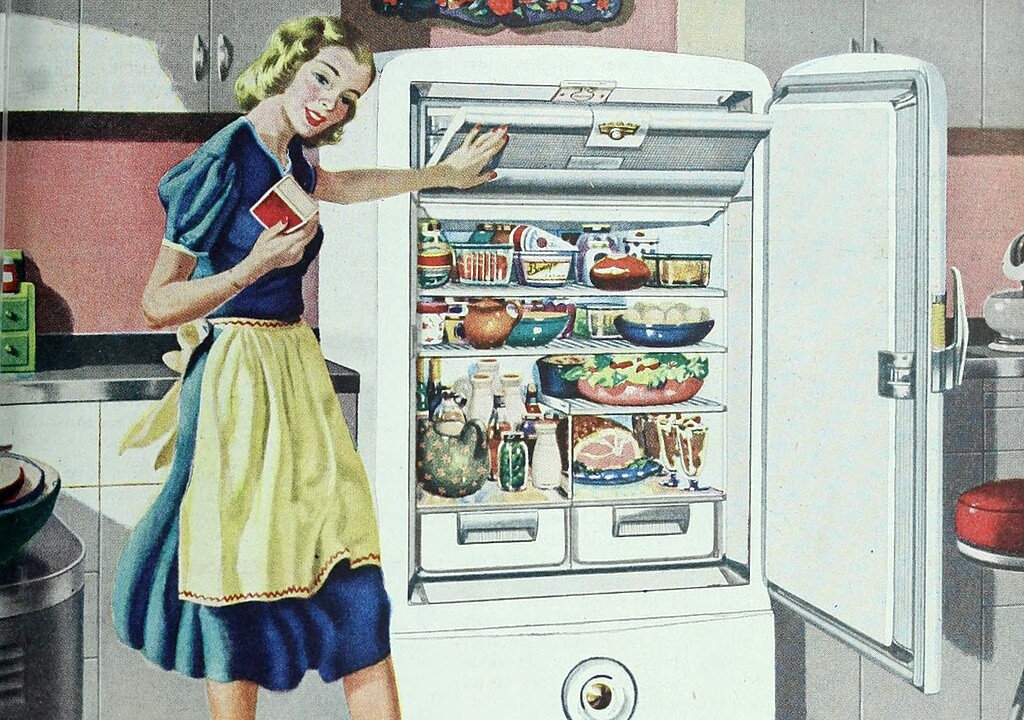
Homemade sourdough, homeschooled children, and a spotless home – tradwife content presents an unattainable ideal for some, and is a source of contention for many. Tradwife culture online idealizes female domesticity. It is not simply that tradwife influencers share their lives online, staying at home and caring for their children, but they portray themselves doing so perfectly. Nara Smith, donning a pink, organza gown, makes homemade mozzarella in a spotless, marble kitchen. Hannah Neeleman, a young mother of eight, documents her idyllic life on the farm, making feta in her barn-style kitchen with milk collected from her own sheep. Combined, these women have 15.2 million followers.
On social media, the tradwife is portrayed as a modern-day housewife who embraces traditional gender roles where women focus solely on homemaking and childcare, romanticising a perfect, peaceful lifestyle for her online audience. Though we are quick to label certain images or behaviours as ‘tradwife content’, there is a divide between our common labelling and the deeper meaning of the term. ‘Tradwife’, a term newly inducted into the Cambridge Dictionary, is an amalgamation of the terms ‘traditional’ and ‘wife’ – but what does it really mean to be a ‘traditional wife’, and does this reflect the carefully curated feeds we see on social media?
The notion of the ‘traditional wife’ echoes antiquated ideals of a woman who is subjected to her husband, the provider, and whose role is societally confined to homemaking. For the ‘traditional’ wife there is no element of choice. A tradwife is not simply a woman who shares her idyllic life as a stay-at-home mum online. Rather, the tradwife ideal forces women to fit a certain mould, limiting their way of being to something restrictive and singular. The tradwife model is one which was constructed to deprive women of autonomy, upholding a vision of a dystopian reality in which the lives of all women are undifferentiated, being forced into the role of the homemaker.
When properly understood to be something much deeper than an Instagram aesthetic, the symbol of the traditional wife is revealed to be inherently anti-feminist. Of course, feminism does not necessarily preclude women from being stay-at-home mothers. Specifically, proponents of choice feminism would support this lifestyle if it were chosen freely, though the societal pressures faced by women may inhibit our ability to judge the extent to which such a choice is truly free. But the tradwife model promotes the eradication of free choice by recalling the ideals of a past wherein this was the only reality for women; the idealization of the ‘traditional wife’ restricts women to a lifestyle predicated on subservience to their husbands.
Expanding our understanding of what it means to be a tradwife reveals, somewhat ironically, that many of the social media stars we are quick to attach this label to are not ‘true’ tradwives themselves. Engagement with social media is focused on image, aesthetics, and perfectly curated posts. What we are seeing on the instagram pages of the likes of Smith and Neeleman is simply that – picture-perfect snapshots of a life that we have no other real, tangible insight into. What underpins our eagerness to place these women within the wider tradwife culture is our mistaken identification of these images with reality. We see the gingham aprons, the spotless kitchens, the free-roaming young children with bizarre names, and immediately feel inclined to categorize these images; we compartmentalize them, confine them to the tradwife label, so as to make sense of the hundreds of thousands of curated lifestyles we encounter online.
Yet, tradwife culture is much more than a simple aesthetic – it is not underpinned by the clothes one wears or the food one makes. Being a real, ‘traditional wife’ in the sense of the 1950s ideal is rooted in relationships, not merely images: a woman’s relationship with her husband, children, the workforce, and society at large. Social media offers such limited insight into the real lives of these women that we cannot simply read into what lurks behind the life they present online. We cannot infer from the glamorised portrayal of domesticity that this lifestyle choice must be one that is predicated on subservience and inhibited autonomy. These women we encounter online may reinforce certain aspects of traditional gender roles through their idyllic portrayal of homemaking and caregiving, but these factors are not sufficient to justify designating them to the limiting category of the ‘traditional wife’.
Ironically, many of the women we are quick to label online as ‘tradwives’ do not fit this model themselves. By selling this archaic ideal, they paradoxically exclude themselves from it. Women like Smith and Neeleman have monetized this romantic image of domestic life online – it is their business, something the ‘traditional wife’ cannot have. The sponsorships and brands that have arisen from tradwife content online actually challenge the traditional gender norms in which the husband is the sole financial provider. Smith, a model, has even disputed the tradwife labels targeted at her, stating that she simply always wanted to be a young mother.
Though tradwife content online often does not exhibit all of the necessary features of the ‘traditional’ wife ideal, it has gained significant attention in recent years. What about this content has drawn such a large and varied audience? The reception of modern tradwife culture is deeply polarizing; for some the romanticisation of the homemaking mother and wife is nauseating, a setback for feminism, and yet their curiosity cannot tear them away from still engaging with this content in defiance. Other avid followers of the tradwife movement online are desperate to live up to this unattainable ideal. Yet, a study from the Global Institute for Women’s Leadership at King’s Business School finds that most women who find the tradwife movement appealing are not really attracted to the subservience promoted by the antiquated ideal of the traditional wife.
Instead, the survey of 1,000 women aged 18-34 explains that the popularity of this content reflects a desire for balance, rather than a return to restrictive tradition. What attracts these women to tradwife content is not traditional gender roles, but rather the aesthetic of simple domesticity that offers an escape from the pressures of everyday working life. An antiquated lifestyle that severely hinders the freedoms of women is misconstrued as a source of freedom and relief. The irony, however, is that these perfectly curated and aestheticised snapshots of domestic life within the tradwife-sphere aren’t even posted by women who can be wholly categorized as ‘traditional wives’. Besides this, the lives that tradwife influencers are portraying online are not entirely aligned with their reality; what is less visible on Neeleman’s page, for example, is the help she receives from several babysitters and homeschool teachers, as well as her husband’s inordinate net worth as the son of JetBlue’s founder. The escape that many women are seeking in the lives of tradwife influencers is rooted in something that is not entirely real.