


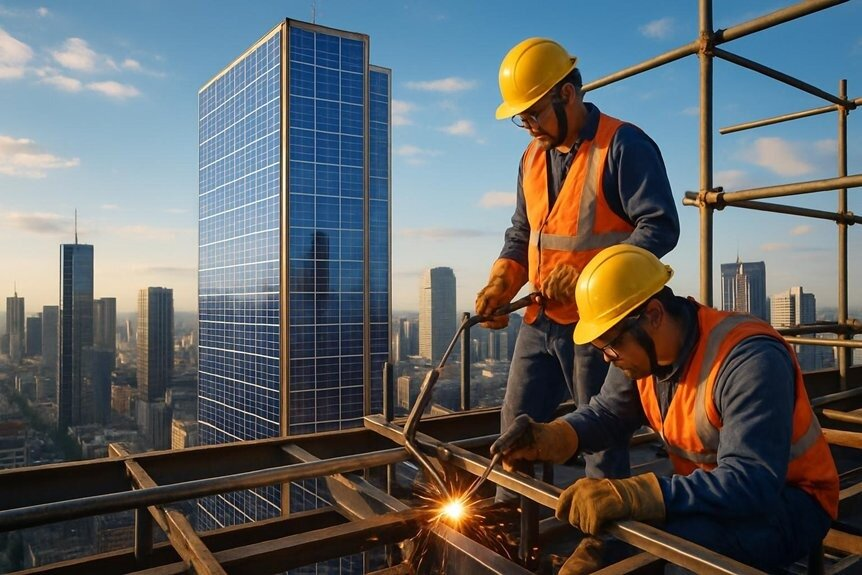
The construction industry is at an inflection point. Metal building systems now account for over 40% of all low-rise commercial construction in the United States. Solar adoption is accelerating in parallel, reshaping workforce demands and compensation structures. These two forces are not operating independently. They are converging, creating a new professional landscape that rewards specialization and punishes stagnation. Understanding what this shift means for careers, earnings, and long-term opportunity requires a closer look.
Metal Construction’s Rise and Why It Dominates Modern Building
Metal construction has reshaped the global building industry over the past century, emerging as the dominant structural choice across commercial, industrial, and increasingly residential sectors, a trend frequently highlighted in industry publications such as metal construction news that track evolving materials and methods. Steel and aluminum now account for the majority of large-scale construction frameworks worldwide, driven by measurable advantages in durability, scalability, and cost efficiency.
Structural innovations have fundamentally altered what builders can achieve, enabling longer spans, greater load capacity, and reduced material waste compared to traditional concrete or wood alternatives. High-strength steel alloys and advanced cold-formed components have expanded design possibilities while simultaneously lowering project timelines.
Prefabrication advancements have further cemented metal’s industry position. Off-site fabrication of structural components reduces on-site labor demands, minimizes weather-related delays, and improves quality control. Studies consistently show prefabricated metal systems can reduce construction schedules by 30 to 50 percent. These combined factors explain why metal construction continues outpacing competing materials across virtually every major building category globally.
How Solar Integration Is Reshaping Construction Careers
Solar integration has fundamentally altered the skill requirements and career trajectories of construction workers across residential, commercial, and industrial sectors. The U.S. Bureau of Labor Statistics projects solar installer employment will grow 52% through 2032, far outpacing most construction trades. This expansion reflects broader adoption of sustainable building methods that now demand workers proficient in photovoltaic system design, electrical integration, and structural load calculations.
Traditional framers, roofers, and electricians increasingly pursue solar certification programs to remain competitive. Energy efficiency considerations now factor into every project phase, from initial site assessment through final inspection. Contractors who once specialized exclusively in conventional materials must now understand inverter technology, net metering systems, and building-integrated photovoltaics.
Community colleges and trade schools have responded by embedding solar coursework into existing construction curricula. Workers crossing into solar-adjacent specializations typically command 15-20% higher wages, creating measurable financial incentives that continue accelerating workforce migration across the construction sector.
Why Metal Buildings Are Engineered for Solar From Day One
While solar expertise is reshaping construction careers broadly, metal building manufacturers have moved beyond retrofitting to embed solar readiness into structural design at the engineering stage. Structural calculations now account for photovoltaic load distribution, with purlin spacing, roof pitch, and panel orientation determined before fabrication begins.
This engineering-first approach reduces solar panel installation time by eliminating field modifications, structural reinforcements, and incompatible attachment systems that plague conventional construction retrofits. Metal roofing systems increasingly feature integrated rail channels, pre-positioned conduit pathways, and load-rated attachment points calibrated to specific panel arrays.
Rooftop solar accessibility is further enhanced through standardized metal roof profiles designed for direct-mount systems, reducing installation costs by approximately 15-20% compared to retrofit applications on alternative materials. Manufacturers now collaborate with solar developers during the design phase, producing structures where electrical infrastructure, roof geometry, and structural capacity function as a unified, optimized system rather than assembled afterthoughts.
The Highest-Paying Job Roles in Metal and Solar Construction
The convergence of metal construction and solar installation has produced a specialized labor market where technical expertise commands premium compensation, a trend that continues to drive searches for solar jobs hiring near me as demand for skilled professionals accelerates across regional markets. Among the highest earning metal installation specialists, structural ironworkers with photovoltaic integration certifications report median annual salaries exceeding $85,000, with senior-level positions surpassing $110,000 in high-demand markets.
Top paid solar project managers overseeing large-scale metal-framed installations command compensation packages ranging from $95,000 to $140,000 annually, reflecting the complexity of coordinating structural engineering, electrical systems, and regulatory compliance simultaneously. Electrical engineers specializing in grid-tied commercial solar systems represent another high-compensation tier, averaging $105,000 nationally.
BIM coordinators who model metal building structures with integrated solar infrastructure are increasingly valued, commanding salaries between $80,000 and $120,000. The U.S. Bureau of Labor Statistics projects solar installation roles will grow 52% through 2032, sustaining upward pressure on compensation across all technical specializations within this converging industry.
What Contractors Earn in Metal and Solar Construction Today
Contractor earnings in metal and solar construction vary considerably by business structure, regional market, and project scope, yet industry data consistently positions this sector among the higher-compensating segments of the broader construction trade. Independent contractors operating in metal fabrication report gross revenues substantially exceeding salaried counterparts, with typical earnings for metal fabricators running between $65,000 and $95,000 annually depending on specialization and overhead management.
Solar contracting mirrors this trajectory. Average compensation for solar installers at the contractor level ranges from $75,000 to over $120,000, particularly in high-demand markets such as California, Texas, and the Southwest. Overhead costs, licensing fees, and crew payroll compress net margins, yet skilled contractors who manage lean operations consistently retain strong income. Federal incentive programs further stabilize solar project pipelines, reducing revenue volatility that historically undermined contractor profitability in cyclical construction segments.
Both trades reward operational efficiency and technical credentialing with measurable income advantages.
The Hard and Soft Skills Metal and Solar Builders Need Now
Strong earnings in metal and solar construction do not materialize without a corresponding foundation of technical and interpersonal competency. Employers consistently prioritize workers who demonstrate proficiency in structural design considerations, including load calculations, material tolerances, and energy system integration. Familiarity with Building Information Modeling platforms and solar layout software has become increasingly non-negotiable across both sectors.
Equally critical are soft skills that support effective project management strategies. Professionals who communicate clearly across engineering, permitting, and installation teams reduce costly delays and rework. Problem-solving adaptability remains essential as supply chains fluctuate and code requirements evolve across jurisdictions.
Data from the National Center for Construction Education and Research indicates that multi-credentialed workers, those combining welding certifications with photovoltaic installation training, command measurably higher wages. The convergence of these disciplines rewards individuals who invest deliberately in broadening both their technical repertoire and their collaborative capabilities across complex, fast-moving construction environments.
Certifications That Fast-Track Metal and Solar Construction Careers
Earning the right credentials consistently separates workers who advance quickly from those who stagnate in entry-level roles within metal and solar construction. The Metal Building Contractors and Erectors Association (MBCEA) offers the Certified Metal Building Assembler designation, which validates structural competency employers actively prioritize during hiring.
For solar, the North American Board of Certified Energy Practitioners (NABCEP) PV Installation Professional certification remains the industry’s most recognized benchmark, with certified installers commanding salaries averaging 20% higher than non-certified peers.
Apprenticeship programs through the Iron Workers International and IBEW provide structured pathways combining paid field experience with classroom instruction, accelerating career timelines tremendously. Technical training courses offered through community colleges and trade-specific platforms like NCCER further strengthen foundational knowledge in areas including blueprint reading, electrical systems, and load-bearing calculations.
Workers who stack multiple credentials position themselves for supervisory advancement, project management roles, and specialized contract opportunities unavailable to uncertified counterparts.
Where Metal and Solar Construction Careers Are Headed Next
Credentials open doors, but the longer-term trajectory of metal and solar construction careers depends on forces reshaping the industry well beyond certification requirements. Emerging technologies, including AI-assisted structural modeling, robotic fabrication, and advanced photovoltaic integration, are redefining required skill sets faster than traditional training pipelines can respond.
The U.S. Bureau of Labor Statistics projects solar installer employment to grow 22% through 2032, while metal construction demand tracks closely with infrastructure investment cycles and green building mandates.
Sustainable design principles are increasingly embedded in municipal codes and corporate procurement standards, making fluency in low-carbon materials and energy-efficient systems a baseline expectation rather than a differentiator. Professionals who combine technical proficiency with systems-level thinking, understanding how metal assemblies interact with solar arrays, building envelopes, and grid infrastructure, will hold the strongest competitive position.
The industry is consolidating around multidisciplinary expertise, rewarding those who adapt proactively rather than reactively.