


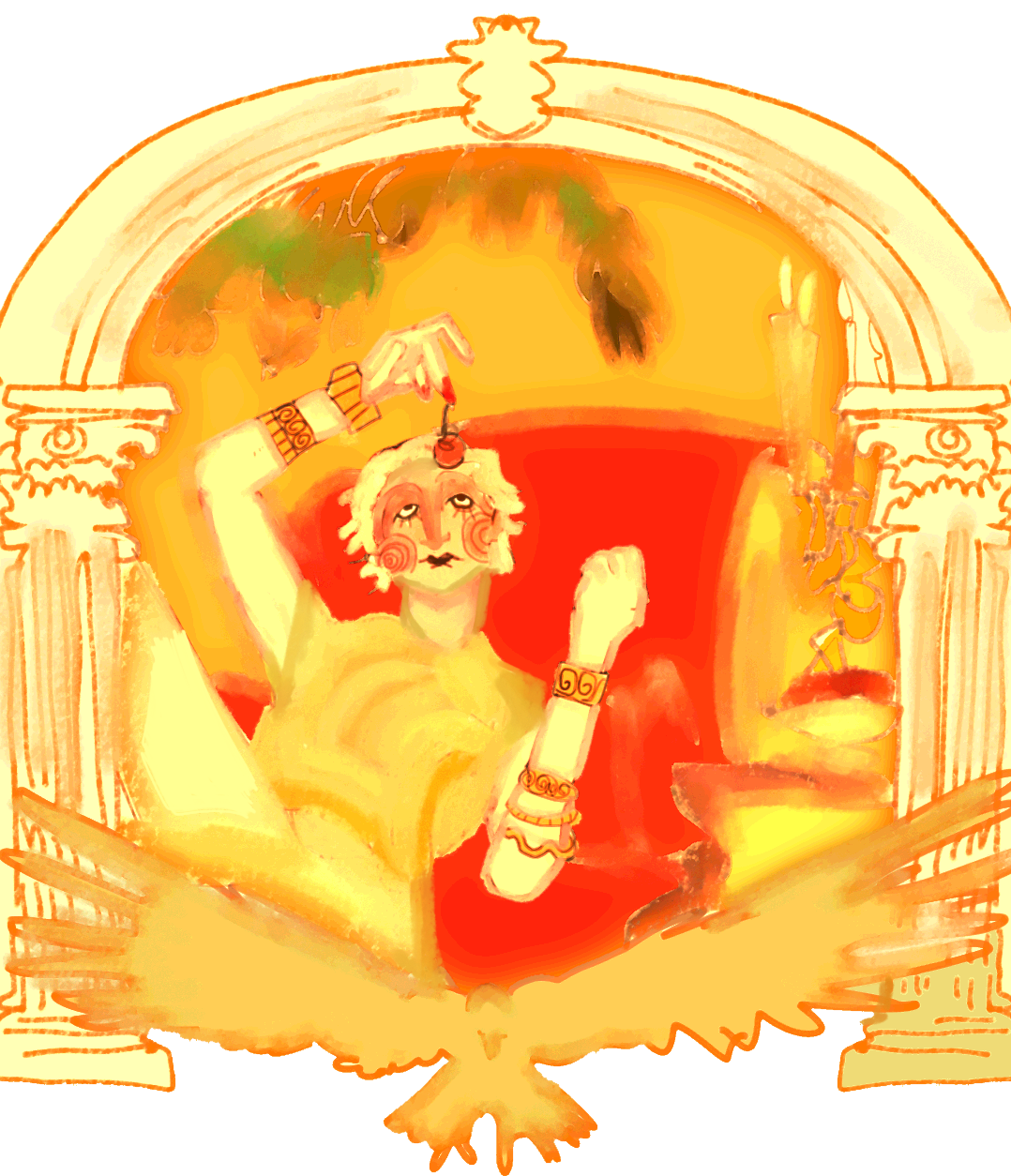
Film is perhaps the most commercialised form of art. Multi-million-dollar investments are the industry standard, and manifold returns are the typical measure of box office success. Kindly, pathos-invoking narratives of the tragically misunderstood poet or musician don’t seem to extend to the unsuccessful filmmaker, especially not one with multiple box office hits under his belt.
Expectations were, therefore, sky-high for Francis Ford Coppola’s dream film, having marinated for nearly 50 years in development hell, with a star-studded cast list, and, (in)famously, self-financed by profits from his wine-making business. When Megalopolis was conceived, Coppola had both The Godfather and The Godfather II under his belt; by the time it came out, he had directed or produced more than ten films, becoming a rare two-time winner of the Palme D’Or.
It seems to me that, when Megalopolis failed to meet those sky-high expectations and subsequently flopped, crashed, and burned at the box office, the widespread surprise and disappointment were entirely uncalled for. Or, perhaps instead, I argue it should be no surprise when a film (like any other form of art) that’s made with the dreams of the artist, instead of commercial appeal, at front and centre is as decadent, incoherent, and utterly bizarre as Megalopolis. After all, Coppola has refused to retire at any peak of his commercial success. It follows that the determinant of artistic quality, for the artist himself, is something very different indeed to audience reception, or perhaps even an audience’s ability to receive.
Providing a chronological plot summary to Megalopolis would tell you nothing. It is important for my thesis that I substantiate this claim. In undertaking this very challenge, all editors are faced with a choice: preserving the director’s choice of chronology or deviating, with the provision of additional details, for the sake of coherence. Wikipedia editors chose the latter, resulting in an article far more comprehensible than the film. I understood the many sporadic, unresolved, seemingly pointless scenes in the film far better once I had read its Wikipedia page. It revealed the protagonist’s invisible source of wealth and status (in the film’s overarching parallel to the social hierarchy of the Roman Republic, he serves as a patrician). It confirmed that his time-stopping powers really do feature in only two scenes. And it confirmed my suspicion that the precise nature of Megalon, the MacGuffin-esque building material upon which the plot hinges, is never really explained.
Suffice it to say that, without supplementary reading, I understood very little about this film. Still, I would like to propose something radical. The fact that Megalopolis managed to convey so little of the writer’s vision does not diminish its artistic quality. Although every scene dashed my hope of finally understanding the plot against the rocks, the apparent fact that no cohesion between visual elements was considered necessary did not take away from the conceptual richness, which replenished my hope all over again. Each set piece and every costume is a welcome detail to the film’s overarching metaphor – the framing of the collapse of one civilisation, a contemporary New York City, within a visual language that associates the setting with another, the ancient city-state of Rome. The result – New Rome – is pictured in such vivid detail, with gladiator fights placed alongside AI-generated pornography, and lavish culturally Christian weddings juxtaposed with classical marble statues, that I found it impossible not to fall in love with the vision.
The vision, I argue further, is everything. I yield briefly to a review writer who words his counterpoint thus.
“[Megalopolis is] a beautiful movie that speaks much yet says virtually nothing. […] It is clear that Coppola had a vision, and yet that vision is completely opaque to the viewer. Megalopolis is craft in excess, but with context and intent lost in translation. It generates no controversy and no outrage, but it does stir the very powerful emotion of sheer bewilderment.”
I went into this film with little context of my own. I’ve read nothing about the Catilinarian conspiracy of 63 BC, I confused Adam Driver for Keanu Reeves, and I’ve never even watched The Godfather. It is true that Megalopolis, allegedly making use of a direction strategy that embraced improvisation, loses its context in translation. Arguably, it does not make any attempt at translation whatsoever. This does not matter. I agree further that Megalopolis does not succeed in instigating a dialogue with its audience. It’s hard to deny that making no attempt at instigating dialogue at least footnotes, if not compromises, the ability of art to perform its purpose. Even so, I contend that, as to its quality, particularly from the artist’s own perspective, the presence of dialogue does not matter.
What makes Megalopolis a success in my eyes is that it is absolutely steeped in the sweat of a visionary, even if the vision itself is incomprehensible. The careful juxtaposition at some points, and merger at others, of contemporary elements with ancient; the repeated focus on background elements – the flirtatious, shallow characterisation of the film’s young female background characters, for example; the dense, detailed costuming, and diverse cast: the film contains an abundance of artistic choices from which to glean the depth of its vision. Further, though perhaps not in the way Coppola might have wanted, Megalopolis provoked no shortage of audience response: speculative articles about its box office flop are plenty. Megalopolis prompted a group of my friends to film a scene-for-scene reproduction, deconstructing and reconstructing the movie’s constituent parts to form something new. Megalopolis provoked such a strong sense of awe within me that I was moved to write this, my first attempt at film review.
One might argue that a call-and-response relationship between art and audience requires the call to be intentional. It cannot be argued that Megalopolis makes a particularly effective call. What I do posit is that it tries very hard to say something, and does so in a way that elicits a very strong response. There is dialogue after all, though of a particular kind: the call is made not expecting a response, and certainly not expecting a response that agrees with it. Despite this, Megalopolis faces no shortage of response whatsoever. What stronger indication could there be as to the impact it makes on the art world?