


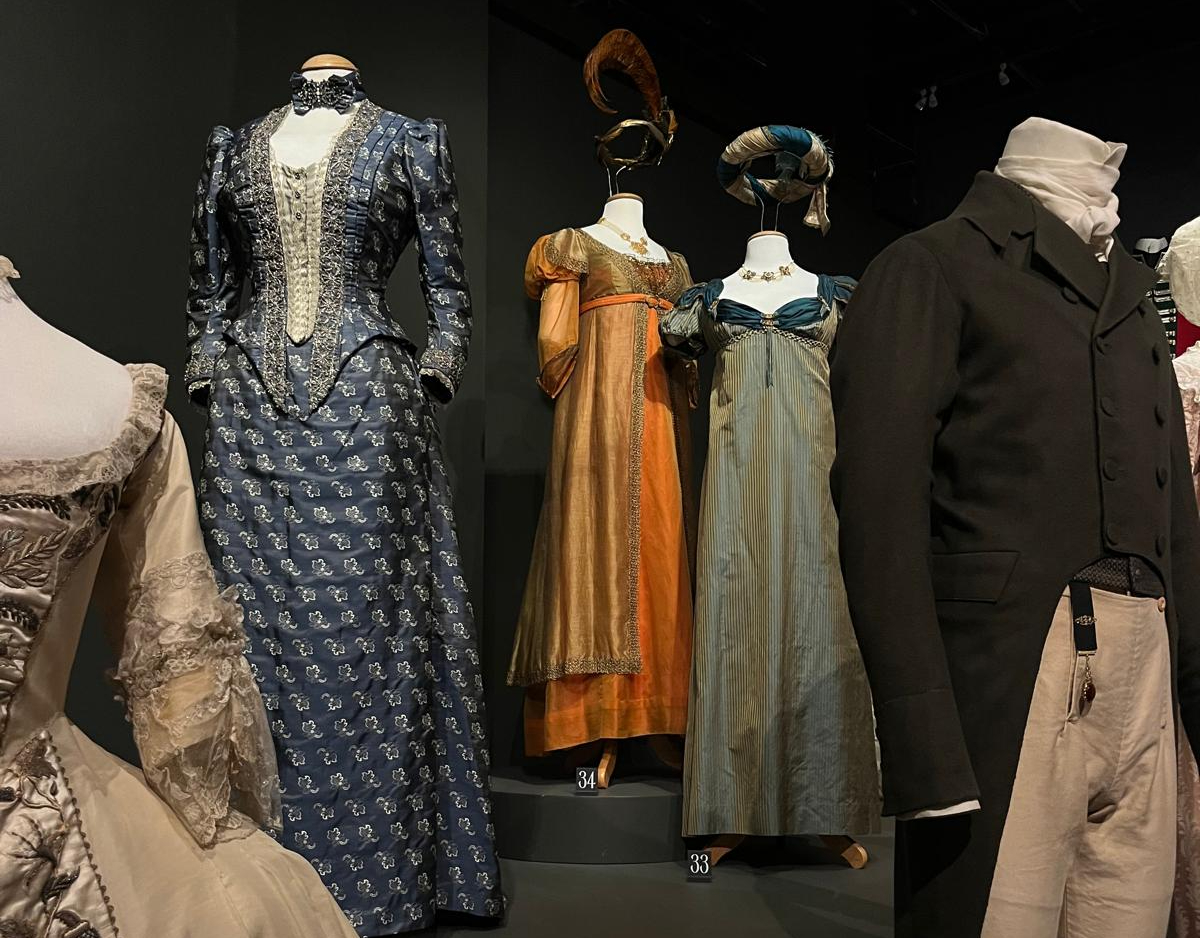
If there’s one thing you need to know about my mum, it’s that she loves a good exhibition. And if there’s one thing you need to know about me, it’s that I love the Mr Darcy wet shirt scene from the 1995 BBC adaptation of Pride and Prejudice. The stars aligned for the two of us when we discovered the Cosprop exhibition at the Fashion and Textile Museum in Bermondsey: a celebration of 60 years of one of the most successful costume houses in the UK, founded by John Bright, which provides incredible period-accurate costumes for productions spanning from A Room with a View (1985) to Peaky Blinders (2013).
The museum was founded in 2003 by Dame Zandra Rhodes, a true icon of the UK fashion scene, instantly recognisable by her shocking pink hair. Mum had teased me on the train that we might end up bumping into her, as she allegedly lives in a flat just above the museum itself. And, as luck would have it, as we walked the streets of Bermondsey, unfashionably early for opening time, the legend herself appeared from around the corner, picked up an empty bottle of Stella from the parking lot in front of her door, and disappeared upstairs. The day was already off to a flying start.
The museum itself oozes with Rhodes’s quirky style: you enter through a narrow entry-way into a carnivalesque array of fabrics, mannequins and cabinets full of trinkets and jewellery. Bright’s story as a costume designer began in the flea markets of Clignancourt, as he diligently sought out authentic corsets and bodices to start his collection and inspire his pieces. Having just returned from my year abroad in Paris, it felt like I was back in the hubbub of bustling street vendors, surrounded by beautiful ornaments. As you might expect, the exhibition is deliciously tactile. The museum’s low lighting draws your eye to the drape of the fabric, the glittering sequins or jewelled bodices, the embroidered edges of jackets, the delicately stitched hems: all things you could reach out and touch, or imagine sweeping across a film set. This is living, breathing, wearable art: something that might pass across your screen for a second, but that forms such a fundamental part of the world-building of a production.
Much of Cosprop’s dazzling reputation can be attributed to Bright’s commitment to authenticity. Designers have access to original items of clothing from the period and can examine them up-close, instead of in a museum cabinet, which allows for a meticulous research process. Aside from this, the costumes have to be functional: even in a whale-bone corset and a bustle, actors need to be able to meet the demands of their scripts, whether that involves running, dancing, or even sitting. In recent decades, following the transition from analogue to digital filmmaking, the costume house has had to adapt to greater demands for intricacy due to the higher definition of films. The demands for wearability, authenticity and visual appeal all speak to the invaluable role of the costume house in cinema, and to Cosprop’s prestigious reputation within the film industry.
The exhibition snakes through various rooms, up stairs and along corridors, as you follow a trail through different films, different time periods and different actors. Bright’s adaptability is something of a marvel: from the stiff tweed coats of Peaky Blinders (2013) to the shrouding and imposing purple cloak of Meryl Streep’s Aunt March in Little Women (2020), he displays such attention to detail in the presentation of the characters he helps to construct. One of the coolest (if most trivial) things about the exhibition is being able to imagine what your favourite actors look like in real life. Anya Taylor-Joy’s dress from Emma (2020), for example, revealed to us that she is deceptively short, and mum couldn’t quite get over the size of Kiera Knightley’s waist (‘How on earth did she manage to fit into that?’). Bright manages to manipulate fabric and form to continually create original silhouettes: an actor can be transformed from one film to the next, just based on the way that a piece of fabric alters their appearance. As he puts it in the exhibition programme: “Actors walk into Cosprop with just a script and the name of their character. They walk out with that character forming in their mind, having brought him or her to life through the angle of a hat, the fabric of a coat or the feel of a pair of shoes.”
Recently, my mum has found a passion for embroidery. I love coming home and watching her diligently stitching in the kitchen, a cup of tea on the table beside her, BBC Scotland humming from her phone. She likes to think of it as painting with thread: telling a story on a piece of canvas, taking inspiration from the world around her. She’s quick to dismiss her talents as just a simple hobby. It’s just something that she loves to do when she has the time. But walking around the exhibition with her — seeing her stand quietly in front of each carefully crafted piece, telling me about the different types of stitches and buttons, asking for my tech support while trying to take a picture — proved to me just how important it is to keep this art form alive. The technique, the skill, and the patience that sewing requires is all but forgotten when we put on a pair of jeans, or watch Colin Firth emerge from a lake, the seams of his beautifully designed shirt dripping on the lawn.
So, when you next watch a good film (or, like me, are watching Pride and Prejudice for the millionth time), think about the clothes you see. Every sequin, bead, and button is intentional, and serve to make period films feel more authentic, and to make actors feel more comfortable in their roles. But above all, these details enhance your enjoyment as a spectator, and can easily go unnoticed when you’re swept up in a film’s action. You don’t need to turn into a full-on Miranda Priestly, but consider the fact that these costumes require so much creative energy and output to manufacture. Or alternatively, check out the exhibition for yourself: it is simple, beautiful, and thoughtfully curated, and would only take an hour or so out of your day. Just please, for Zandra’s sake, don’t leave your empty Stella bottles outside.