


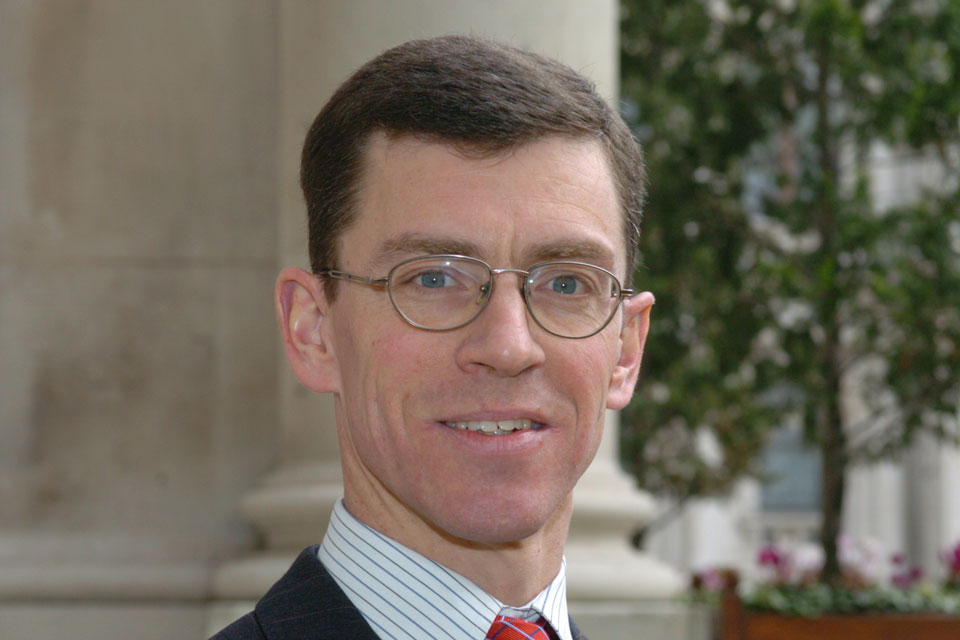
James Dauris, who served as the British High Commissioner for Sri Lanka and the Maldives, as well as the British Ambassador for Peru and Panama, spoke to the Oxford Politics Society on Friday evening. He reflected on the roles and responsibilities from a diplomatic career that has spanned over thirty years, while also discussing the viability of multilateralism, especially during Donald Trump’s second presidency.
He started the session with an explanation of ambassadors’ diverse range of responsibilities, which all help to represent British interests. They help promote economic development in the United Kingdom by encouraging investment from foreign companies and negotiating trade deals. They also contribute to the UK’s security through facilitating collaboration with a country’s law enforcement agencies. Indeed, Dauris spent considerable time in Latin America working to limit the flow of drugs to the UK. He highlighted the extensive consular support which ambassadors help to provide, including supporting those who have lost their passports and facilitating the evacuation of British nationals from conflict zones. Furthermore, he noted how his time in Latin America was spent expounding Commonwealth diplomatic principles.
He continued to explain how, to fulfil these substantial responsibilities, ambassadors need to become good linguists, highlighting the UK Foreign Office’s test to identify the most difficult category of language any official would successfully be able to learn. For him, it was category 3, meaning he could learn Russian. Additionally, he explained how ambassadors need to be able to digest large amounts of information quickly, such as when he lobbied Peru to support the British stance in the UN regarding Bashar al-Assad’s usage of chemical weapons in 2013. According to him, being an ambassador is a “very public role”. Therefore, it is essential for individuals serving in such positions to develop confidence to speak before audiences. Humour potentially aids this, though he described how a joke he made before a meeting of accountants in his first year in Sri Lanka was met with silence. Most importantly, he highlighted the need for ambassadors to be driven by a genuine passion for foreign cultures; he said that he still feels excited at the possibility of visiting new countries.
Dauris then spoke about his time working for the Foreign Office, during which he realised the importance of relying on locals to help understand cultural norms, leading to better relations with foreign officials. He discussed witnessing a moment “when history was being made”: he was in the Red Square on New Year’s Eve 1999 when Boris Yeltsin appeared on a screen to announce his resignation and replacement by Vladimir Putin. He witnessed the crowd go silent due to their understanding that this would have “extremely far-reaching consequences”. He valued the role he was able to play in supporting democracy in the Maldives through promoting the freedom of the press and meeting with various opposition leaders, experiences which allowed him to feel that he was “making a difference”. He noted an “extremely special” experience talking with a beekeeper for 4 hours when he was invited to trek one of Siberia’s highest mountains.
He discussed how his time as ambassador allowed him to interact with numerous individuals who worked for non-state actors, including terrorist organisations. He recalled travelling on a helicopter with Erik Solheim, the eventual Foreign Minister of Norway, to reach territory controlled by the Tamil Tigers, so that he could negotiate with S.P. Thamilselvan, one of the organisation’s political leaders. Describing the experience as surreal, he recalled how their travel through territory controlled by the organisation “resembled a Hollywood movie”, with signs warning them not to deviate from the marked path since the surrounding areas were scattered with landmines. He also described attending a peace negotiation in Colombia between members of the FARC and the government, which allowed him to realise how many of the organisation’s fighters were driven by poverty or forced by the militia’s members, who threatened their family with death if they did not comply. His interest in reconciliation was greatly increased when he realised how the differences between many of these people, who were “on paper, on completely different ends of the spectrum”, were actually “paper thin”.
Prompted for his opinion regarding the American capture of Venezuelan President Nicolás Maduro, Dauris initially responded by categorising former President Maduro as “not a good guy”. He expanded on this, stating that the Venezuelan government systematically rigged the previous elections and that the country had a “broken health, education and transport system”. He also noted that 8 million people had fled from Venezuela, describing this immigration as a “driver” for President Trump’s decision to act. He opined that Venezuela’s close ties with Cuba – especially its role as the latter’s main oil supplier – were a crucial factor in motivating Secretary of State Marco Rubio. He believes that the United States’ lack of objection to Delcy Eloína Rodríguez’s ascension to the Venezuelan Presidency reflects that the restoration of democracy was “not very high on the US priority list”. Rather, according to him, this was about President Trump being inspired by his version of the Monroe Doctrine, seeing the US as the dominant power of the Western Hemisphere. He acknowledged that it was “right to ask” questions about international law regarding American action in Venezuela.
He further elaborated how Britain ranks amongst the “top in the world” in its soft power, which he defined as everything you get “through earning goodwill and respect”, observing how, in Latin America, the presence of many British schools enables the UK to draw on “a huge amount of goodwill”. He noted the need to continue carefully maintaining such goodwill through institutions such as the British Council and the BBC World Service. He further mourned what he viewed as a decline in British trade with countries in the region, declaring that “we as a collective… should be putting more effort than we are in Latin America”.
When asked about President Trump’s pursuit of isolationism, Dauris responded by warning that the former’s “disregard” and “lack of seriousness”, in regards to collaborating with other countries, would diminish American global influence in the long run. He expressed that a country is truly influential when it is working with like-minded nations. Subsequently, he found the US’s treatment of its allies, notably Canada and the UK, concerning. He noted how China had progressively moved to fill the vacuum left by the US, and how it would become increasingly difficult for the country to re-occupy that space if a future administration sought to pursue a different set of policies.