


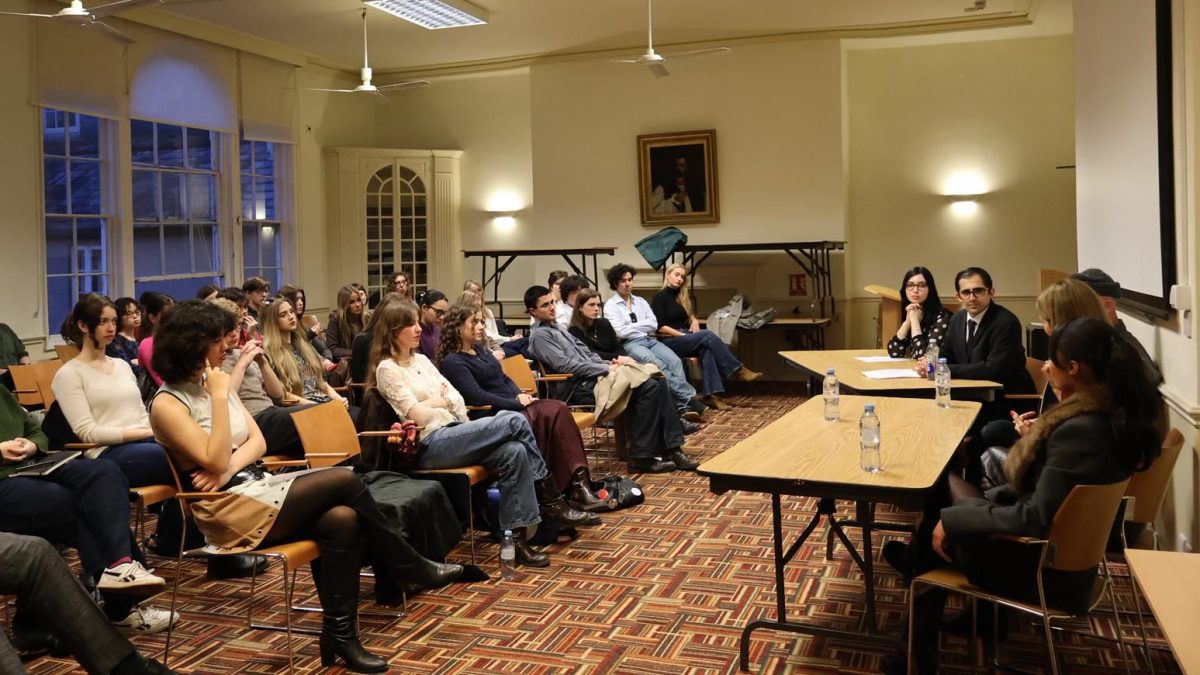
On Tuesday 24 February, the first ever panel hosted in collaboration between Oxford University Media Society, The Oxford Blue, The Isis, and The Oxford Student took place in University College.
The panel featured three major names in the world of journalism: Plum Sykes, Mike Williams, and Cree-Summer Haughton.
Plum Sykes is a former Vogue fashion editor, novelist and socialite. Her work has been so influential that she was rumoured to have inspired the character of Emily from The Devil Wears Prada.
Mike Williams was the former Editor-in-Chief of New Musical Express (NME) Magazine, and is currently the Editor-in-Chief of Sight & Sound, a monthly film magazine published by the British Film Institute (BFI). Since 1952, it has conducted the well-known decennial Sight and Sound poll of the greatest films of all time. In addition, Mike has also won several BSME ‘Editor of the Year’ awards.
Cree-Summer Haughton is a journalist and digital reporter for ITV News. She has published award winning medical investigations and health features.
The event began with the hosts, Dhillon Lalji, Co-Editor-in-Chief of The Oxford Blue, and Hannah Stewart, Co-Editor-in-Chief of The Oxford Student, introducing the panelists to the audience and explaining the intentions behind the event. Stewart stated that it was part of an initiative to help unite student journalism in the university and foster a more connected community.
They opened the event by asking the panel about the decline of printed media, relating it to the societies present, as The Isis and The Oxford Student are both still printed , whereas The Oxford Blue is only digital.
Mike Williams expressed how print has almost become a luxury item. He stated “people either want to pay nothing or fifty quid”; there is a desire for media to be easily accessible and free, or a premium quality and a worthwhile investment. He also compared the print industry to the music industry, explaining that the same kind of attitude is also being adopted in our consumption of music, as we can see with the purchasing of physical media, such as vinyl records or CDs, being in decline.
Plum Sykes added to the conversation, comparing print journalism to books, explaining the transition to digital media from an author’s perspective. She stated, “you can’t just have your book, you need to have your Substack, your Instagram…(etc)”, discussing how it is not enough for an author’s work only to exist in a physical, printed form, it must also exist in multiple digital forms to gain readership and traction. She also highlighted that, despite the new move to becoming digital, those who are successful in the industry have remained very much the same. Those people were trained at Wall Street Journal and the New York Times, and so, “it’s really no different to old media, but it’s made digestible on our phones.”
Cree-Summer Haughton’s perspective was slightly different, explaining that she comes from a digital-first background, meaning that everything she does is in its digital form first. She explained how she forms her ideas with the digital media in mind, and then transfers her ideas to television. As Lalji pointed out, this creates an analogy for the world of print itself: as we move away from print in magazines, we are also beginning to move away from televised news towards a new digital era.
She also highlighted that she views television as a means of getting funding, through high-volume advertising and direct public funding, whereas digital media cannot receive the same kind of funding. However, according to Haughton, the attitude towards digital broadcasting is beginning to change, with more funding becoming available. Despite this, all of the panelists were in agreement that the print industry is not dead’, and, as Haughton highlighted, as long as every news outlet, magazine, or newspaper still has their base in print, retaining their core, as well as venturing into different avenues, there will certainly still be a future for print.
The panelists were then asked individual questions. Williams was asked about his own career, and recalled his first magazine, Kruger. This independent music magazine was begun in 2003 by Williams and his friends, who were also creatives in Cardiff. Kruger was a mix of reviews, interviews, and features about music and culture which closed in April 2010, the same year Williams joined NME as features editor. He explained that his success was a combination of hard work and luck, with no connections in the industry, and no means of partaking in unpaid internships as he needed to make money. He had to just “do his own thing”, and find his own opportunities. He described it as “luck” when Kruger was picked up and promoted by Huw Stevens, but that, even if it had not happened, he would have continued to do his own work and, through grafting, would have hopefully got to the same place. He stressed the message that the “things you make and do yourself are as valuable as internships”, encouraging originality and creativity.
Plum Sykes explained that she began her career path into journalism through student magazines, with many rejections along the way, including The Isis many times. However, she eventually broke into the world of media after graduating with work experience at British Vogue, where she said she “found her place” in the world of fashion journalism, which, according to her, is “its own universe”. She also gave advice on how to succeed in digital journalism, saying that, despite the plethora of legacy names on digital platforms, anyone can be successful. One must persevere in order to succeed, as many people often try on platforms like Substack and give up in a short period of time after not having enough attention. She added, “it’s a great platform for people who can’t write these pieces elsewhere in other newspapers and magazines.”
Haughton did not go to university, but, like Williams, explained that she took a career path that worked for her, knowing she needed to make money and therefore could not do an unpaid internship or go to university. Instead, she did an apprenticeship with ITV and expressed that it benefitted her hugely. Her advice is to “get your foot in the door” but that this is also “the most difficult step.”
After the panel ended, there was a Q&A session where a range of questions were asked, from how to propel one’s student journalism career, to how to apply journalistic skills to the actual industry, to legacy names in journalism.
After that, the panellists were then taken to a formal dinner at St John’s College by the hosts of the event.