


Lola Dunton-Milenkovic
There was something incredibly emotionally overwhelming about Bad Bunny’s Super Bowl halftime performance on 8 February 2026. Maybe it was the fact that he only spoke in Spanish, refusing to conform on a global stage at a “quintessential American event”. Maybe it was the plethora of allusions to Latin American culture and history. Maybe it was the message surrounding the whole performance: one of love over hatred, something that is rarely heard these days. Or maybe it was the final march of flags, all the countries of South, Central, and North America grouped together in a carnival-like embrace of solidarity.
Through his 2025 album DeBÍ TiRAR MáS FOToS and now this performance, Bad Bunny is managing to create unadulterated joy in an increasingly polarised and dangerous world. Using the cheerfulness of Latin American music, and pairing it with the region’s devastating history, he has succeeded in creating an anthem of love. Above all, what he has achieved is the representation of Latino identity, unity, and pride after decades of colonialisation, destruction, and dissolution.
Benito Antonio Martínez Ocasio
Bad Bunny is the stage name of Benito Antonio Martínez Ocasio. Born in Vega Baja, Puerto Rico, he was raised in a lower middle-class household. He started singing when young, and chose his stage name after sharing a picture of himself as a child in a bunny suit with a grumpy expression.
Before Bad Bunny became a global music star, he was known as the “King of Latin Trap”. He brought forth a Spanish version of trap music (a subgenre of urban hip-hop), revolving around themes of drugs, violence, and sexuality. His musical style has since changed significantly, and is now a fusion of trap, hip-hop, and reggaeton (a hip-hop subgenre developed in Jamaica and Puerto Rico).
He began to find global success when Latino music started rising in popularity around the world. First Shakira and Ricky Martin reached international fame though only by signing in English, and then in 2017 “Despacito” by Luis Fonsi and Daddy Yankee became the most streamed song of the year. Latino music was centre stage – precisely at the right time for Bad Bunny, who released his first song in 2016. Then, following successful collaborations with Cardi B, J Balvin, Karol G, Drake, Rosalía, and others, he gained more listeners and garnered an audience of his own. By 2020, he was a star, invited as a guest performer to the Super Bowl co-headlined by Jennifer Lopez and Shakira.
What made him different, however, was that he ascended onto the global music stage by exclusively singing in Spanish. He has never lost this side of himself, as evident in interviews where he frequently resorts to speaking Spanish with no need to translate himself.
Recently, Bad Bunny has faced incredible success: in 2025, his songs were streamed 19.8 billion times on Spotify, making him the most streamed artist globally for the fourth time. His album DeBÍ TiRAR MáS FOToS was also the Spotify Global Top Album, showcasing the increasing worldwide appreciation for Puerto Rico’s vibrant culture and music. He likewise won three Grammys at the 2026 ceremony, including for Album of the Year, making DeBÍ TiRAR MáS FOToS the first all-Spanish-language album that has won the Recording Academy’s top award. He has, in short, put Puerto Rican music and culture on the global stage.
DeBÍ TiRAR MáS FOToS
Bad Bunny’s latest album is his most Puerto Rican yet. He connects reggaeton and trap to traditional Puerto Rican musical genres like plena, bomba, and salsa. While singing and rapping, he is accompanied by iconic Puerto Rican musicians, making the album a true homage to both Puerto Rico’s culture and its history.
“LO QUE LE PASÓ A HAWAii”, for example, exalts the beauty of Puerto Rico, and expresses the artist’s fear of loss of identity and gentrification. While at first toned down, the melody then marches to battle, with drums engulfed by a hypnotising guitar over which Bad Bunny vows to fight alongside his community to preserve his island’s rituals before they become lost to overtourism, as is the case with Hawaii. Historically, both territories were annexed by the United States, which resulted in loss of land, culture, and identity of indigenous peoples, as well as excessive tourism and the settlement of foreigners who harmed locals and their environment.
“NUEVAYoL” opens with a 20 second excerpt from the 1975 salsa hit “Un Verano en Nueva York” performed by the El Gran Combo orchestra from Puerto Rico. It then ignites into an explosion of Dominican dembow madness, forcing the past and present to collide. While highlighting the presence of Latino immigrants in New York City, Bad Bunny populates the song with the smallest of details, like the reverberating crack of a home run or the mention of salsa icon Willie Colón. He incorporates multiple generations of Puerto Rican rhythms: salsa, plena, old-school perreo, hand drums and Afro-Indigenous sounds, all paired with today’s Latin pop, música urbana, hypnotic synth and sub-rattling bass.
“CAFé CON RON” combines traditional sounds of the Caribbean in collaboration with Los Pleneros de la Cresta, a Puerto Rican musical group that uses traditional percussion instruments from the region with instruments like the güiro and the tambourine. The song is an example of plena, an urban musical genre with African roots often called “el periódico cantado” (the singing newspaper) for its legacy of political and social commentary in the working-class barrios of Ponce. Bad Bunny taps into this, one of Puerto Rico’s oldest musical traditions, first evoking images of celebrating Las Fiestas de la Calle San Sebastián, before accents of Latin club draw the pandereta-led revelry toward a mountain peak.
“BAILE INoLVIDABLE” is a captivating six-minute salsa. Although much more personal, focusing on heartbreak and the nostalgia of a past love captured through the nostalgia of an unquenchable corrillo, his culture is still incorporated wholly, as the song is performed by students from the Escuela Libre de Müsica San Juan.
The album truly showcases Puerto Rico’s struggle for sovereignty, rooted in centuries of Spanish, then American, colonisation. Life in Puerto Rico consists of Boricuas confronting the consequences of nearly 130 years of US corporate investment and gentrification through generous tax incentives. The bolero lullaby “TURiSTA” underscores this toxic, transactional relationship, portraying the tourists that visit Puerto Rico and consume its beauty, leaving the country unrecognisable to its inhabitants.
Even Concho the toad, a signature element in the DeBÍ TiRAR MáS FOToS universe, bears symbolism. He is a sapo concho, better known as the Puerto Rican crested toad, who first appeared in the short film accompanying Bad Bunny’s album. It represents both the island’s fragile ecosystem, as the toad is on the Threatened Species list, and Puerto Rican identity, as it is native to the island. Once thought extinct for over four decades, it was rediscovered in the 1970s. Concho has since brought attention to an endangered species tied to the island Bad Bunny has spent his career celebrating.
Lo único más poderoso que el odio es el amor
What the Super Bowl halftime show achieved was to take all of these political messages and compress them into 13 minutes of celebration and representation. He took all of his auditory historical references, and transferred them onto a visual stage in what is truly a masterclass in cultural storytelling. Every element carried meaning rooted in Puerto Rican history, identity, and resistance. So Bad Bunny did not just bring his music to the Levi’s Stadium – he brought all of Puerto Rico.
The show opened with the lush green fields of Puerto Rico, featuring workers wearing traditional pava straw hats in homage to the jíbaros, the 19th-century agricultural workers on Puerto Rico’s sugarcane fields.
The stage was filled with traditional Puerto Rican instruments, representing the bomba and plena music traditions he incorporates into his work. This included the pandero (tambourine-like hand drums), the cuatro (Puerto Rico’s national instrument, a 10-string guitar), the güiro (a percussion instrument central to Boricuan music), the maracas (rattles), the palitos (percussion sticks), and the cencerro (cowbell).
The casita (little house) on stage recreated his “No Me Quiero Ir de Aquí” residency at San Juan’s José Miguel Agrelot Coliseum. At the Super Bowl, it became the centrepiece of a Puerto Rican vecindad (neighbourhood), populated with Latino icons like Pedro Pascal, Cardi B, Jessica Alba, Karol G, Alix Earle and Young Miko, recreating a “party de marquesina” or quintessential Puerto Rican house party.
The neighbourhood was then built around it. It featured a piragua stand selling shaved ice treats, a staple of street vendors across the island; a nail salon that represents the service businesses that anchor neighborhood life; sugarcane in honour of the agricultural workers and crop that shape Puerto Rico’s economy and history; boxing in nod to the island’s rich sports tradition; plantains, a dietary staple; a barber shop as a classic neighborhood gathering spot; domino tables which bring Puerto Rican communities together; Villa’s Tacos, a real Mexican-American business; and a child asleep in a chair while a (real) wedding rages around him, a universally relatable image for Latino family gatherings that last till the early hours.
Toñita Cay, owner of Brookyln’s Caribbean Social Club (one of the largest surviving Puerto Rican social clubs in New York City) also appeared on stage. She served Bad Bunny a drink from a shop named “Conejo”, or rabbit, referring to Bad Bunny’s nickname “El Conejo Malo” (the bad rabbit) and his foundation “Fundación el Buen Conejo”.
The white plastic chairs of the album’s cover were brought to life with Ricky Martin’s segment. The chairs are ubiquitous in Puerto Rico, found at every family gathering, block party, and community event. They are functional, humble, and tied to the social fabric of the island – serving as a reminder that the most meaningful moments often happen in the simplest settings. Ricky Martin’s presence, too, was momentous, as he paved the way for so many Latin artists. Decades ago, he was told he had to sing in English to be accepted by mainstream audiences. Now, after Bad Bunny’s Grammy win, Martin released an open letter saying: “You won without changing the colour of your voice. You won without erasing your roots. You won by staying true to Puerto Rico”.
Similarly, Lady Gaga’s salsa rendition of “Die With a Smile” was an embodiment of artistic unity, mutual respect and cross-cultural endorsement. Adorned with a red floral brooch of the Flor de Maga, which is Puerto Rico’s national flower, she highlighted the power of Latin music to bring together diverse audiences.
One of the most beautiful moments was the emergence of violin players to perform “Monaco”. It was a dramatic, cinematic moment, through which Bad Bunny delivered a powerful message in Spanish (translated into English): “My name is Benito Antonio Martínez Ocasio, and if I am here today at Super Bowl 60, it is because I never, ever stopped believing in myself. You should also believe in yourself. You are worth more than you think. Trust me.” He directly addressed young people, immigrants, anyone who has been told they do not belong… all delivered on the biggest stage in American entertainment, in Spanish, by someone who worked at a grocery store just 10 years ago.
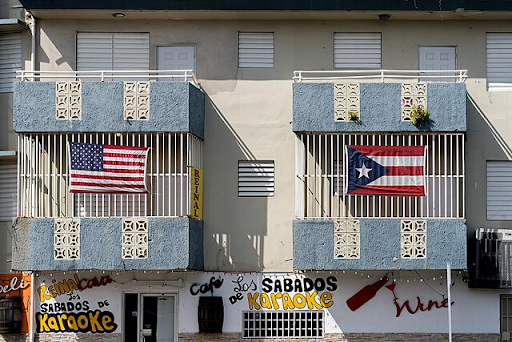
The presence of power line poles alluded to “El Apagón” (the Blackout), a reference to Puerto Rico’s ongoing electrical power crisis. Jíbaros in pavas climbed the poles which then exploded, symbolising the frequent blackouts and failing power grid. Bad Bunny proceeded to climb up them and sing his “El Apagón”, a protest song about the island’s infrastructure failures following Hurricane Maria, government corruption, and the gentrification threatening to displace Puerto Ricans. Even the flag he held up featured not the standard dark blue of the official Puerto Rican flag, but the light blue associated with its independence movement. Bearing the flag was particularly significant, as in “La MuDANZA” he refers to Law 53 of 1948 known as the Gag Law which criminalised displays of the Puerto Rican flag in an attempt to suppress the independence movement. The law was repealed in 1952.
The performance ended with Bad Bunny’s first and only English words of the entire show: “God bless America”. He then named every Latin American country, before ending with the US, Canada, and finally Puerto Rico. He held up a football inscribed with “Together We Are America”. Behind him, the big screen displayed a final message: “The only thing stronger than hate is love”. Cue “DtMF”, an anthem-like song about living and loving as much as we can… and cue the tears.
In 13 minutes, Bad Bunny showed honour for workers, celebration for musical heritage, community, love, colonial neglect, hope for the next generation, and a rejection of the false choice between being Puerto Rican or being American. He delivered “a history lesson, a political statement, a cultural celebration, and a party” all at once.
Baila sin miedo, ama sin miedo
DeBÍ TiRAR MáS FOToS is more than an album; it is a representation of Puerto Rico. Similarly, the Super Bowl was more than just a performance; it was a reminder not just of Latinidad, but of humanity.
Latin American history is plagued with tragedy. Dictatorships fuelled by American influence, countries exploited of their resources, people massacred for foreign domination. What Bad Bunny created was a performance illustrating the equality of all people and countries across the Americas. US President Donald Trump might have found the performance abhorrent; few others did. Instead, as Bad Bunny’s music tends to do, despite all the hatred and polarisation plaguing the world today, viewers embraced the unity, joy, nostalgia, acceptance, community, remembrance, living, dancing, and celebrating. Above all, they accepted the love. And that is a message that transcends borders.
If you enjoyed this article and are interested in what Bad Bunny has taught us about Puerto Rican politics, take a look at Nick Marshall’s article here!