
‘All art is quite useless,’ Oscar Wilde says in his prologue to The Picture of Dorian Gray, yet ‘the only excuse for making a useless thing is that one admires it intensely.’ The Trinity Players production of Wilde’s novel running from 26 to 30 May fits that bill of admiration perfectly.
Adapted for the stage by Neil Bartlett, the play follows Dorian Gray (Luca McCormick), a handsome and rich young man who gets his picture (the eponymous one!) painted by his friend Basil (Dawuud Abdool-Ghany). After striking up a friendship with the hedonistic Lord Henry Wotton (Thomas Arensen), Dorian goes down a dark path of sensual depravity. Convinced that youth is the pinnacle of life and the only treasure worth having, Dorian secretly wishes that the portrait Basil had painted of him ages in his place. His wish comes terrifyingly true.
However, what follows is not a story of a goal achieved, but a train of bodies and lives ruined, all because of Dorian’s selfishness: Sibyl Vane (Holly Rust), the woman he proposed to then dumped; Basil the painter who saw the painting, deformed by Dorian’s vice; Alan Campbell (Keiaron Joseph), a doctor Dorian blackmailed into disposing the body; and James Vane (Sonny Fox), Sibyl’s brother who was hunting Dorian for vengeance. With no possibility of redemption, Dorian in despair destroys the painting to etch his own name onto the long tombstone of his crimes.
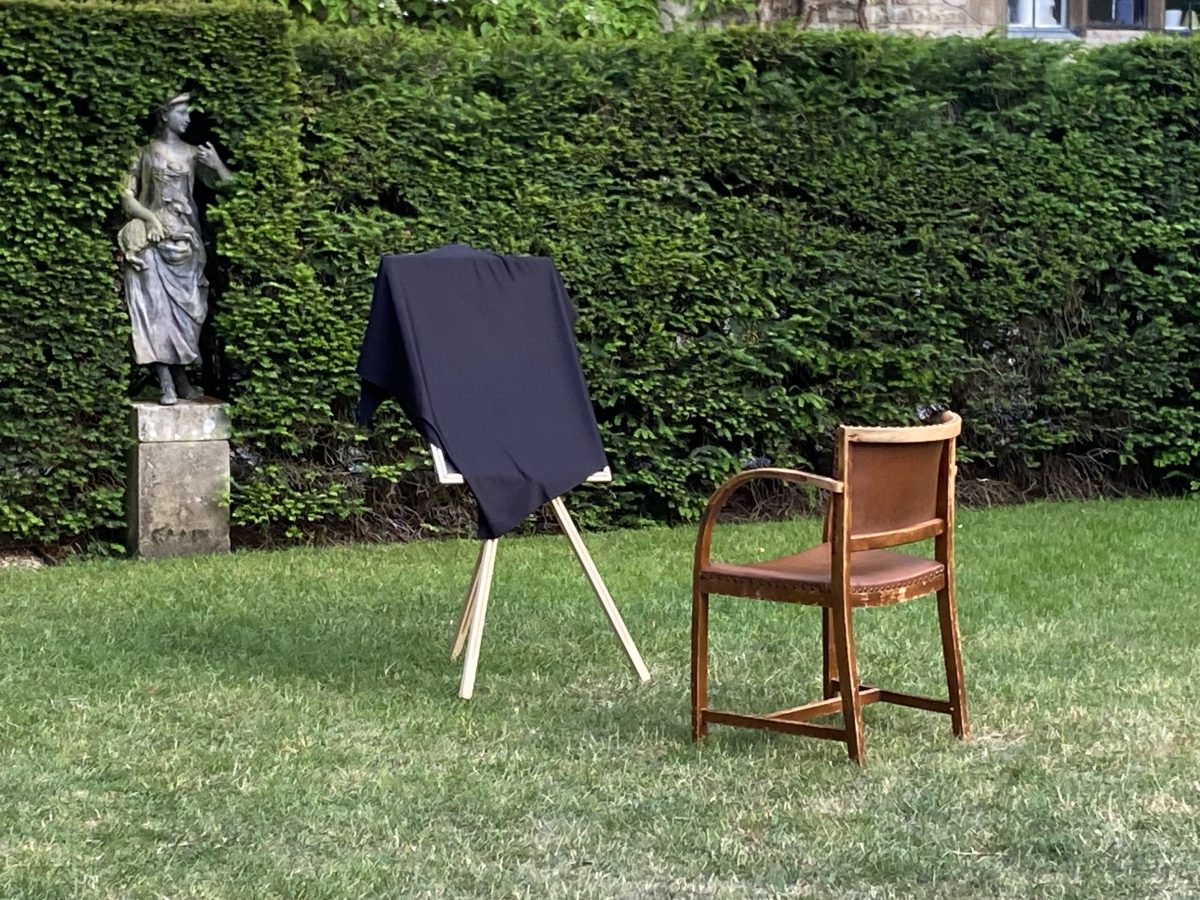
The set was minimalistic from the beginning: just a sole chair for Basil and a canvas resting on an easel. Nevertheless, the space was used to great effect. At the back were the choral characters – a group of changing composition depending on which of the lesser roles were acting in each scene. Positioned relatively far away, they would often appear during scene changes or moments as Dorian descends into madness: marked as physically distant from the action, yet commenting on it for the audience and acting as intrusive voices of both reason and despair in Dorian’s head. In the centre of the grass was the nominal ‘inside’ area – variously a space for Dorian and Henry to speak, the room hiding the painting, a writing room, or the theatre – which made the audience feel like they were voyeuristically looking through a window at the action. Distant, yet very real. The final section of this clever tripartite division was the ‘monologue’ area, the crescent directly in front of the audience. This was where Dorian and Henry deliver their most powerful speeches directly to the audience, as if ruminating on their innermost thoughts.
It is fair to say that the lighting faced an uphill battle against the glaring sun throughout the first half – though I probably wouldn’t have noticed it was on unless I was right next to the person turning the switches in vain. Thankfully, the sun fell sufficiently just in time for the dramatic ending. An anguished red glow reflected the blood of Dorian’s death toll upon the audience.
Going into the performance, I was intrigued as to what form the advertised musical interludes would take. However, I remain unconvinced that they really gelled with the rest of the performance: the speaker was too quiet to sound like a deliberate part of the play, and was utilised with such a light touch that it seemed to intrude upon the action, rather than enhance it. I felt myself pulled out of the play whenever it would randomly play a couple bars of Chopin or the the cadence of a musical. A tad more confidence and a few more decibels would go a long way to integrating this effect with the actors’ performance.
Aside from these technical issues, the acting itself was largely excellent. Arensen as Lord Henry was truly the star of the show: the very picture of an erudite yet pleasure-centred English gent, he delivered some of the most elaborate and mind-bending soliloquies with a sure and delicate touch. Whether he was speaking softly or passionately, his voice remained pleasant on the ear, always clear, audible, and filled with emotion (even if tongue-in-cheek!). His presence on stage only ever enhanced a scene, and not only due to the helplessly entertaining nature of his character, but also because of his exquisite embodiment of it.
McCormick as Dorian Gray received a rapturous round of applause and whoops as he led the cast in their bows – and well-deserved it was. Similarly to Arensen, McCormick proved himself to be a consummate actor, assuredly navigating the tightrope of expression and never over-acting his part though he was the lead: his voice was powerful, yet never shouty; his presence was strong, but never domineering. However, McCormick pleasantly surprised me by his vigour in action as well as words: as he pushed over his servant Victor (Keiaron Joseph), murdered Basil, and knifed the painting, he proved that deeds can actually be carried out with conviction and realism within a theatrical setting.
The chorus played a very significant role within the play for their internal viewpoint. They deftly threw around word-by-word sentences and repeated phrases to create an echoic effect in Dorian’s mind. However, the communal nature of the chorus was its weakness as well as its wonder, for on a few occasions some of their number fell victim to overacting.
Humour is not something you would necessarily expect to find in a gothic horror story, yet the actors got the audience to chuckle on several occasions. Some of these were part of the story anyway, such as the caricature-esque noble Ladies at the theatre, with their arms linked and cigarettes wafted dandily in the air, the very image of carefree living – and unfortunate prey of Dorian Gray’s affections. Other characters like Joseph’s Victor brought it into the play themselves, twitching nervously as Dorian circled him, desperately answering ‘yes, sir’, ‘no, sir,’ back and forth. Other moments of laughter could never have even been conceived by Wilde, as people tried not to laugh every time Henry called Dorian a ‘good boy’!
A final word of praise goes out to the costumes. The extravagant dresses and skirts worn by the Ladies truly set the aristocratic scene – one bright yellow, another rich pink; some voluptuous, others sleek. Costumes did not stop at the clothes the actors were wearing, but also extended to include some smaller details like Basil’s hair greying after a few years, even though Dorian was as young as ever.
The Trinity Players pull off this version of The Picture of Dorian Gray with the only two things you could ask for: artistic sensibility and a bucket load of enthusiasm. They take the timeless plot and multifaceted characters and make them their own. So, although we might agree with Wilde that ‘all art is useless’, this production deserves to be ‘admired intensely’ for there are few more entertaining plays than one the actors are having fun in.
[The Picture of Dorian Gray, staged by the Trinity Players, is running at The President’s Garden in Trinity College, 26-30th May, 2026]