


Oxford is a place where the past settles among the present and nowhere is this sentiment more apparent than in the portraits and statues which fill our colleges. We are surrounded by the monarchs, scholars, priests, and heretics who moulded our city and university. Their images, gilded in Latin and gold, watch over us as we take our turn to eat, drink, and study among the spires.
Walking through the city, we are immersed in this gallery of Oxonian history. Not only are the college halls and libraries decorated with portraits from Oxford’s past, but the city itself radiates a similar feeling. Indeed, there is something mystical about these streets – Queen’s Lane, Magpie Lane, Broad Street; they’ve been here a while. This city vibrates with a quiet energy. The bells ring out across the meadow, the lanes run in no straight line. Latin crests linger above the doorways. I can almost feel the shadows of former students move across these streets in trench coats and gowns. I can hear the sound of wagons clattering across the cobbles, as lamplight catches on the sandstone.
It is these strange relics – the portraits, the colleges, the traditions – that form much of the university’s identity. Students are united through these shared experiences and, at a university with nearly a thousand years of history, it’s difficult to overstate this power. Through these experiences, we together become a part of Oxford’s ever-expanding life.
Some, however, view the portraits not as gentle tokens of Oxford’s past, but as fragments of an outdated and elitist world; symbols of oppression and hate. Statues of controversial individuals, such as Cecil Rhodes, continue to occupy spaces that seem to commemorate rather than question. There is a sense that they represent a standard of behaviour and thought that we all ought to mimic. A tension seems to exist then between the austere exclusivity of Oxford’s misty past, represented by some of its portraits and statues, and its modern student body.
Although this is a valid sentiment, I have a slightly different perspective: it is precisely this tension which gives Oxford its eccentric character, allowing the university to keep the past in dialogue with the present.
Oxford, like everything, changes. Yet these portraits and statues enable the university to occupy a liminal space between the old and new. They represent points in time, mementos of Oxford’s evolution through the ages, but they do not bind the city to those points. They record but they don’t restrict. They create a distinct image of the university – one which acknowledges its heritage while continuing to grow into the future with knowledge and acceptance. They reflect another time, yet continue to be brought forward into new conversations by the students who interact with them.
Indeed, art has never simply been about the artist or the idea presented, but about the individuals who make it their own, about those who respond to and debate with it. Art is not merely a historical souvenir, but a point of discussion.
Mansfield College, rich in its own unique collection of art, is no stranger to this phenomenon. Our library is lined with the portraits of several significant 17th century non-conformist ministers and dissenters such as Thomas Goodwin, a Puritan theologian and minister who served as chaplain to Oliver Cromwell, and John Foxe, a historian known for his ‘Foxe’s Book of Martyrs’, in which he traces the history of martyrdom in Western Christianity, with a particular focus on Protestantism. Though the names of these ministers may be unknown to some of the students here, there is still something wonderful about their presence. They remind us of the battles we’ve fought, both good and bad, and that we shall continue to grow. They remind us of how far we have come as an institution. Though we might not agree with the theologies or political views of these ministers, their ability to stand up to the ruling institutions and choose to follow their own consciences, is consistent with Mansfield’s own values and history.
Indeed, Mansfield is known for its eccentricity and its ability to thrive within the ‘tension’ between old and new. Our main building, designed by the wonderful architect Basil Champneys, reflects the grand aesthetic of the city, with its battlements, turrets, and hallways. The statues of great theologians line our chapel and, whether we agree with their values or not, they remind us of our proud theological history and academic rigour.
At formals, we theology students often look up at these statues, trying to spot the figures on our readings lists, discussing their various poses, and imagining what they would think of our recent essay submissions. We engage with them, put them in discussion with one another, and smile at the evolution of our college and our subject. These statues are representations of our own history, which we are free to discuss, debate, and disagree with.
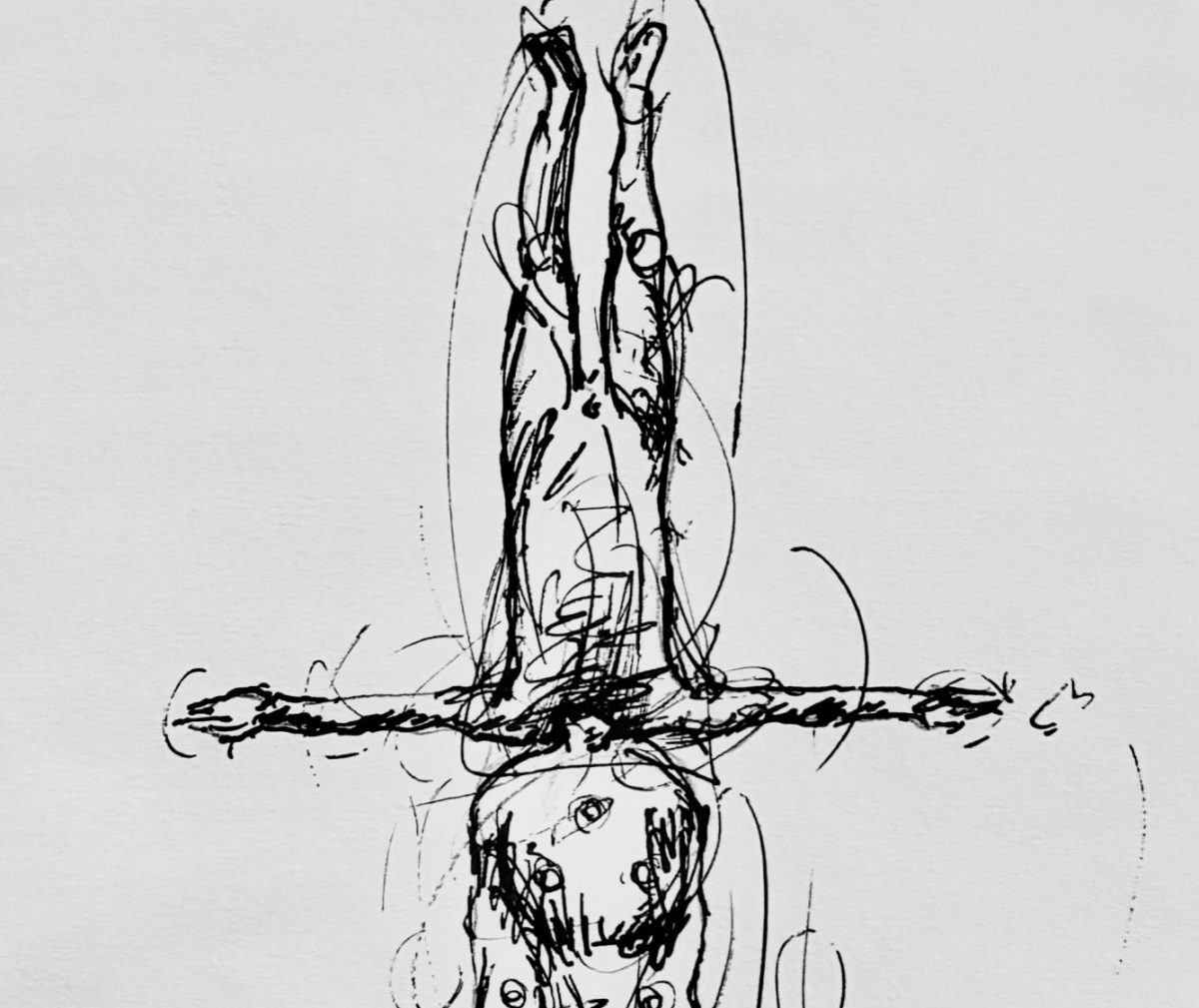
Among these artworks are slightly more unusual pieces. Mansfield’s most famous piece of art is the statue by Antony Gormley in the centre of its geometrically incorrect quad. This statue is called ‘Present Time.’ It is made of cast iron and is based on two moulds made of the artist’s own body. The lower figure, bound and restricted, represents our limited, physical body, while the upper figure, with its outstretched limbs, represents the liberated, spiritual mind.
Although the statue is frequently discussed by students trying to ‘figure out’ its meaning, it is precisely within these discussions that this statue finds new life. It has become an icon of the college, reflecting our eccentricity. It has inspired logos, essays, poems, and continues to be (quite literally) at the centre of college life.
Between Antony Gormley’s ‘Present Time’ and a collection of portraits of non-conformist ministers, Mansfield has managed to fuse modernity with tradition.
This is the power of art.
Art is not static. Art is not one-dimensional. The meaning of art, much like the meaning of words, changes depending on their circumstantial context. The portraits and statues of Oxford, as austere and random as they can be, exist in this space between the old and the new. Like Oxford’s ancient streets and poetic names, they remind us of the city’s vast history, of how far we’ve come, and of how much we’ve achieved. Yet, they are also in dialogue with the students that view them. These portraits are not standards or idols. They do not demand our reverence. They simply ask us to look back at them and to continue their conversations.