
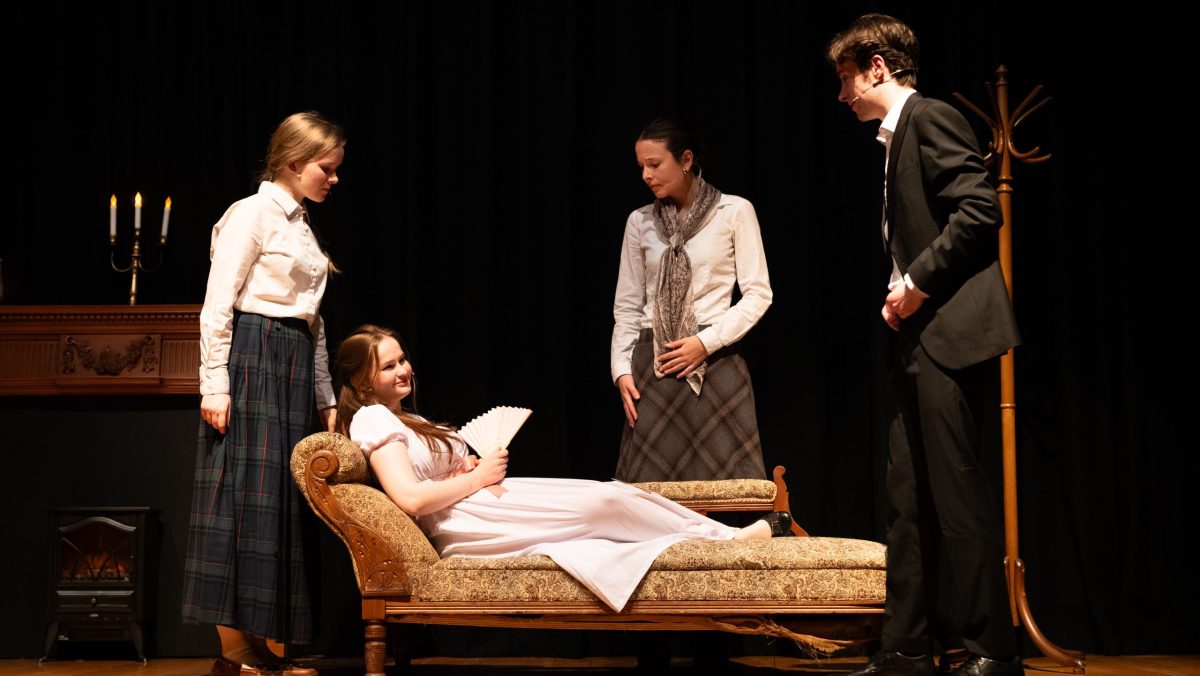
This Hilary has been a very musicals-themed term. I mean, first there was Tick Tick… BOOM! at the Pilch – then, of course, that phenomenal production of Little Shop of Horrors at the O’Reilly. And now, to finish the term in full circle comes Dawuud Abdool-Ghany’s production of Little Women: The Broadway Musical, at Pembroke College’s Pichette Auditorium.
Louisa May Alcott’s classic tale of four sisters discovering love as they venture into adulthood evidently continues to grip our imaginations. While 2019 feels a long way away, now, who can forget Greta Gerwig’s famous period drama? Allan Knee’s musical treatment was almost inevitable. Talking to the director after the show, Abdool-Ghany concurs with me: “I think it is just timeless. That’s clear simply from how many generations this narrative has endured […] I have four siblings myself, so the spats and the quarrelling between the sisters, and also the love and support, is something that I am heavily acquainted with.”
At the heart of the narrative lies Jo (played by Emma Hamilton), an aspiring writer who is a bit of a tomboy (highlighted by her markedly different costume to her dress-wearing sisters) and hates the words “Will you marry me?” Hamilton does the role justice by breathing life and vibrancy into her performance. She was a dynamic stage presence from the very opening minutes of the production, leaping into action (and onto furniture) as she dramatically retells her story to Professor Bhaer (Nikhil Mark). And this is to say nothing of her musical performance: it would be an understatement to say that she knew how to hold her high notes.
Of course, this narrative is about women plural; it would be amiss to neglect Jo’s sisters, who provide differing counterpoints to our irreverent protagonist. Grace Greaves’s performance of Meg was particularly strong. Alcott’s Meg stands apart as the eldest and most conservative March sister, but Greaves lays it on thick to the point that her character appears to be comically naive. Lines such as “I like primitive” and “men are so amazing” live in my head rent-free, and her performance was the source of a good few chuckles from the audience.
On the other hand, Maisie Thorn’s Amy is the least mature of the siblings, and she performs her youngest-child syndrome to comedic effect in the first half of the play. Anna Gillespie’s Beth is a quieter and more measured stage presence – matching her timid character – but with the capacity to surprise, between her impressive piano-playing on-stage and the poignant significance that she adopts in the play’s second, darker act.
There were no weak musical performances – the cast were all strong singers, could beautifully harmonise with one another and were complemented by the efforts of a 14-piece live band (directed by the ever-talented Samuel Tagg). My main criticism, however, is that the choreography of the musical numbers themselves could occasionally feel a tad static – a difficulty which is undoubtedly more of an inevitable fault with the Pichette’s restricted staging space (which I will come back to later!). But this did work well for the more intimate solo or duet pieces of the production.
However, my two personal favourite numbers were far from static. The choreography of ‘Five Forever’ – in which Alex Innes’s Laurie gets knighted as an honorary brother by the March sisters – was one of the most dynamic in the show. In terms of stage presence, I would argue that Innes’s Laurie is the closest match to Hamilton’s Jo, which is quite ironic given the trajectory of the narrative. Innes provides a welcome source of comic relief by investing Laurie’s character with a healthy dose of eccentricity, as he sings about the musketeering adventures that he will have with the March sisters.
The strongest number in the play is the opener for Act II. ‘The Weekly Volcano Press’ draws together the full force of the entire cast of the production, as Jo brings her revised novel (and her more personal tale of bringing it to the press) to life on the stage. From silly duels to evil trolls, this number was as charming as it was thoroughly amusing, winding up to a climax in which the cast sing together, and we get to hear the full synergy across their range of voices. It would have been lovely to have more numbers like this – though I suppose that this boils down more to allowances with the script, rather than the actors’ willingness.
I was intrigued by the staging of Little Women. The transformation of a lecture theatre into a musical stage was (unsurprisingly) a difficult feat, the director tells me: “There isn’t much storage space for one, so it’s very difficult to do intricate set changes”. Consequently, the production embraces a minimalist set. Throughout the drama, the audience’s focus is drawn to a few, period-appropriate props: an easy armchair, a coat hanger, a fireplace, a piano. “Little Women really lends itself to a more minimalist aesthetic. A lot can be done with a little,” Abdool-Ghany states. I would concur: the staging space enabled an intimate atmosphere, befitting the tone and theme of Little Women. The actors encouraged us – in a manner highly reminiscent of Jo’s storytelling – to constantly re-imagine the set, even while its features stayed the same: at turns, this living room became a ballroom, a beach, and finally, a wedding. Credit, here, is undeniably due to set designer Jessica Rodrigues.
Pembroke’s drama scene does not get nearly as much attention as it deserves (especially compared to, say, its rowing culture…), but this year’s iteration of the college’s annual musical rounds off this musical term in style. Abdool-Ghany’s Little Women makes for a charming adaptation of a charming adaptation of a quintessentially charming novel – and he, alongside the cast and crew of this accomplished production, should be proud of their hard work.
[Little Women, staged by Pembroke College, is running at the Pichette Auditorium, 3rd – 6th March, 2026.]