
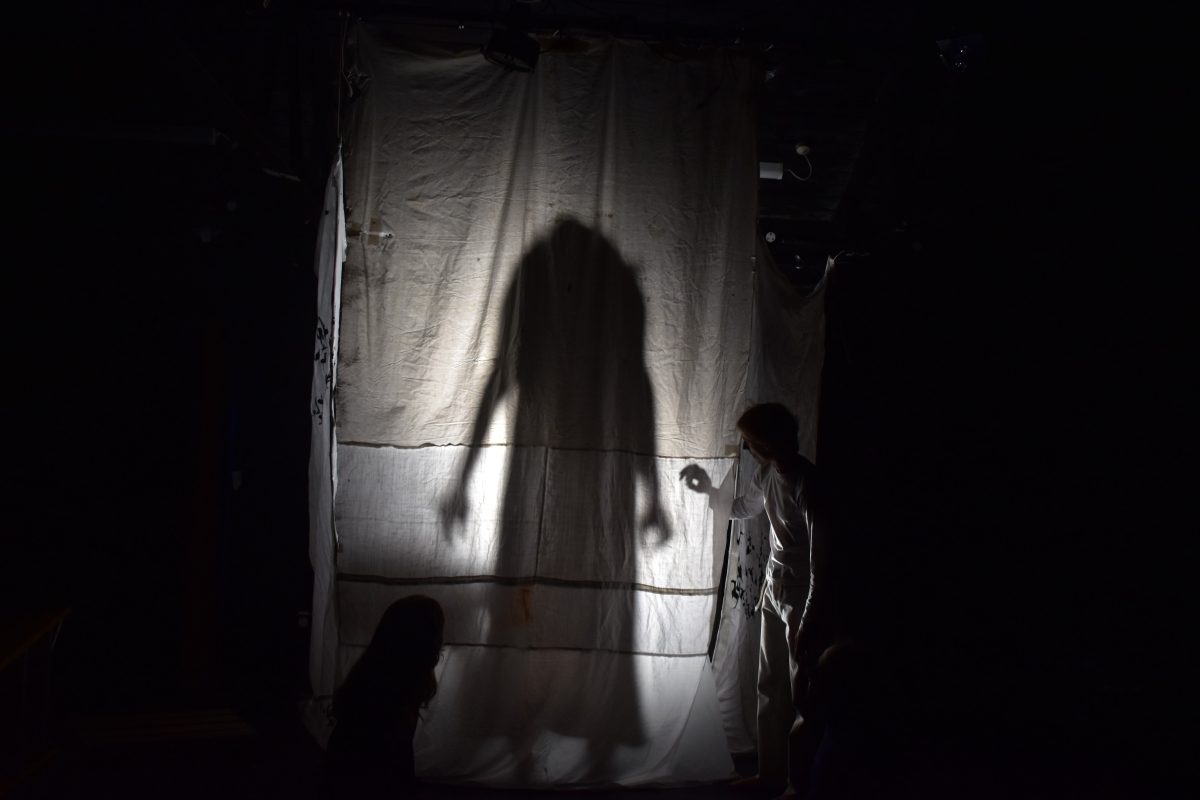
Pecadillo Productions’ The Harrowing of Hell.26 plunges the audience into the fiery depths of Hell. Well, into the Burton Taylor Studio in Week 6 or the St Peter-in-the-East’s Crypt in Week 7. Méryl Vourch’s adaptation tells the story of Christ’s descent into the underworld to reclaim trapped souls, a sidequest he (is alleged to have) completed in the interim between crucifixion and resurrection.
Vourch’s creation is an adaptation of a narrative found in all four of the main English mystery plays, so-called because ‘mystery’ historically refers to ‘miracles’ (the content the plays were concerned with) but also to ‘guilds’ (the people who put the plays on). Think: the York Cycle, Chester Cycle, Wakefield Plays, or N-Town Plays. These plays staged scenes from the Bible in tableau fashion with accompanying music. Each mystery play differs in content but they all contain the most iconic scenes (the Nativity, Noah and the Flood, Cain and Abel). Traditionally, a designated guild would take responsibility for one of the 40 or so plays. The saddlers, who crafted and repaired horse saddles, would have been responsible for The Harrowing of Hell. Evidently a unique passion project, this is a play seemingly destined to please critics.
On entry to the Burton Taylor Studio, I was confronted with a wall instead of the expected black box performance space. Vourch dispensed with a standard layout by divvying up the BT into a small corridor on entry and a rectangular stage space flanked by the audience. Morton-Wright’s set design reflected — shock! — the layout of a chapel, with a tall white sheet hanging in place of an altar. At the narrow entryway to the ‘chapel’, I was blocked by two cast members who asked me a fantastically eerie question: “May we wash your hands?”
I assented, and water was poured over my hands from a tall, hefty jug over a brass bowl. How quaint and reverent! It was exciting to see the same bowl used in the play when Satan is trying to ‘cool’ down by towelling himself. I was delighted that audience experience was been considered and incorporated into the performance. Having been baptised on entry, I was excited as I dried my hands and took a seat, spotting four cast members (the two devils, Adam and Eve) seated amongst the audience.
Unfortunately, my excitement didn’t last long. The Harrowing of Hell.26 centres on a fundamentally good idea but is executed with a poor understanding of what an audience finds engaging. This was labelled as an ‘adaptation’, but I struggle to identify much about this production that was actually altered to suit a twenty-first century audience. Even the language, adapted from middle English, is labelled in the show’s leaflet as contemporary but sounded Shakespearean; for example, the devils taunt Adam and Eve in a curiously animalistic rhyming chant that I’m sure Caliban could relate to. More fundamentally, what was I supposed to care about? Who was I supposed to root for? It’s one thing to disorient your audience, but another to disregard them entirely in favour of needless exposition of stories that enjoy relentless worldwide fame.
There were moments of extreme interest that were neglected in the abstract sweep of the action. For instance, Satan has some massively endearing lines in response to Christ’s abduction of the inhabitants of hell. “They’re not yours to take” and “Don’t leave me here, alone” hinted at a complex emotional life ripe for exploration. How does Satan respond to isolation? I applaud Vourch’s identification of this dynamic, and only wish it had been explored properly. In another instance, the devils mock Adam and Eve in a chattering line “you filthy piece of filth”, which should be hilarious and made clear how dreary the straight-laced delivery was. Actors had evidently been told to try and put the audience on edge, but the scare actor approach was far less engaging than comedy could have been.
Satan (Thomas Arensen), costumed in laid-back white jeans and tee, is the first character we meet. Arensen is indeed as sophisticated and captivating as one Oxford Blue review recently claimed. His ability to embody the mental and physical decay of Satan was impressive, juddering and shaking as if possessed by some poltergeist. Arensen is entirely natural and completely absorbing, with masterful control over volume and physicality. He was the beating heart of the show.
Christ (Ian Machalek) delivered his first lines – a long monologue instigated by a ghostly gasp – from behind a sheet, and despite the weakness of the lines managed to be engaging. Like Satan, who is imagined as a sad victim of Christ’s bolshiness, Christ gets a rebrand: he’s an intimidating, brash, and even arrogant presence, throwing his cosmic weight around where he doesn’t belong. Machalek fit the bill perfectly, and his talents managed to keep me entertained even through a sheet and heavy-handed dialogue.
The narrator (Patrizia Hinz) delivered several deadpan expository monologues about heaven and hell that were apparently deemed necessary, serving only to delay the interactions that actually progressed the story. The two devils (Elizabeth Henderson-Miller and Sonny Fox) were quite magnetic. I would have found the action quite difficult to follow had it not been for their context-providing reactions. Writhing around the stage is never an easy feat, and both actors are certainly to be commended on their physical commitment to the vision. Eve (Anastasija Vidjajeva) and Adam (Caleb Silvergleid) were grounded and reliable forces who led the devils in a sequence of abstract rhythmic dancing that communicated their entrapment beautifully. Antoinette Cheng’s soundscape is bizarre and dislocated, sparse but evocative; the sound of Satan’s teeth grinding in one of the opening scenes provides a xylophone-trill-type motif picked up by other percussive elements in later scenes. Heather Stokes’ lighting is similarly subtle, tinged red or blue, save a strobe sequence that accented a moment of high emotion.
Ultimately, fealty to the cold hard facts of the harrowing plot was prioritised at the expense of emotionally interesting interactions. I found my attention continually adrift as the talents of the cast were buried beneath drab dialogue. I felt patronised by the narrator, who continually explained things that were entirely self-evident. In the moments I wasn’t absorbed by Arensen’s or the cast’s talents, I was bored.
A leaflet promises that the play ‘explores domination, dependency, exhaustion, and the unsettling question of whether salvation can itself become a form of violence’. With the exception of the fantastic blocking and use of space (what I might call the ‘domination’ of the stage), I can’t say the production achieved any of its aims convincingly. Nonetheless, I’m still excited to see someone working with this unlikely source material, and I am inclined to be impressed by anyone who manages to put together a coherent show amidst a busy Oxford term.
You might think I’ve been spoiled by energetic, charismatic, funny adaptations of hell that treat the viewer as an equal, as was the case in Disenchantment (2018) and The Good Place (2016). If that’s the case, then I intend on going on being spoiled. Who knows, the possibility remains that the show might kick up a more entertaining fuss in its second run (or resurrection) at the Crypt next week.
[The Harrowing of Hell.26, staged by Pecadillo Productions, is playing 2nd-6th June at the Burton Taylor Studio and on 9th-11th June at St Peter-in-the-East’s Crypt.]