
Harold Pinter’s The Birthday Party is nothing short of an engaging, yet ambiguous, play. It is ambiguous in the sense that it leaves the audience with dozens of questions, and I found this to be the main theme throughout. This production was a thoroughly enjoyable work in portraying this comedy of menace in all its complexities and humorous contrasts.
We are introduced to the boarding house of an older couple, Meg (Cait Kremenstein) and Petey (Charlie Heath), and their long-term boarder, Stan (Rufus Shutter). Kremenstein portrays Meg’s partly maternal, partly flirtatious attitude towards Stan, who contradicts this with a harsh sarcasm. Stan’s attitude shifts, however, on the news that two men are coming to stay in the boarding house, of which he is immediately suspicious. The subsequent arrival of the men, Goldberg (Will Hamp) and McCann (Seb Foster), sends the play spiralling into an increasingly sinister series of events, culminating in an unsettling game of Blind Man’s Buff.
The play is characterised by the ambiguity of its characters and the sharp contrast between its well-expressed comedy, its darker themes, and its sexist undertones. By having only six characters throughout a ninety-minute play, I expected to be able to understand what each character represents, and about their role in the play. However, this play successfully makes its audience unable to pinpoint the characters’ true natures and intentions, which captured my interest throughout. Even from the first scene, Meg’s attitude towards Stan raises questions. In the way she speaks about him before his first appearance for instance, I found myself questioning her relationship to him. Kremenstein is impressive in her portrayal of this character, as Meg’s overbearing nature is depicted strongly in both words and behaviour.
Yet, it was Goldberg’s character that I found the most intriguing. Hamp was admirable in his portrayal of Goldberg, coming across well as a wise older man. He fascinatingly combined his charisma and charm, with, at times, an authoritative and dominant side. His double act with Foster’s McCann perfectly combines comedy with fear, as their cryptic, rhetorical questions in confrontations with Stan and Lulu (Amélie Rosner) leave their audience in suspense. Their dual scenes, in which they challenge Stan’s stories of his past, were my favourite scenes of the play, as they bounce off one another in an amusing and genuinely compelling manner. An interrogative “Why did you betray the organisation?” into a yelled “Why did the chicken cross the road?” conflicts the audience whether they should gasp or laugh, especially while Shutter’s Stan gives a remarkable transition from fear into mental collapse as a result of Goldberg and McCann’s actions.
To take this further, Stan’s shift is also portrayed in his costume. Beginning the play disheveled, he ends it in a suit in the style of Goldberg and McCann, who have pushed him to join their side. Shutter’s performance of Stan’s character development is commendable, in which he changes from simply a rude boarder, to a nervous wreck, before he finally snaps. Nonetheless, even before this, I found it interesting to note the ambiguity in Stan’s, Goldberg’s, and McCann’s identities. As outsiders to the boarding house, their histories are largely unknown and up to interpretation, which prompted much discussion after the play’s end. Goldberg refers to himself with a myriad of different names – Nat, Simey, Benny – and Hamp’s charm plays off this discord to the other characters. The same is true for McCann, who Stan insists that he recognises from Maidenhead. However, he denies this, and Foster presents himself in a far more intimidating manner, distinct from the anxiety that was expressed earlier in the play. It was this notable change that drew my attention to the depths of McCann’s character: he is far more than just Goldberg’s anxious sidekick.
Still, one of the most interesting aspects of the show was the uncertainty in the title itself. I went into the show blind, expecting only for it to be someone’s birthday party. Yet, Stan denies it is even his birthday throughout, whilst every other character insists that it is. This embodies the themes of the show, as Goldberg and McCann are resolute that he needs a party, and express this with threatening undertones, frequently referencing a “job” they need to do. Both their purpose in the boarding house – which they claim is for a holiday – and the description of Stan’s own past as a piano player remain vague. Alongside Stan’s hazy relationship to Goldberg and McCann, these leave the audience not knowing the intentions and secrets of the characters: they are strongly implied, but never clarified.
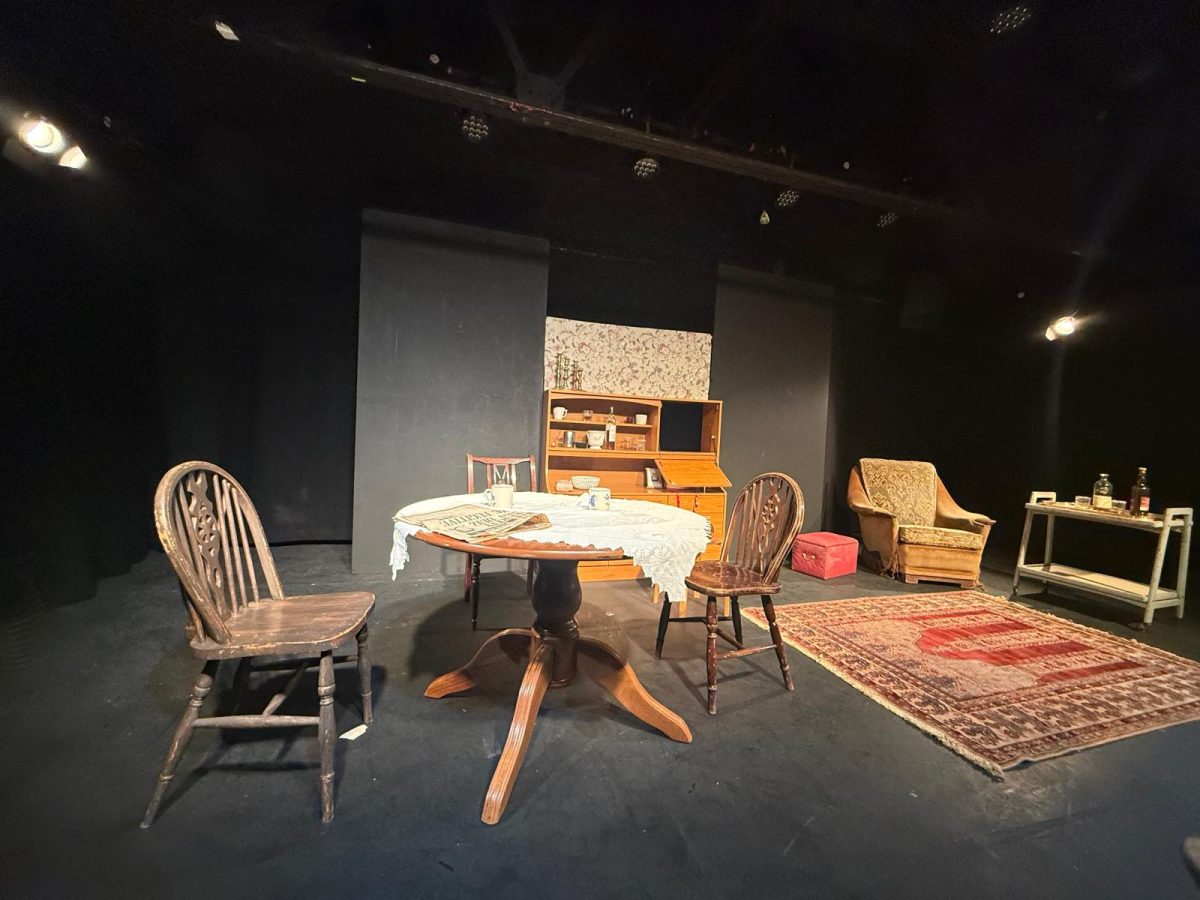
Lastly, the set was usefully employed to advance the menacing undertones of the play, with the trapdoor to the kitchen employed to dramatic effect. Similarly, Meg’s emphasis on the tidiness of the house for the visitors adds to the presentation of the play as, on the surface, a harmless comedy in a harmless 1960s seaside town. That said, the use of lighting throughout the production was interesting, as it is used to highlight Stan. When McCann’s torch shines on him alone, his deterioration is (quite literally) highlighted. Once the lights disappear completely, so does his sanity. This is particularly impressive in the Burton Taylor Studio: the audience’s proximity to the stage made the production feel more intimate, as they were fully able to take in the performance and see Stan’s transition close-up.
As it plays with the conflict of humour and fear, The Birthday Party is an excellent production that keeps its audience engaged, wondering, and brimming with questions and discussion upon its cyclical ending. This production makes for an intriguing interpretation of Harold Pinter’s classic comedy of menace, and a strong depiction of its ambiguous nature.
[The Birthday Party, a play staged by Postbox Productions, runs at the Burton Taylor Studio, 5th-9th May, 2026]