
[cw: suicide]
Have you ever laughed at Antigone? No, probably not—you’re probably a good person who doesn’t find tragic deaths funny. I was too until I saw The Anti-Gone, the eccentric collaboration project of Atelier V and Carfax Productions. Director Marcus F. P. succeeds in turning Sophocles’ ‘horrid little play’ into a cynical fin-de-siècle tragicomedy bursting with blithe bathos.
The Greek play of 441 BC follows the consequences of Antigone’s decision to defy her uncle, Creon. Prior to the play’s action, Creon’s nephews, Polynices and Eteocles, die on opposing sides in Thebes’ civil war. Eteocles, who fought with Creon, is to be buried with full honours; Polynices, who fought against Creon, will be left unburied.
Antigone, however, decides to perform burial rites for Polynices, and Creon condemns Antigone to death. But after hearing a terrible prophecy from Tiresias, and the desperate pleas of the Chorus, Creon relents. His repentance, of course, comes too late: Antigone has already hanged herself. Worse still, Haemon, Antigone’s betrothed and Creon’s son, has taken his own life on discovering Antigone dead.
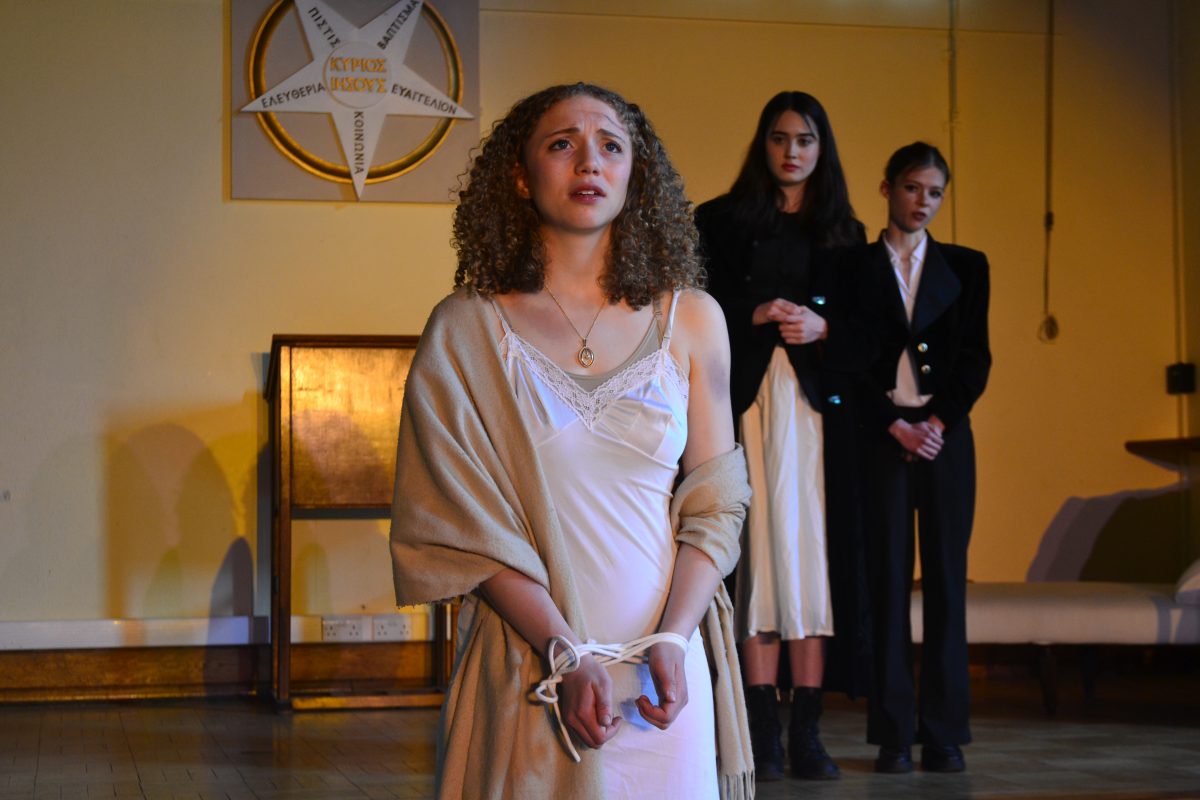
Atelier and Carfax’s reimagining follows Sophocles’ main contours, but makes three major changes to Sophocles’ play. The most important of which is the relocation to 1890s London. The result is a striking shift in tone, best summarised by one audience member at the end of the play: ‘I wasn’t sure whether I was supposed to laugh or cry?’ The answer was both. Seeing Greek tragedy fused with comedy of manners was not on my generic-mashup bucket-list, but Anti-Gone (miraculously) manages to make the two genres seem like strange but resonant bedfellows. Witty and artificial, the cast spoke in the exaggerated RP and hiccups of the upper-class. The cast were styled in period costume by Rowena Sears: think tailcoats, hats, bow-ties, frilly shirts, and opera gloves.
Another key change was the decision to gender-swap Antigone’s uncle Creon into aunt Creona (played by Rosan Trisic). Oftentimes, a gender swap entails nothing more than the added ‘a’ on the end of the male name, but in The Anti-Gone Creona’s gender is properly and skillfully woven into the plot. Creona is keenly aware of her status as woman, pointing it out in moments of conflict, especially in the much-altered interaction with her pleading son Haemon. Aphorisms about ‘men’ were oftentimes switched to ‘women’. Despite such skillful handling, I do remain skeptical that it is possible to retain the essence of Antigone when the gendered element to the conflict between Creon and Antigone is replaced by internecine female strife, which is an altogether different dynamic. Likewise, the dynamic between Creon and his citizens, as opposed to Creona and her citizens, is also very different: Creona suffers double-damage as a woman and tyrant, as opposed to just the latter, and her vulnerability as new leader is therefore far greater. Neither of these issues were properly reconciled, presumably due to the sheer size of that can of worms which would threaten to undermine the whole operation.
The final change of significance sees Eurydice, wife of Creon, dispensed with in favour of focusing on Ismene (Kitty Brown). Ismene takes her own life in the final moments of the play, as Eurydice does in Sophocles’ play. Despite what are quite monumental changes, the story manages to remain mostly faithful to Sophocles’ play, whilst embracing Marcus F. P.’s 1890s high-society vision.
Music Director Richard Meehan has cooked up compositions that veer towards the ominous. The chorus, consisting of a choir alongside an ensemble, provided exposition punctuated by a militaristic trumpet (Mark Murphy) and marching drum (Laurence Britton). Three bass singers (Jake Pawson, Adam Vasilko, and Ben Tribe) huddled around a mic to produce evocative prehistoric vocalisations that mirrored the discordance of the action.
Rosan Trisic as Creona was a force of nature with considerable range. From Clinton-thumb wielding tyrant (‘These are my principles.’) to upright, intimidating mother, Trisic’s Creon(a) was a pleasure to watch. In her final moments onstage, Creona meltdowns over the bodies of Ismene and Haemon. Seated less than a metre away in the front row, I found my pen had automatically ceased scribbling down feverish notes to allow my eyes to absorb every possible second of Trisic’s effervescent outpouring of grief. At one point, mourning over the bodies of Ismene and Haemon, amidst fountains of tears, a string of snot dangled from the actress’s face as she screamed in pain, finally dropping into a tiny puddle on her skirt. The fact Trisic accomplished all of this whilst cheeky, cynical commentary was issued from the Wildean inserts was all the more impressive. Lady Sentry (Rachel Wade) jokingly navigated stepping over the bodies of Ismene and Haemon, issuing poorly crafted reassurances, as Creona cried hysterically.
Meanwhile, Rose Hansen’s talent is also undeniable. Hansen’s Antigone was optimistic and brave, her monologues piercing and moving. I must commend the direction that saw Antigone, indignant, cast her ambitious eyes to the stars, while Ismene kept her eyes resolutely fixed on her sister. I was, however, slightly disturbed by Antigone’s mischievous smile after admitting to performing burial rites (read: ‘I did it.’ [smirks]). Sophocles’ Antigone’s actions are born from orthodox diligence to the gods and ferocious loyalty to her brother, not from some kind of actively curated renegade spirit. To me, therefore, her smirks came across as inappropriate and wince-worthy, similar to Debby Ryan’s infinitely memed Radio Rebel smile.
Nonetheless, Hansen and Brown conveyed the sibling dynamic endearingly, and both delivered good performances overall. Brown’s Ismene was appropriately composed, the perfect foil to Hansen’s energetic and at times explosive Antigone. There’s not much to be said for the strange chaise scene between Ismene and Haemon (Sonny Fox), in which Ismene is bizarrely enamoured with Fox’s smarmy, rakish Haemon. Fox shone most in his scene with Creona, where his Haemon oscillated between didactic mansplainer and cringing weakling.
The unexpected but brightest star of the show was Wadie as Lady Sentry, a minor messenger character adapted to fulfil a bigger role as both messenger and chief comedian. Wadie was born to play the high-society woman of intrigue, delivering lines that dripped irony with a delectable quippiness. Reporting Polynices’ unauthorised burial, Lady Sentry says: ‘The body. Someone’s buried it. Surprise!’ Wadie’s movement and delivery made an often static stage come properly alive, and her performance was regularly rewarded with (increasingly less confused) audience laughter whenever her character arrived to introduce bathos into bleak moments, usually by pouting (or mewing?) mid-sentence.
The pair of leading Chorus-members-turned-aristocrats, Lady Smythe (Sophia Lee) and Lord Fothergill (Ellie Dinning), kept audiences engaged with metatheatrical witticisms, jesting at the Chorus, characters, and anything else with a pulse. Smythe and Fothergill’s cynical commentary and metatheatrical detachment from the action made the audience feel a sense of tacit complicity. For instance, the pair joke about the Chorus, a feature of Greek drama usually considered too anachronistic and obsolete to stage: ‘Oh God, they’re going to sing again. One can only bear so much moralising.’ The conflict generated was engaging: far from a self-conscious nod to potential anachronism, this expert deployment of metatheatrical commentary was confident, and perfectly conveyed by Lee’s and Dinning’s vivacity. A brief cameo from a limping, grunting Tiresias (Ali Khan), painted ghost-white and only half-clothed in a tattered priest’s cope, legitimately horrified the audience.
Bordering on sacreligious, decidedly silly, and sometimes solemn, The Anti-Gone is more phenomenon than mere production. In the show programme, its director teases: ‘Surely it is impossible to laugh at a play this bleak?’ I’m more than happy to report that not only is it perfectly possible, but that I, along with the rest of the opening night audience, laughed pretty damn hard.
[The Anti-Gone, a collaboration between Atelier V and Carfax Productions, ran at Helwys Hall, Regent’s Park College between the 2nd and 3rd of May, 2026]