


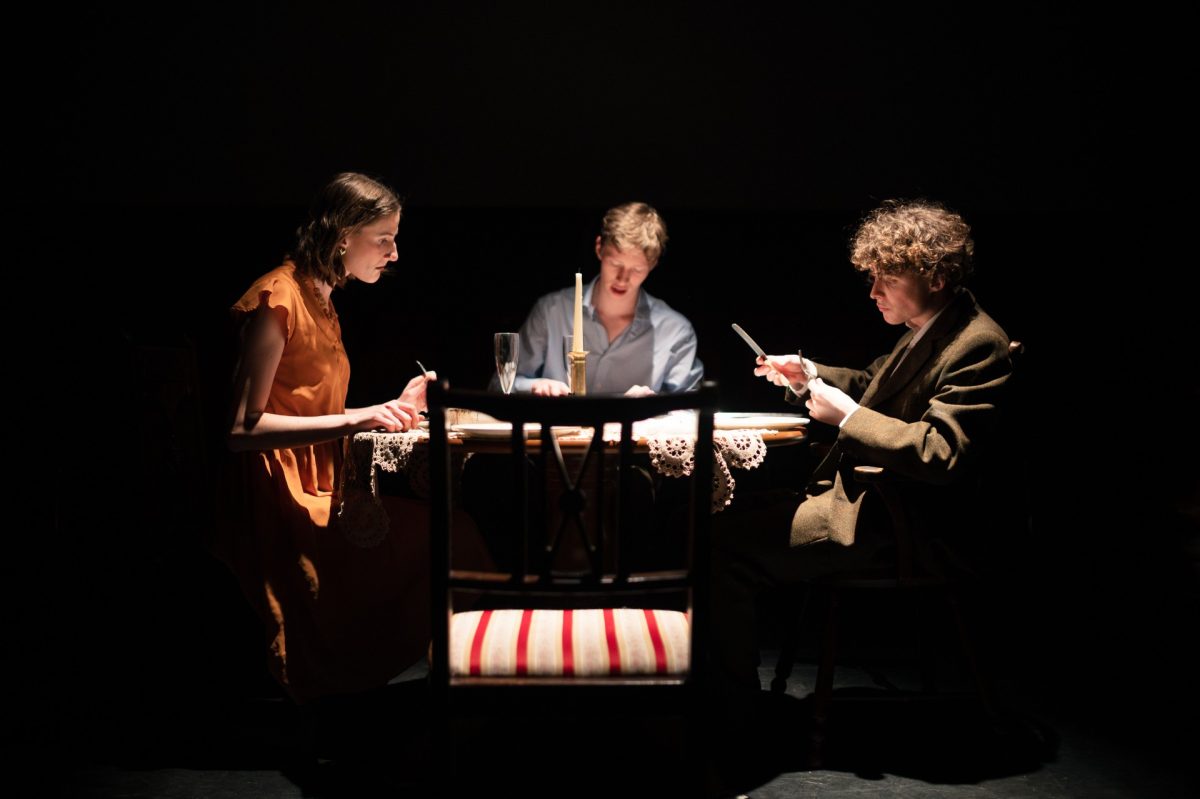
Tennessee Williams’ The Glass Menagerie, staged by Crazy Child Productions, is a small, quiet kind of tragedy. References to Guernica, to war, leave us with a tentative hint towards the wider world it is a part of; but the disappointments of its protagonists, the Wingfield family, occupy us entirely.
It is a family situation explained in extensive detail by Tom Wingfield (Oli Spooner) in the play’s opening. A long-absent father; a reclusive sister; a domineering mother; and Tom, the prototypical frustrated artist working an unfulfilling job at a shoe warehouse. The play draws on autobiographical details from Williams’ own life, and Tom impresses upon us in his opening monologue that this story is a memory, his memory, and so may not all be true. It’s a gambit slightly complicated by Tom’s long absence from the second act, but the retrospective focus adds a sense of resignation to proceedings that complements the action we see.
The tensions between the family members are clear from the outset, as Amanda (Lyndsey Mugford) snipes at her son for his rushed eating. Mugford delivers an excellent performance as the harried, over-involved mother. A former Southern belle, she is in many ways the most charming of the play’s four characters, and at the centre of almost every laugh of the night. Her catchphrases (‘Rise and shine!’) and hectoring manner are balanced by enough moments of genuine happiness and love for her children to ensure we see a softer, more human side to the person Tom feels is suffocating him.
Amanda’s quest in this play is to secure a ‘gentleman caller’, that most elusive of specimens, for her daughter Laura. (Although I must note her penchant for calling Laura ‘sister’ made the first minutes a little confusing.) Laura (Matilda Beloou, in her second role with the company) seems to have a clubfoot, definitely a limp, which Beloou portrays convincingly through her movement quality. The character is withdrawn, contemplative, and, as every other person in the play says, ‘different’. Despite Tom’s status as narrator, and indeed the vitality and dynamism of Spooner’s performance, it is Laura’s perspective that is most baked into the play’s structure.
The Keble O’Reilly is organised in the round, a very different, more enclosed space partially thanks to the wall formed by the unused top bank of seats. It is a quite brilliant choice by directors George Robson and Magdalena Lacey-Hughes, although it did take until the second act for me to properly immerse myself in the production as a result.
It is an effective choice for two reasons. The first is to do with Tom. As mentioned, Spooner is a frenetic performer, a highlight being the moment Amanda questions her son on what exactly he does when, every night, he leaves home to ‘go to the movies’. Spooner bursts into life here, dancing across the stage as he spits his mother’s worst fears back into her face in an act of brutal mockery. His energy infects the stage: because the audience is on every side, everything is in constant motion. Credit here goes to the play’s extensive set department: designer Patryk Wisniewski, as well as Loris Avery, Olivia Hargreave, and stage manager Méryl Vourch. Chairs, tables, seating arrangements are all constantly on the move, as when Tom and his mother circle the room in their eventual heart-to-heart. This restlessness is at the centre of his character arc, though it could have been enhanced by contrast through the inclusion of the never-moving portrait of the Wingfield patriarch which the script references. It is the father who provides the reference point for Tom’s character, as demonstrated by Tom referencing him as one of the play’s five characters in his opening monologue. Not including his portrait lessens the (still-present) sense that even he, in his artistic individuality, is merely taking one step after another on a long-predetermined path in life.
The second brilliance of the staging relates to Laura. She is the owner of the eponymous glass menagerie, a collection which has to be admired by making a conscious choice to look into the transparent, rather than through it, to see the depth in something that seems shallow. It is this ability that most sticks with Tom in his poignant final narrator’s speech. And it is an ability the staging forces us as audience to cultivate, ably helped by the lighting (courtesy of Wisniewski and lighting assistant Cohen Rowland). Though some lighting shifts were occasionally abrupt, the design throughout was excellent, especially the use of an overhead spotlight to physically contain the action at particular moments of tension. The wire animals hanging overhead, meanwhile, are the subject of a genuine moment of wonder at the play’s end (I will say no more). Washing in and out between scenes, the lighting also carries Laura’s stillness into the play’s architecture, as the set’s movement does for Tom’s restlessness (though it did mean the interval was slightly unclear).
The play’s second act picks up the pace of the plot a little, as the elusive gentleman caller finally arrives in the form of one of Tom’s colleagues at the shoe warehouse. Jim (Charlie Bach) is a warm, affable presence on stage, shaking hands with the audience as Tom (in narrator mode) introduces him, and generally radiating contentment. That is somewhat of an act, though, as we learn in his conversations with Laura. The two actors give the pair a great, if slightly troubling, dynamic. Beloou captures Laura’s tenderness as she hesitates between timidity and quiet happiness, while Bach is a commanding presence (thanks no doubt to Jim’s public speaking classes) as a slightly washed-up former high school darling.
Jim hovers on the line between empowering and dominating, an American dreamer flying a little too close to the sun of his ego. He is just like every other character in that respect: the Wingfields, too, hover precariously between hope and despair. Money troubles cause the power to be cut while the four have dinner, resulting in a quite exceptionally-executed candlelit sequence, which everyone involved is to be commended for. It was a formidable display of ambition on the directors’ part, and paid off magnificently. Spooner put out one of the candles while trying to light a cigarette, in a presumably accidental but very fitting moment where the fragility of the social situation in the play became reflected in the fragility of the performance itself.
The Glass Menagerie is, as I’ve said, in many ways a small play. Its action is rigidly contained, its plot essentially just a slow breaking-down. But Crazy Child Productions have given this classic text an excellent presence on the stage. This is a considered, confident production, and demonstrates the company’s assurance following last term’s Creditors. I await their next contribution to the Oxford theatre scene with anticipation.
[The Glass Menagerie, staged by Crazy Child Productions, is running at the Keble O’Reilly, 4th-8th February, 2026.]