


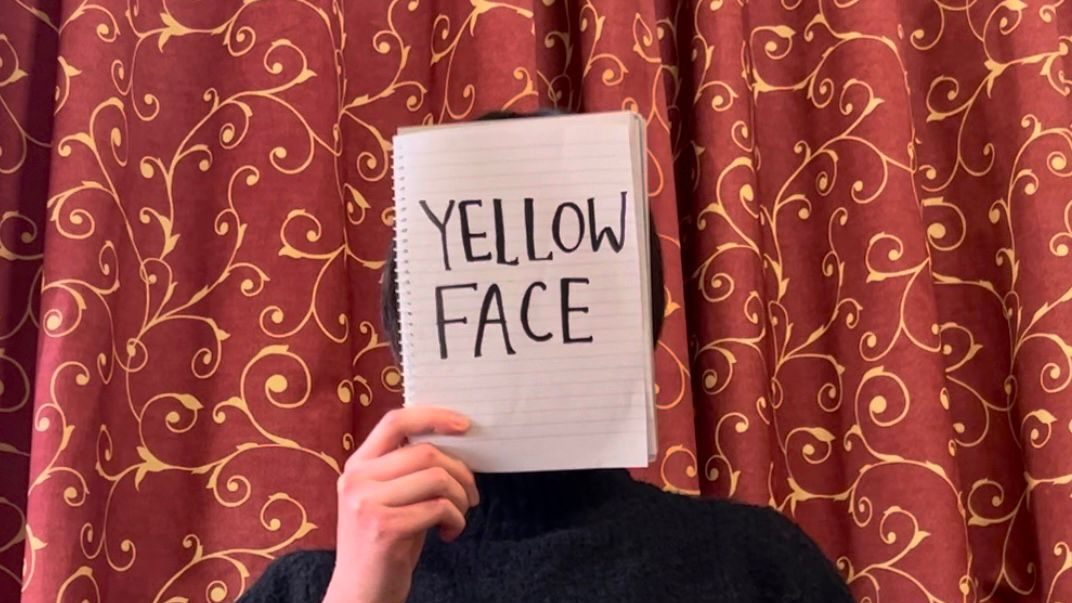
Violet Wan discusses David Henry Hwang's Yellow Face and identity under commodity culture.
“As much as race was a construct, wasn't comparison to the racist practice of 'yellow face' an insensitive exaggeration that minimised the systematic power imbalance that still existed between White and non-White people in the USA and many other Western countries?”
Image by Violet Wan, used with permission.
[Spoilers for Yellow Face (2007)]
During the winter break, in preparation for my English Lit 20th-century paper, I read David Henry Hwang’s 2007 play Yellow Face. Having read and loved Hwang’s breakout play M. Butterfly (1988), which viciously interrogated racial/gendered dynamics, Orientalism and self-deception, I had high hopes going into Yellow Face. I found myself coming away with a bad taste in my mouth.
Yellow Face is a semi-autobiographical play in which the protagonist, David Henry Hwang (henceforth DHH, the character rather than the playwright), unknowingly casts a White man, Marcus, as an Asian character in his new play. After realising his mistake, DHH fires Marcus, but not before lying about the latter’s “Siberian Jewish” heritage in order to save face.
To DHH’s chagrin, Marcus continues to publicly claim Asian ancestry and play other prominent Asian roles in the national theatre scene, telling interviewers about the “responsibility” he feels as an “actor of color” to “be true to his or her community, to make sure we only put out positive images.” Marcus even starts preaching “collective empowerment” to an incredulous DHH (“You’re lecturing me? On how to be Asian?”), explaining (Whitesplaining?): “David, are you familiar with the Chinese concept of ‘face’? […] Basically, it says that the face we choose to show the world—reveals who we really are. […] Well, I’ve chosen my face. And now I’m becoming the person I’ve always wanted to be.”
Later in the play, during legal investigations targeting Asian-American donors of presidential campaigns, Marcus finds himself under scrutiny. Henry Yuan Hwang, DHH’s father and founder of Far East National Bank, also comes under fire. DHH is invited to an interview about this incident and asked about his position on the Directorial Board, which had been revealed earlier to be a position he briefly took for financial reasons after the failure of his last play. To my growing dismay, DHH himself begins throwing the same diversity buzz-words that Marcus spouts mindlessly—”it was as if the voices of my ancestors rose up, telling me it was my filial duty—to join the bank board.” “I also felt a sense of responsibility to the Chinese American community.” “As Chinese Americans, we need to empower ourselves.” “[D]ig deep into the American psyche, dispelling stereotypes, creating positive images.”
Eventually, in order to stop the McCarthy-esque “American purge” against Asians, DHH and Marcus come clean about the latter’s Whiteness, the reasoning being that it would expose how “idiotic” the plan to “find evil Chinese spies” was, since it would end up targeting “a regular American.” This somehow… works? (Even now, I’m skeptical. How likely is it that racial persecution on a systemic level can be stopped by embarrassment? Institutions seem remarkably resistant to shame these days.)
Anyhow, the scandal blows over. But there’s a final twist—DHH turns to the audience, and says, “Marcus is … a fictional character. Created by me.” By way of explanation, he continues: “Years ago, I discovered a face—one I could live better and more fully than anything I’d ever tried. But as the years went by, my face became my mask. And I became just another actor—running around in yellow face.”
Profound, right? Hwang had contested the boundaries of race, exposed it as an unstable category vulnerable to exploitation and capitalisation by people both inside and out of those boundaries, and shown it to be a kind of persona bound to complex sets of narrative rules that acted as both constructive scaffolding to the individual and community, but also as a cage. It was bold and meta-theatrical and subversive. Or was it subversive?
Hwang’s actual execution of that intended subversion irritated me to my core. The fact that DHH could even use that Asian-American persona to his advantage (or, to avoid blame in his interview) was because of the enormous privilege he wielded—both his socio-economic class and social prestige as the son of the (albeit self-made) founder of a successful bank and a well-known playwright with “Asian”-ness built into his brand. And that brand was not accessible to or profitable for the many other Asian-Americans he claimed to be in community with. Also, what kind of message was the play sending to less tolerant audiences? Wasn’t Hwang perpetuating the myth that racial oppression wasn’t a real issue, that it was only a “trendy” talking-point for non-White individuals to get opportunities as “diversity hires” and avoid accountability? And, as much as race was a construct, wasn’t comparison to the racist practice of “yellow face” an insensitive exaggeration that minimised the systematic power imbalance that still existed between White and non-White people in the USA and many other Western countries?
To borrow Jordy Rosenberg‘s phrase: “The whole thing had been so petit bourgeois (I thought to myself, petit bourgeoisely.)”
The fact was, I was so terrified and preoccupied by the potential of “bad representation” (the opposite of Hwang’s “positive images”) that I bulldozed my way through my own feelings of squeamishness with, ostensibly, critique. It was not until I read Brandon Jacobs-Jenkins’ lecture-parody I Promise Never Again To Write Plays About Asians (2012) a few days later that I could even see a large part of why I was discomfited at all.
I Promise Never Again To Write Plays About Asians, labelled “a lecture/play for a very young actor-playwright” by Jacobs-Jenkins, is a long monologue delivered by an actor-playwright who claims to have been writing as Branden Jacobs-Jenkins, explaining that such writing had been part of a “social experiment with ethnographic elements” in which he assumed the roles of “conceptual playwrights” of different ethnic identities. The actor-playwright character, a self-identified “critical theory junkie,” condescendingly explains his undergraduate academic work in media studies, particularly mentioning David Henry Hwang and cultural critic Rey Chow. According to the character, Chow’s The Protestant Ethnic and the Spirit of Capitalism expands upon questions of identity:
“…honestly, she’s just interrogating uses of the idea of “ethnicity” itself as a kind of commodity. […] in what are artistic claims of resistance by an ethnic group on the basis of their ethnicity complicit with the macro social structures that created the very category of ethnic subjects themselves, e.g., capitalism?”
(Was it embarrassing to unironically glean critical-theoretical insights from a piece that, at least partially, pokes fun at critical theory? Probably. But embarrassment appears to be the structuring principle of my musings on identity in general.)
A week or two later, I was invited to interview at the Oxford Blue for the position of Junior Editor for the Culture section. During the interview I was asked to pitch any ideas for the publication, to which I offered up a half-baked proposal of asking people about their favourite pieces of media in their own native language.
“It’s inspired by my own experiences, kind of, in trying to reconnect with my own—heritage…” I was cringing at myself already, but I found myself barrelling on: “Over the summer I tried to watch more movies from the 90s in my mother tongue, and it was kind of nice getting in touch with my roots since I’m, um, from [redacted].”
I sighed internally. I kept talking, but the question had crept its way to the forefront of my mind: in what ways are artistic claims of resistance by an ethnic group on the basis of their ethnicity complicit with the macro social structures that created the very category of ethnic subjects themselves, e.g., capitalism? I wasn’t applying for the Identity section—technically, my identity was irrelevant to the question asked. Did my offering that information up unprompted, mean that I was complicit in commodifying and selling a part of my identity to get a professional role? (You’ll notice that I’ve ended up being assigned to the Identity section. Environmental storytelling, or something.)
I thought back, too, on the media practices I had alluded to in my interview. I thought about my obsessions with Goodreads and Letterboxd, and with keeping meticulous lists of books and films I’d read or watched in relation to different parts of my identity. To what extent was my promotion of curated media consumption as a way of engaging with one’s heritage “complicit” in the “macro social structures” of consumer culture, or in Western mainstream media’s use of ethnic and racial “Otherness” as, in bell hooks’ words, “spice” for “the blank landscape of Whiteness”? To what extent was my project—and it was a conscious project—to learn about my culture just a warped version of the narrative of self-actualisation that feeds into the growing hyper-individualism in Western society, only inflected by performative calls for diversity that really end up being tokenism?
DHH called his Asian-American identity—his “face”—”one I could live better and more fully than anything I’d ever tried” before it calcified into “mask”. I’m not sure I’ve consciously “lived” my ethnicity before the last couple of years, nor worn it as a “mask”. I think my efforts to learn about my home culture have been attempts at constructing such a mask, because I was embarrassed to not have the option of wearing it at all. I wanted to be “good” at being Asian so bad, whatever that meant. And I felt a need to be embarrassed that I wasn’t.
I was embarrassed about the Eurocentrism of my studies—so I started learning about postcolonial literary approaches. This summer, when a White British friend recommended a genre of dramas in one of my native languages, I was embarrassed about how little I knew about it—so I watched probably more than a hundred hours of it, then read a 1600-page novel and a critical monograph on that genre for good measure.
When I told some friends from [redacted country of origin] (who were now also studying abroad) about my embarrassment, one of them said they felt it as well. And months later, when we discussed a local music awards show, I felt embarrassed to not have been keeping up with the local music scene as regularly as the others did, even though I’d also watched that awards show with my parents.
There are choices Hwang makes in his play that I still massively disagree with. But upon more careful reflection, I can now recognise that the gut feeling of repulsion Yellow Face evoked in me had come from a place of embarrassment—the same inexplicable embarrassment I felt when my mother would amiably ask me if I was “searching for my roots” every other time I brought up the films I watched at dinner. I’d been caught red-handed moulding a mask that Hwang was partially deconstructing. But was I now to feel some obligation towards embarrassment for both being disconnected from my culture and doing something about it—the wrong way, somehow? It was an impossible double bind. I don’t have any answers. And I’m embarrassed about that, too.
You’ll notice that I’ve redacted the place I’m from, and you might think it’s because I’m consciously trying to remove myself from the practice of naming and commodifying parts of my identity. That’s not entirely untrue—but in an article about embarrassment and ambivalence, it would be, to borrow a phrase from Yellow Face, “intellectually dishonest” to not give my other reasons as well.
I’ve redacted my culture of origin because after all that discussion about representation, I am still terrified about bad representation, and being bad representation, even if it’s unfair and dehumanising for people of any marginalised identity to have to assume the burden of being “representation of the community,” and to have to anticipate bad-faith interpretations of their words and actions (see for example recent Oxford Blue column, Borders and Belonging: The Politics of the “Good Immigrant”). I’m also afraid of doing what DHH does in Yellow Face; I’m afraid of reflexively using my identity as defense for personal mistakes to the detriment of others who, while sharing that identity (and my home), have much less privilege than I do. And that makes me reluctant to disclose my home culture.
But is it worse for my public-facing writing persona to be “unspecified Asian”? Is that simply another way of making my ethnicity a blurry background for profitable Other-ing? Again, I don’t know. I could talk circles around this for another thousand words, going back and forth over and over, and it would never end. Maybe this kind of relentless existential crisis—that unceasing spiral over identity, which is, by definition, at least partially a preoccupation with the self—is itself a symptom of privilege. “Self-indulgent,” as DHH ironically remarks to his interviewer about writing a semi-autobiographical play. But in general, I hope, a healthy dose of self-reflection will do more good than harm.