


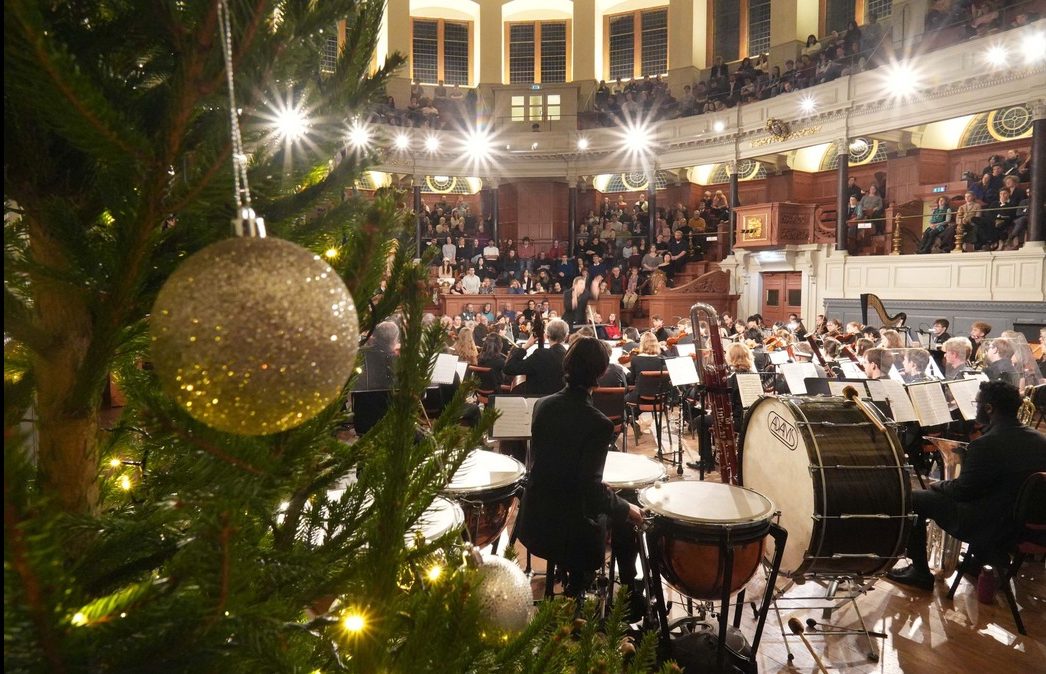
The Oxford Millennium Orchestra (OMO) returned to the Sheldonian Theatre on the 28th of November with a richly imaginative programme, transporting the audience from Prokofiev’s Verona to Stravinsky’s mystical forests. Under the direction of Joe Davies, the orchestra delivered an electrifying performance that highlighted the virtuosity of its players and the conductor’s distinctive interpretative flair.
Prokofiev’s Romeo and Juliet is a score built on contrasting dynamics: ceremonial grandeur, adolescent lightness, austerity, and devastating tragedy. OMO’s performance captured this narrative arc with admirable coherence. The opening “Montagues and Capulets” was commandingly driven by the brass line. Jude Holloway’s principled trumpets and Sebastian Higgins’ trombone foundation lent real weight to the movement’s heavy tread. The low strings section, led by principal cellist Virgínia Casablancas Antràs, carved out sharply articulated phrases that conveyed the simmering hostility between the families.
In “Juliet as a Young Girl”, the mood shifts gracefully. The upper strings, led by Caleb Kosciecha and the first violin section, offered a bright, agile sound that evoked the character’s capricious innocence. The woodwinds brought delightful colour, with Jayne Parle’s piccolo and John Fung’s oboe lending an airy sparkle to Juliet’s mischievous dances.
Perhaps the standout moment of the suite was “Friar Laurence”. Prokofiev’s writing here depends on instrumental characterisation, complemented by Adam Vasilko’s warm bassoon and the strings’ fervent response to Romeo’s expansive melody, supported by the rich vibrato of the viola section, led by Olivia Tredre.
The slower central movements, “Dance”, “Romeo and Juliet Before Parting”, and especially “Dance of the Girls with Lilies”, revealed the work’s only real drawback. Despite the beauty of Prokofiev’s writing, its pacing can feel stagnant, and here certain sections did lag, particularly in the meandering chromatic passages of the “Girls with Lilies” movement. That said, the orchestra’s recovery of momentum in “Romeo at the Tomb of Juliet” was impressive. The final surges of anguish were taut, dramatically shaped, and driven by the brass and timpani hits from Laurence Britton, which gave the narrative’s climactic ending rhythmic impetus.
After the interval, the orchestra launched into Stravinsky’s Firebird Suite. This was unquestionably the highlight of the evening. From the low strings murmuring to a dark chromatic ostinato that opened the piece, the players captured the atmosphere of Stravinsky’s enchanted world.
The “Firebird and Her Dance” showcased the orchestra’s colourful range. The woodwinds glittered, especially in the extended techniques of the “Variation of the Firebird”, with Tom Dixon (clarinet) and Aldus Whitfield (cor anglais) producing delicate, darting gestures that mimicked the Firebird’s flashes of plumage. String tremolos shimmered with disciplined precision, and brass punctuations landed with just the right levity to avoid overbalancing the ensemble within the Sheldonian’s notorious acoustics.
OMO handled “Princesses’ Khorovod” with beautiful poise. Harpist Isabel Samuel provided a luminous backdrop, her arpeggiations floating beneath the tender melodic lines in dialogue shared with the flutes and violins. This was one of the most atmospheric sections of the night, with Davies drawing a pastel texture that allowed the folk melody to bloom.
But it was the “Infernal Dance” that brought the audience to life. Here, Davies’ conducting reached its expressive apex: dramatic gestures, sharply contoured cues, and vividly animated facial expression made him an absorbing presence. His physicality mirrored the score’s violent shifts in colour, from Jason Sengel and Shuyi Luo’s percussive explosions, snarling brass attacks, and the evocative polyrhythms of the strings which pushed the music to absolutely exhilarating heights.
The subsequent “Berceuse” brought a haunting calm, carried by a beautifully controlled bassoon solo from Adrien Carrère, and the concluding Finale soared. The horn section, anchored by Ellen O’Brien and Jake Pawson, rose confidently through the movement’s steadily mounting optimism, culminating in a radiant brass fanfare that set the Sheldonian ablaze.
Throughout the evening, Joe Davies proved himself an orchestral magnet, commanding a vivid theatrical presence. His expressive face, sweeping arms, and sharply delineated gestures traced musical shifts in texture and color with emotional intelligence. Many players seemed energised by this visual communication. Smiles appeared frequently among the strings, and the brass responded eagerly to his cues. Davies remains, unmistakably, one of OMO’s most valuable assets and was a joy to watch from the spectator stands.
Despite occasional pacing issues within the slower Prokofiev movements, the Oxford Millennium Orchestra delivered a richly satisfying concert. The Firebird in particular demonstrated the orchestra’s technical assurance and flair for colouristic repertoire, brought to life under Joe Davies’ charismatic conducting style. This was an evening that confirmed OMO’s ability to balance discipline with exuberance, leaving the audience eager for their next appearance at the Sheldonian.