


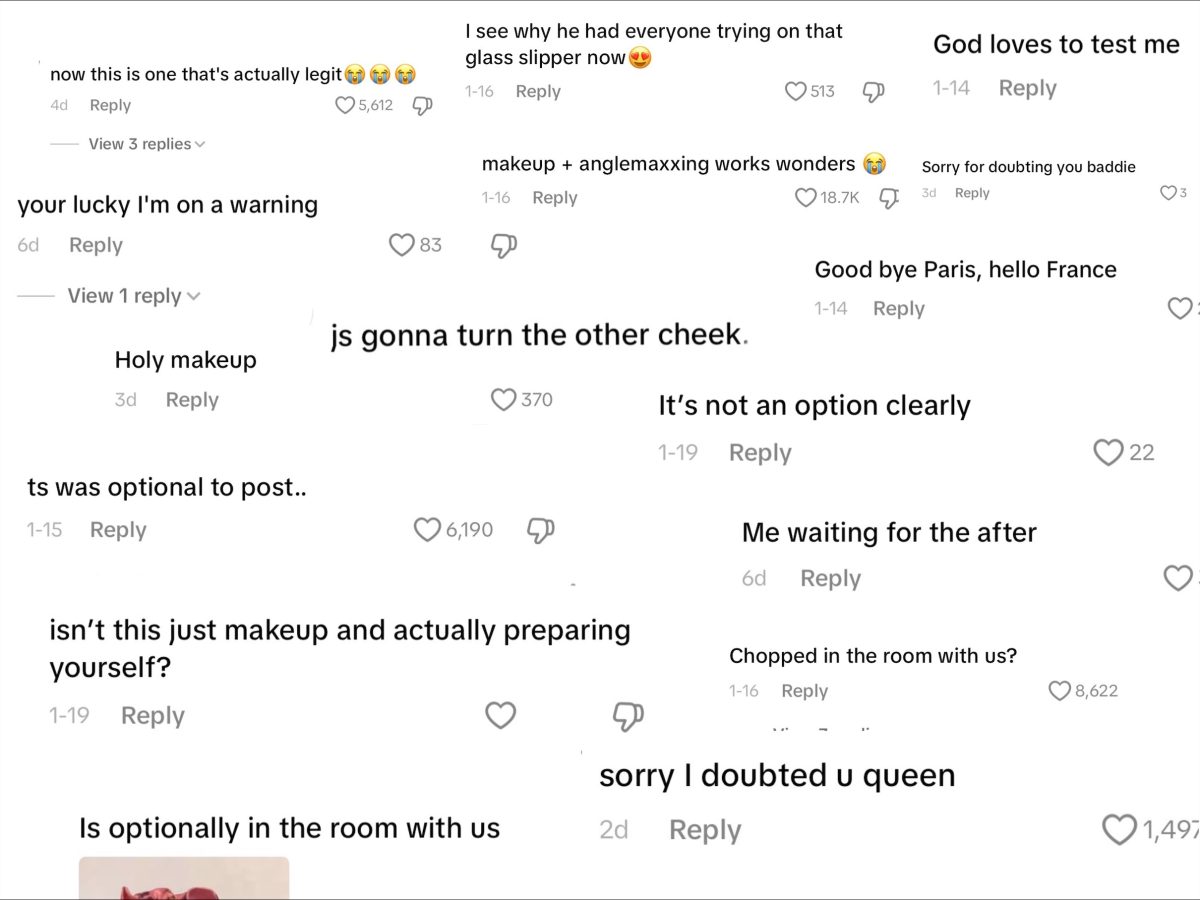
As many of us chronically online scroll-addicts may have realised, the word “chopped” has gained a lot of traction lately in internet discourse. The most notable use, in recent weeks, has been the “optionally chopped” trend that has cast a cloud of controversy over the term. But what does “chopped” mean? And what is the “optionally chopped” trend?
To put it simply, if you get called “chopped,” you’re being called ugly. But the trend puts a self-deprecatory spin on the word, as users (mostly young women and feminine presenting people) edit a video of them first looking “chopped” — usually just without make up, either talking to the camera or doing something silly, in baggy clothing, with their hair up or messy — followed by a video of them posing and looking their best. The point is supposed to be to show that you, the creator, are beautiful, and that it is your choice to be perceived as ugly; that you can switch at any moment to your genuine, beautiful self. On the surface, we might think that this is a nice trend, an empowering trend, a trend where people can appreciate their beauty and safely express that they do not always feel the need to enhance or display it. That we can let ourselves go part of the time, and still be considered beautiful the rest. The comments quickly dash these hopes.
Many of the comment sections are thankfully lacking in rude, judgmental voices, and are instead flooded by women hyping the creator up. Patented TikTok responses like “Chopped in the room with us?” “Can your man fight??” and “I didn’t sneeze but thank you for blessing me” — or, my personal favourite, the Abby-Lee Miller-open-mouth-meme — are fairly common in this trend. But, upon closer inspection, it seems that not all the videos are good enough for temperamental TikTok audiences. When there is not enough of a difference between the first and the second clip, meaning that the girl in question has not transformed enough from her “chopped” form, she is deemed ugly by the audience. The comments are openly cruel. Statements like “your [sic] lucky I’m on a warning,” “god loves to test me,” “before and before,” “ts [this] was optional to post..” and “is the optionally in the room with us” confidently dominate the comment section. On the other hand, when the creator doesn’t look “chopped” in the beginning and is ordained beautiful all-round by the masses, the comments are sweet and complimentary, but clearly hungry for a more dramatic metamorphosis.
As a result, creators have taken to intentionally heightening their “before” clip, playing into social media stereotypes of what supposedly makes a woman unattractive. They create or emphasize their double chin with low angles, contort their facial features with exaggerated expressions, and wear baggy, plain, or mismatched clothes that hide their figure. If the audience considers the first clip too “chopped” to be capable of achieving a pretty “after” clip, but the creator provides a stunning “after” video that meets the audience’s harsh standards, the comments are littered with backhanded compliments, like “sorry I doubted u queen” and “I could see the potential from a mile away girl!” Even when the creator achieves the desired transformation and embodies the Western beauty standard, there will still be comments dismissing her beauty, saying it is “just makeup and actually preparing yourself.”
Ultimately, the message this trend sends is a bleak one; the less effort we put into, or the less capable we are, of achieving an unattainable ideal, the uglier we become in the eyes of the internet. Now, I would get into how the TikTok comment section has become a space for people to anonymously (and, therefore, more-or-less without consequence) express controversial opinions that they would not be comfortable with voicing in real life. I would discuss how these opinions are often perpetuated by capitalist, patriarchal media biases and inherited by young people to reinforce this dominant agenda. But that would be a whole other article.
The trend reinforces the idea that women cannot be pretty without straight hair, makeup, and cleavage, while paradoxically discrediting their beauty by saying it is “just makeup.” They relegate our natural beauty to the ugly, “before” stage, while suggesting that our heightened beauty is fake. Evidently, we cannot win. We cannot feel or be beautiful in our natural state, and we cannot be perceived as genuinely beautiful if we put effort into our appearances.
While it is not a bad thing that women are being acknowledged as beautiful when we proudly display our cleavage, false lashes, and acrylic nails (there can be so much power in these modes of self-expression when we are aware of our reasons for choosing them), the trend does not allow us to realise this power. It reinforces the idea that we are ugly when we are not made up, styled, and hyperfeminine. Therefore, it shuts down the possibility of finding beauty outside of the rigid and restrictive Western beauty norm. The most worrying aspect of this trend that struck me was the bold exclusion of masculinity and racial diversity from what can be considered beautiful.
Many of the videos by Queer creators, labelling themselves in their captions as #wlw, show their masculine features or styling — e.g. beanies, hoodies, fluffy wolf cuts, and angles that show off their jaw lines — in their “before” videos, therefore aligning their masculinity with being “chopped” and framing their feminine selves as beautiful in contrast. Does this not quietly tell us that masculine women cannot be perceived as beautiful? Similarly, many Black creators show their curls, coils or bonnets in their “before” video, then wear wigs or blowouts in their “after” videos, hinting that they do not find their natural hair beautiful. This sustains the idea that racially diverse hair should be hidden or altered, and that beauty can only be achieved if we approximate Whiteness. Again, I am not suggesting that these women are to blame here and that they cannot enjoy feeling feminine or wearing wigs. It is the question of why we feel that we have to do these things to be beautiful that concerns me.
Even the trend’s choice of the word “chopped” is part of the erasure of blackness. In their ASMR style video, TikTok user skylarsnclre draws our attention to the use of phrases like “chile,” “cooked,” and, of course, “chopped,” which have been removed from their origins in African American Vernacular English (AAVE) and misappropriated into Gen Z internet slang. Their video is just one example of a long-standing effort by Black creators to educate TikTok audiences about the use and misuse of AAVE, out of frustration at the erasure of African American culture. And it is not just TikTok users that are signposting the term’s African American origins. Merriam-Webster Dictionary also states that the slang use of the word derives from AAVE.
It is easy to scroll past these trends, to find enjoyment in the shock of a physical transformation, or to get indignant about the rude comments, without taking the time to interrogate the subtle but lasting effects that these videos have, especially as they reiterate themselves on the dreaded For You Page. Trends shape the way we see ourselves and other people. They condition us to automatically view certain things as bad and others as good. And, oftentimes, they are very intentional. I have gotten into the habit of asking myself two questions when I come across a trend. First, I ask; what does this trend want me to think? Then I ask myself what I actually think. Maybe, in this way, we could get closer to a place where we stop defining our worth by being “beautiful” instead of “chopped” and just start being, without the fear of faceless strangers in our TikTok comments, and whether they think we are enough.