
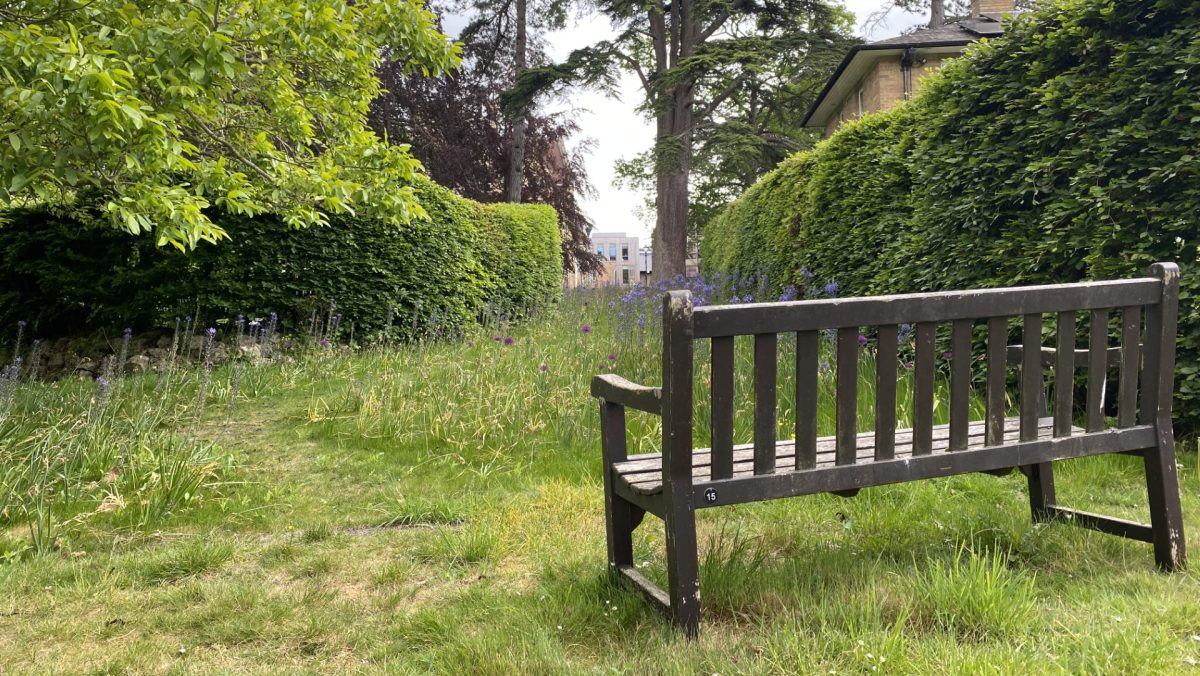
A beautiful white butterfly flits past me, one of the ones with orange-tipped wings, grazing the tops of the purple hyacinths. Kit-kat the cat stalks her way through the long grass, oblivious to my presence. The sunlight lights up the leaves of the tree, in whose shade I lounge, a brilliant green…
BANG!
I was jolted out of my mental slumber by a punt deciding its only desire in life was to crash into one of its fellow river-skimmers.
Sitting quickly back up I was so annoyed at myself, not because I seemed to have found (and promptly injured) a new muscle in my lower back, but because I realised I had just wasted nearly 15 minutes gazing at my surroundings. My book sat open, yet idle in my hand.
Surely I should have been more compelled by the world that lay in those pages, an imaginary vision of dragons, fragile kingdoms, and parted-lovers than this simple scene in front of me – a place I had specifically pottered to for peace, not distraction?
But as I huffed and scrambled to remember who on earth was speaking in this scene, a thought struck me. Every time I read, watch, or consume fantasy I feel a huge longing to return to that far-flung land which I had become so enamoured with: to hear just once more the skin-tingling Fvwwhwwvh of a light sabre being ignited, to open the lovely green door of Bag-End to Gandalf’s chuckle. I could not deny that feeling existed, yet I just then realised that was not all that I felt.
Every time I have read fantasy I always emerge far more enchanted with my own world. What I had considered ‘meh’ before, glancing at it blurry-eyed, now held my gaze entranced.
As I pondered why this was the case (my book, again, ironically forgotten), I could only think that I had become so rooted in this fantasy world that, when I looked back at my own, it was the world that looked tantalisingly unfamiliar. Half an hour ago I had ignored the accustomed glinting river beside me whilst I bubbled over with awe imagining Lasian Ichneumons (for those wondering, this archimedean book was A Day of Fallen Night by Samantha Shannon). But now the Dragons of Seiiki were forgotten and it was this dainty little butterfly, perching so beautifully on a (sadly withered) daffodil that held me rapt.
But why? Why was I struggling to pick my jaw back off the floor when I was looking at nature I had seen so often over my fifth of a century?
Naturally, my first thought was to see if this effect I was experiencing was one of the main reasons people read/watch fantasy: surely, for it to be so powerful it must have been an anticipated effect of the genre? Two main reasons seemed to emerge from my investigations.
On one hand, we have the ‘escapists’. For them, the allure of fantasy is its distance: it provides a place that they can escape to from day-to-day problems. It does not even matter that the characters in fantasy worlds are often placed in straining circumstances, and for the empathetic amongst us it might not be an emotion-free experience: the simple act of not being where we actually are is enough.
However, this cannot be the only aspect of escapism in fantasy that makes it so popular, because surely it could be applied to any form of fiction? Watching a sit-com like How I Met Your Mother should be able to provide the same sense of separation: it is not real, set in a fictional version of our world, and we can immerse ourselves in this world without any effect on ourselves.
Therefore, this impetus for escapism is also inspired by the awe of the deeds and unusual element in fantasy: the thrill of being somewhere unfamiliar and unfamiliar things occurring. As author Francis Spufford concludes, during our course through life it is very easy to come to the assumption that our own world is disenchanted – that there is a firm dividing line between what happens, and the extraordinary events that occur in fiction. We see no ghouls, spirits, demons, or fairies, and are content to live safely in the world as it is. However, this ‘buffered self’ does deprive our imaginations of the extraordinary, and it is a natural part of being human to wish magical events to be possible… occasionally.
This term, used by philosopher Charles Taylor, identifies the far stricter boundary we draw between self and other than our ancestors centuries ago, who lived in a far more ‘enchanted world’. However, the arts have tried to combat this feeling of a claustrophobic reality, seeking to re-enchant the world: for example Novalis’ magischer Realist, who brings back enchantment and sees beyond the physical without fully getting rid of the real world. Think too of Schiller’s poem Gods of Greece in which he mourns the loss of imagined life in the world: ‘where once the warm and living shapes were rife, shadows alone are left’.
This consequently is one reason why fantasy is such a popular genre: it is a place separate from real life where no real life thoughts can tap annoying on your shoulders (watching Friends might make you stress about careers, but education and exams go poof! in the make-believe land of Avatar), and it satisfies an itch your brain has to experience something radically new, something absolutely unknown, something that used to exist in our own world but which we have rationalised into extinction.
A second explanation often given for why we read fantasy is its ability to experiment with many difficult ideas – ethical, philosophical, political, and more – we encounter in our own lives, but placed at a safe remove from us. Fantasy has an inherent relevance through distance. Far from being disconnected as I was arguing before, this viewpoint would claim that fantasy has a strong allegorical didactic/moralising element: it gives us life lessons, teaches us how we should act, and how societies should function, even if it often does this by providing us the worst case scenario and illuminating the light through a contrast with the dark – a warning of a path we should not follow. The Chronicles of Narnia is one of the clearest examples of this. As a portal fantasy universe, they very clearly indicate that the messages and morals learnt in the land of Narnia can and should be brought back into people’s real lives. The children who stumbled into snowy Narnia are far from the young adults who left: Lucy shows the power of belief, Edmund the importance of sacrifice and redemption, and all are deeply affected by Aslan’s self-sacrifice – they are awakened to the power and potential for change, both in themselves and the world around them.
So, you may be now wondering which of these reasons led to my newfound appreciation of planet earth. Neither of course.
Both can be ruled out swiftly. Escapism has little use if you are left more engaged by where you are than where you escaped to. On the other hand, if fantasy’s purpose is to make you see your own world differently, then I should recognise my world in the fantasy and vice versa. So I should not be totally astonished whenever I look between the two.
These are not the only effects we experience, even though they are the ones we seek out. Our reasons for reading fantasy need not be the cause of the effect it has on us.
Looking for alternative explanations, I also accepted that Viktor Shklovsky’s concept of ‘defamiliarisation’ was not to blame. This principle dictates that the purpose of art is to make objects we know seem strange and new, to see the art in an object and not just the object itself. He thought art should make the familiar unfamiliar, to make us stop knowing something just by habit, but instead to appreciate it out of original perception every time anew. Yet this, again, didn’t quite fit the bill. Shklovsky’s idea here is to re-present objects we are already familiar with in a different setting to raise our awareness of them. The problem I was trying to solve involved the presentation of completely different objects in the fantasy world that impart a reflexive effect on how we see objects we are accustomed to.
The conclusion I came to, therefore, had to be separate from both author and reader alike. The great power of fantasy is not something that any author could deliberately set out to achieve, nor something any reader could know was even a possibility, but is rather an innate quality of the genre: the phenomenon of reflexive wonder.
We fail to acknowledge that in fantasy the process of escapism, i.e. the relocation of the mind, happens twice: once on the way to the new magical world, then once again when you are dropped back into your real life.
Fantasy steals you away from reality so effectively that you essentially become a character in the story. You have to delve so deep in your imagination to forge the universe in which your chosen fantasy world exists that it, in many ways, becomes what your brain expects.
You probably know the feeling when you are starting to read a book – all the names, places, languages, sights, and deeds are odd, and it is often hard to fully disengage with reality and fully immerse yourself in the novel. So too at the other end of the process. For a brief moment when you put your book down, before your mind readjusts, you exist on the opposite side of the window, looking askance or in awe at the fantasy world that is planet earth.
You stand shoulder to shoulder with Aslan, laughing at peculiar, plump, black and white birds that have wings too small to fly. You cheer with Avatar Aang whilst watching this strange, yet riveting game ‘football’. You and Anakin can’t resist joining this mind-blowing line of people dancing to something you heard called ‘samba’.
Fantasy as a genre immerses you in an ‘other’, as one of the characters in the story, stealing you away from where you actually are. So, as soon as you are dropped back into your real life, suddenly colours which before were samey now shine a brighter, more intriguing hue. Unconsciously, as we behold our own world from a window of fantasy, our brains behold the abundance and cornucopia which we let fall by the wayside.
Experiencing fantasy is truly a journey that Bilbo would call ‘There and Back Again’ – twice you experience the thrilling sensation of the unfamiliar, twice your perceptions are flooded by fantastic new feelings, twice your mind cannot be restrained from wondering about each and everything you experience.
By this point I must have been dissociating on the bench for another quarter of an hour, so I decided to call it quits. My book could wait. I would definitely be back – now I knew about this double rush of amazement I had twice the incentive to return.
Though many people might read fantasy to escape, it always manages to slingshot them back – it is escapism that brings us home.