
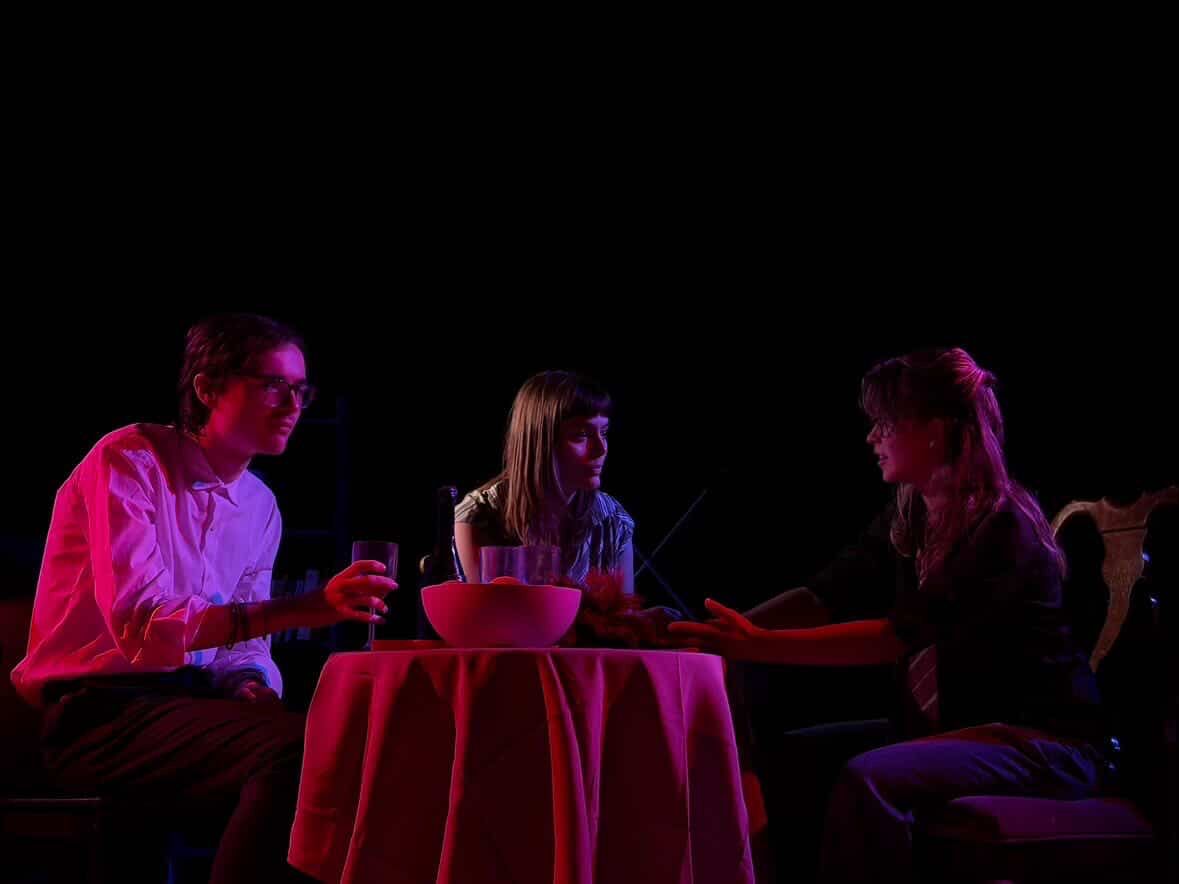
I was ushered inside the Pilch and, as I entered, the stage was dimly lit with blue lights and three characters sitting slumped in their chairs. It looked like they were asleep. I was elated to get a seat right in the middle of the room, close to the stage, where it felt as if I was not just a mere spectator, but a part of these characters’ lives. The background music, produced by Magnus Gravell, was light – quietly building up anticipation , making the audience feel that something unsettling is about to happen.
Wide Eye Productions’ latest play, Dependants, begins with Finn (Samantha Good) jolting abruptly from a dream-like state as she hears a knocking on the door. Following her instinct, she asks, startled, “Who is there?” There is no answer from the other end. A few minutes pass, and Mick (Alexander Lewis) joins Finn, who begins to rattle on about a strange dream he had. It is a strange beginning to a play, as, for the audience, an element of context seems amiss in this scene. It made me curious as to why these characters were in the room in the first place.
The plot revolves around three half-disoriented characters who find themselves trapped behind a door, unable to recall how they arrived there in the first place. As they navigate the possibilities of opening it, they reveal their frustration, anger, and vulnerability. They are stuck in an endless circular loop that we, as humans, often indulge in. This play, written and directed by Milo Ghiandai with assistant direction by producer Orla Wyatt, explores the innate human tendency to avoid confrontation in moments of emotional rupture and uncertainty.
The play is strikingly intimate, adding an emotional texture that allows the audience to connect with the narrative. The characters remain within the house throughout, and for me, this created a creeping sense of familiarity. The set was designed with minimalistic props. The use of books stacked at the back, clothes left hanging to dry, and a table with a teapot places a subtle emphasis on the characters and their emotions. These intricate details ground the space in in a sense of everyday domestic life, allowing the audience to focus more closely on the inner lives of the characters. But this simplicity also mirrors their entrapment, making the environment feel both ordinary and inescapable.
There was a table where these characters laughed, confessed, joked, conversed, or simply started their day by talking about the ‘strange dreams’ they had. In one of these conversations, Finn says out of frustration: “it is a matter of time and approach”. This is one moment in the play where you can feel the character’s helplessness building. In our daily lives, we often allow such feelings to grow into resentment. Upon hearing this conversation, Jo (Amber Meeson) wakes up. Meeson carried her character with sensitivity in both her words and actions. She was the only person in the room who seemed to live in the present moment, without much anxiety about what the future might hold. Her ability to sit with uncertainty instead of resisting it gave the character a quiet sense of courage. Meeson does not talk much about opening the door, as if she has accepted that if it is meant to open, then it will. She seems fulfilled with the life she is living and does not look at the external world for validation. I think Jo portrayed that vulnerability in a way that made me feel as if I was let inside her thoughts for a brief moment.
Good portrays Finn with a strong sense of desperation. He looks frequently towards the door, as if it is a solution to all their problems. I quite liked Finn’s character, not because he was rational and calculating (as one would expect in a situation like this), but because of how much energy he filled the room with in his constant blabbering. There was a layer of honesty in his desperation to escape the place. Mick, on the other hand, was the composed and rather unpretentiously funny character out of the three.
Finn and Mick’s characters indulge in banter here and there, but they are comfortable with one another. Their relationship creates a push-and-pull effect that accentuates both desperation and stability, making their connection feel natural, layered, and believable. Lewis, in his portrayal of Mick, pulls you all in with his gentlemanly poise and the way in which he carries himself. He makes you laugh with his unsuccessful attempts at a cartwheel, but he also unsettles you with his thoughts, or simply by being so present in the space. There is a particular line that really struck a chord with me. Mick asks Jo, “What do I look like?”. I remember having similar thoughts about how I am perceived by the people around me. The writing of the play carries this anxiety throughout.
This play carried a flicker of Beckett’s absurdist elements, between the fluid body movements of the characters and the way in which they made use of the space. It reminded me of Samuel Beckett’s Waiting for Godot, in which the two characters, Vladimir and Estragon, keep on waiting indefinitely for a mysterious figure, Godot, who never arrives. Much like in Waiting for Godot, these characters are struck in this endless attempt to open the door. There is a strong parallel between Godot and Dependants in their exploration of existentialism, isolation, and entrapment. In this play, the ‘door’ is a symbolic presence rather than just a physical object. It represents hope, change and escape from the monotony they are trapped in. Ghiandai’s writing style and visualisation align perfectly to depict the inner contradictions of the inherent vulnerability in searching for meaning in your life.
However, unlike pure absurdist theatre where meaning is denied and hope is often absent or meaningless. The characters of Dependants depict to the audience how we linger on the slightest possibility of hope. How we find it in something as inhumane and static as a door. The play shows how we as humans tend to lean towards different people in our lives for this sense of faith: we expose ourselves fully to these people with our vulnerabilities, insecurities, and feelings, and do so without any expectations in return. In this sense, ‘Dependants’ is an appropriate title.
One scene which particularly stood out to me is when these characters argue and, as Gravell’s background score grows louder, everything feels chaotic and frightening but what I saw in all these characters is a shared sense of vulnerability. They are not just dependent on the door but on the fact that within that house, no matter what, they have each other.
The costume selection, developed through a collaborative effort by the team, successfully reinforces the play’s sense of comfort and familiarity. Their clothing feels natural and lived-in, fully immersing the audience within the setting and emotional atmosphere of the play. Good wears a solid maroon shirt, its deep tone symbolic to the character’s determination for a solution. Meeson’s light green dress softens the space, with the colour suggesting calmness, growth, and a desire for harmony that contrasts the tension around her. Lewis, in a white shirt and blue coat, embodies composure and control. The white shirt hints at clarity or detachment, while blue conveys stability together reinforcing his measured presence within the play. Overall, the costume choices subtly reflected each character’s emotional state and personality, while also strengthening the play’s atmosphere of familiarity and quiet confinement.
Ben Tilley’s lighting design transitions according to the mood of these characters occupying the space.In the opening sequences, the stage is bathed in blue light, creating a cool, distant atmosphere. A clear transition occurs when the characters are awake, as the lighting shifts to a stark white, heightening a sense of clarity. When they fall asleep, the space softens almost instantly, moving into more subdued, sombre tones. This shift between solid, harsher light and gentler, muted hues made the play more intimate for me personally. It made me feel like I was experiencing a conversation from my own life but from a third-person perspective .
Ghiandai’s characters are caught in a liminal space, unsure whether to hold on to what feels safe or to risk stepping into the unknown. The play uncovers complex thoughts – whether silly, strange, important, or just a fragment of our emotions – and displays them through the characters and space. The music enhances this depth. In life itself, we will see a door like this, but the way we see that door depends on our internal perspective. What makes this play special is its ability to show this paradox through the intimate lens of these characters. Together, these elements make Dependants an immersive and emotionally resonant experience for me. Congratulations to Milo Ghiandai, Orla Wyatt, and the cast and crew for creating a production that felt deeply human and lingered in my mind long after I left the theatre.
[Dependants, an original play staged by Wide Eye Productions, is running at the Michael Pitch Studio from 5th-9th May, 2026]