
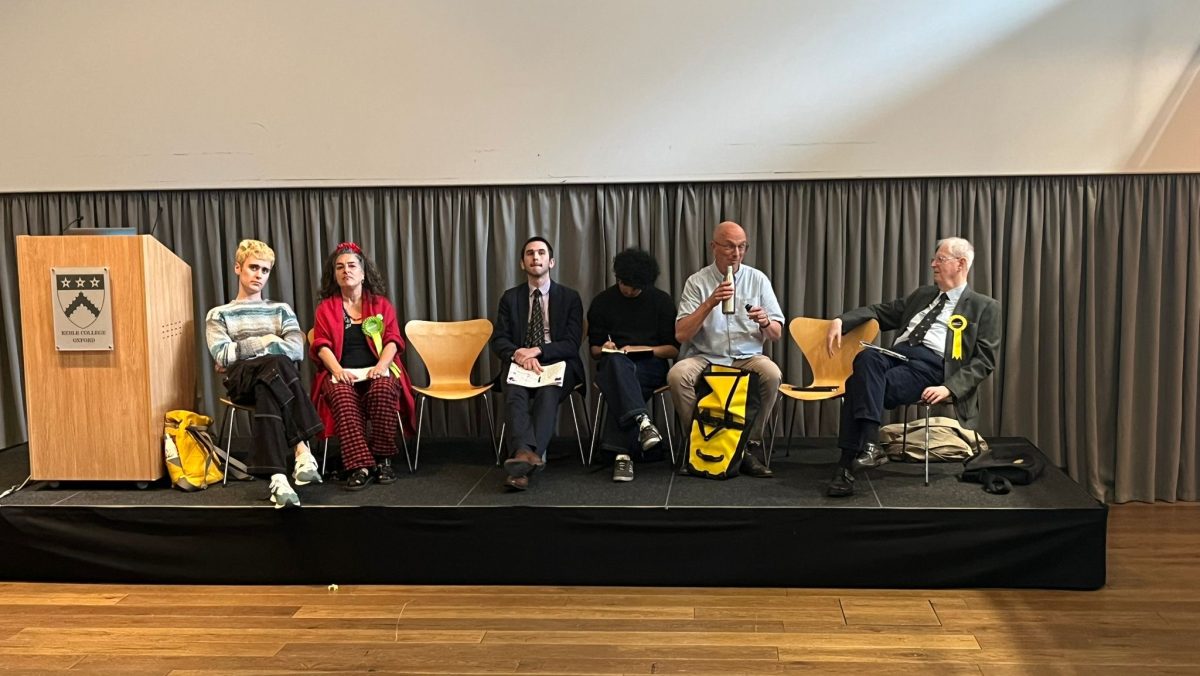
On Tuesday 5 May 2026, Keble College’s O’Reilly Theatre played host to a “town hall” style event, organised by The Oxford Student, in which several candidates for the Holywell and Carfax and Jericho wards of Oxford City Council laid out their cases and answered questions from a student-dominated audience.
The candidates in attendance for Carfax and Jericho were Labour’s Alex Hollingsworth, the Greens’ Sushila Dhall, the Liberal Democrats’ John Howson and Reform UK’s Vittorio Cuneo-Flood. For the Holywell ward, Alfie Davis for the Green Party and Awab Kennedy for the Labour Party were the only representatives.
The session began with a brief introduction from each candidate. Hollingsworth highlighted his experience in local government, alongside his job as a lecturer in town planning at Oxford Brookes University. Howson, a former county councillor, also made a point of his knowledge of local government, while Cuneo-Flood believed that his position as a political outsider made him a more enticing choice.
Dhall emphasised her work in helping refugees suffering from trauma, while her Holywell-counterpart Davis underscored his leadership credentials, as the Co-Chair of Oxford Class Act and his position on the Executive Committee of the Oxford University LGBTQ+ Society whilst studying at St Anne’s College. He is currently Director of Operations, Fundraising and Communications at Oxford Mutual Aid, the city’s largest foodbank. Finally, Kennedy, a first-year History student at St Edmund Hall, believed that he could bring “a real understanding of what the issues are that students face”, and emphasised the importance of housing as a political issue, primarily due to his experience of homelessness as a teenager.
Housing was a key point of discussion over the course of the event, with several candidates naming it as their most pressing issue. Davis claimed that 45% of the average renter’s income goes to paying rent, a figure he criticised as “extortionate”. He advocated for an increase in the city’s housing stock, bringing rents down through greater supply, stronger action against rogue landlords, and a limit on the number of workspaces in the city centre.
Kennedy, however, drew attention to what he believed was the Labour Party’s achievements in this field. He stated that under the Labour administration, Oxford already has the highest proportion of affordable homes in the UK, and that Labour is making sure that 100% of the city’s social housing is owned by the council. He also highlighted Labour’s role in introducing the UK’s first landlord licensing scheme. Hollingsworth added that “you can’t wish away jobs”, and that Oxford’s status as an economic destination means that housebuilding has to keep up with an increase in residents. He also spoke strongly against the city’s growing proportion of short-term lets, saying that the council needs to fight against Airbnb “killing cities like ours”. On the issue of homelessness, the Labour candidates spoke in favour of their “Housing First” programme and the importance of authorities constantly reaching out to people experiencing homelessness, however much resistance they may face. Also discussed was the cost of living, with a study from accommodation marketplace student.com ranking Oxford the second-most expensive student city in the country. Davis advocated for an increase in the Oxford Living Wage to be equal to that of London, in light of Oxford’s increasing unaffordability. Cuneo-Flood said that the opposition of the council to the reopening of the Campsfield Immigration Removal Centre made no sense in light of the city’s high cost of living. This sentiment, however, was sharply rebuked by Kennedy, Dhall and Davis, who pointed out that most people in the room have more in common with asylum seekers than with billionaires.
The Oxford Blue asked how the candidates would seek to improve Oxford’s infrastructure for pedestrians and cyclists. Howson responded that while the pedestrianisation of Broad Street was largely positive, it could still be reworked. He also stated that the primary walking route from Oxford Railway Station into the city centre down Hythe Bridge Street was an “absolute disgrace” and was not fitting for a city of Oxford’s beauty and importance. Hollingsworth advocated for more shared space in the city, but warned against pushing buses out of the city centre as it limits the mobility of those who rely on them. Cuneo-Flood criticised the “loud techno music” on “Market Street”, stating “there’s busking and there’s busking”. Dhall, drawing attention to her history as a transport campaigner, highlighted the necessity of wide pavements where two wheelchairs can pass each other and that she would fight to take car parking off the streets.
Another recurring theme was the so-called “town-gown divide”, and the candidates were asked how the relationship between students and permanent residents can be improved. Howson criticised previous policy decisions of making Oxford a “mega education city”, although he stated that good transport and shops helps bridge the gulf between the two groups. Hollingsworth said that students and permanent residents should not be divided, and that Oxford has always been a city of people from other places.
Cuneo-Flood believed that as temporary residents, undergraduates should not be allowed to vote in council elections, and Dhall claimed that the university’s Estates Department can act as the “biggest, most powerful landlord ever”, leading to tension between the two camps. Hollingsworth said that the university does not always open itself up to the community as much as it should, and that it is imperative that the social enterprise “Common Ground” is given a new site, following the threat of eviction by the university, while clarifying that they do not currently pay any rent.
Two days later on May 7 2026, voters headed to the polls. In the Carfax and Jericho ward, Dhall’s Greens won with 50.2% with Labour on 32.4%, the Liberal Democrats on 7.6%, the Conservatives on 5.2% and Reform UK on 4.6%. In Holywell, Davis led the Greens to a landslide victory with 68.0% of the vote, compared with Labour’s 15.6%, the Liberal Democrats’ 10.1% and the Conservatives’ 6.3%.
Oxford City Council remained under no overall control, with Labour remaining the largest party on 20 seats with the Greens on 13, the Liberal Democrats on 9, the Independent Oxford Alliance on 4 and Independents on 2.