
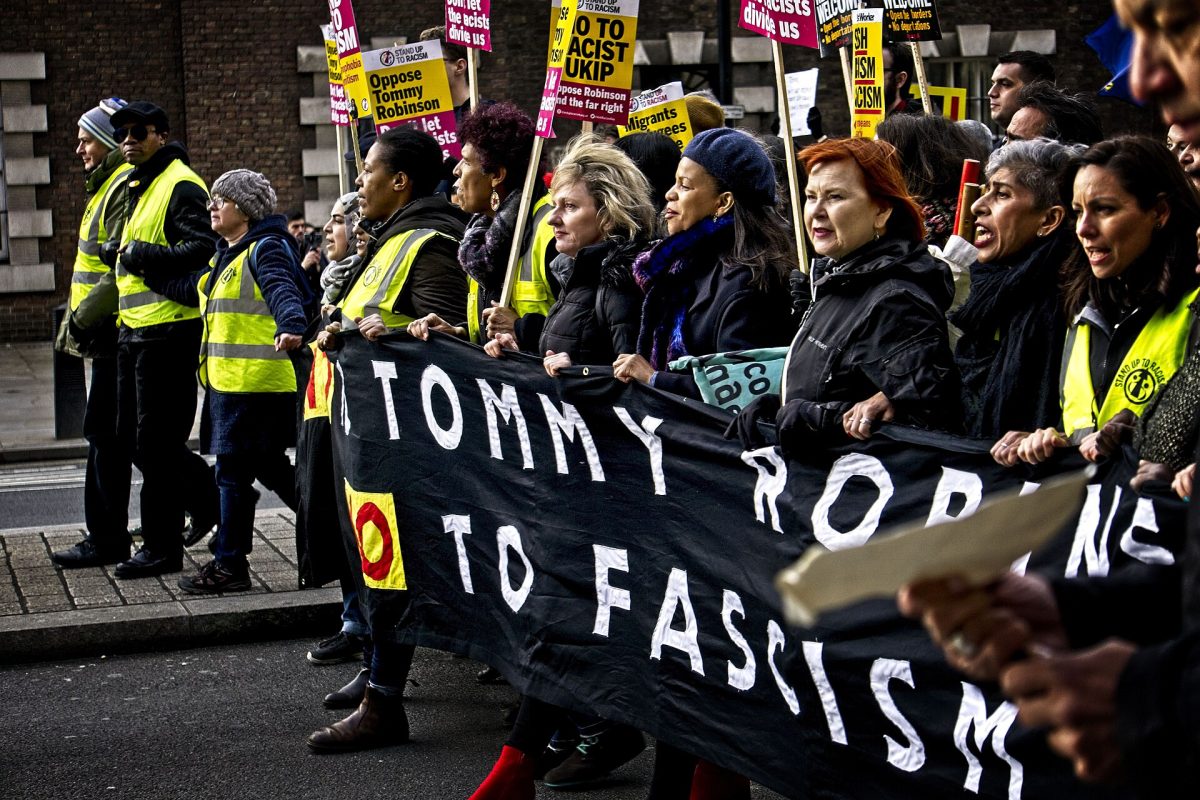
Tommy Robinson’s recent invitation to the Oxford Union cannot be separated from the lived experiences of British Muslims and the fear we carry throughout our lives.
Tommy Robinson is widely associated with anti-Islam rhetoric. The controversy surrounding his invite is not an abstract debate issue about free speech or politics, but directly touches the identity, safety, dignity, and place of British Muslims in British society.
I wish to first ask all those who support Tommy Robinson’s invite to the Union: Does it not suffice that he and his supporters have continuously spread Islamophobic slurs and conspiracies on our streets, and will likely do so again at their upcoming rally on the 16th?
Or must we also provide him with a prestigious platform at our university as well?
I beg to ask, why are Muslims continually expected to intellectually engage with or tolerate rhetoric that contributes to an atmosphere in which we feel endangered?
An invite to the Oxford Union is a badge of honour. Surely those responsible for inviting him already know this. Inviting Robinson to speak in such an academically elite atmosphere, only comes across to me -and so many other British Muslims I’ve spoken to- as attempting to legitimise his viewpoint.
Following the 2024 riots, that Robinson was a key agitator of, British Muslims along with other minorities across the country, stopped using public transport, called in sick to avoid going to work, and packed up and left their local areas all together. But even those at home were not safe. A Sikh woman was raped in her own home, because the perpetrator falsely assumed she was Muslim.
Two months ago, a Muslim woman was deliberately run over. Our mainstream media barely reported on this, and many similar instances. Instead, victims’ families, like mosques that have been attacked, have had to resort to publishing CCTV footage on their own social media to raise awareness.
Just two days ago, a Muslim man was physically attacked in North London, after the perpetrator shouted “you Muslim terrorist, you are here illegally in this country”. This has always been our lived reality: unacceptably normalised and underreported.
Between March 2020 to March 2021, nearly half (45%) of all hate crimes were targeted against Muslims. Annually, 35% of mosques are the target of at least one religiously motivated attack. In 2024, when I wanted to attend a workshop in London, after around a week of secluding myself indoors, I had to tell the organisers that they may need to pick me up from the station and walk me to the venue because it felt dangerous to walk alone.
All the moments leading up to this however, my life was no different. Strangers had stopped me on the street many times to say “You’re not welcome here.”or “Aren’t you hot? All those clothes!” or “l’m going to pull your hijab off.”
School was no different. A quote from Salman Rushdi, author of Satanic Verses (referring to the Quran) was displayed in every classroom, and remained even after I pointed this out. An older pupil, who I had never spoken to, once stopped my friend and I to say that “The school is going to get bombed because of you.” Teachers too were emboldened to make comments like “I can only feel sympathy for you, for what your family has taught you,” a statement rooted in deeply Islamophobic understandings of Muslim women and girls being victims to their Muslim family members, despite me never mentioning my family teaching me anything, to them.
University too was no different. In Freshers’ Week, I called one of the halal butchers that provided for Wadham College; the man on the phone, who was not Muslim, but likely profited from selling halal meat, and who knew I was a Muslim caller, proceeded to go on a rant about halal meat. He made baseless claims, sarcastic comments, and insulted my faith.
At the Oxford Union, during a student debate on whether the UK has become an “Island of strangers” – a direct quotation from Enoch Powell’s the Rivers of Blood speech – fellow students mocked residents of Muslim-majority areas of London and made comments I do not wish to repeat here.
Even in death we cannot rest. A cemetery in which I have loved ones resting recently saw the graves in the Muslim section desecrated. This is to say that the 2024 riots were not a shock, precisely because this is simply the lived experience of being Muslim in Britain.
While in the UK, we are a marginalised minority, I quickly realised that most of the Muslim students I encountered in Oxford did not grow up in the UK. They didn’t grow up walking into vandalised Mosques. They did not ever need to defend their faith in conversations. They did not ever need to excuse themselves at lunchtime to go and pray alone in an empty classroom, then watch videos of people at far-right marches mimic and mock their prayer. Although now, we have headteachers like Katharine Birbalsingh who have banned prayer in school.
This is to say that at the very least, the Muslims I encountered in Oxford, who grew up in Muslim countries, did not grow up witnessing Tommy Robinson rallies and feeling their direct impact on their own lives. Islamophobia didn’t touch their lives the same way, nor was it their daily lived reality. Islamophobia didn’t seep into every minor interaction nor impact what their Muslim identity meant for them.
As a British Muslim, I firmly argue that it was because of figures like Tommy Robinson and his supporters that during Ramadan this year, I kept reading news upon news of more and more Mosques across London being vandalised, raided, and the target of arson attacks. They have not stopped, and neither has their underreporting. The most recent arson attack on a UK Mosque was just last week.
My anger is not only directed at Tommy Robinson’s invitation to the Union, but the fact that, it seems to me, institutions protect provocative speech when Muslims are the target, but become cautious elsewhere. If the Union really cared about free speech, they would not censor Palestinian author Susan Abul Hawwa’s full speech in November 2024.
This Oxford Union invite exposes so much on how public institutions treat Muslim communities and how elite institutions do not understand the consequences of who they platform. These debates are not entertaining for those who feel unseen and unheard from these institutions.
When my own, and so many other British Muslims’ entire childhoods and adolescence have been tainted by Islamophobia and Tommy Robinson rallies, we are simply under no obligation to try and give those who invited Tommy Robinson the benefit of the doubt, or justify this invitation. This is a man who organises rallies where people in their thousands chant “who the f*** is Allah?”
To me, such an invitation signifies an extreme lack of thought and care for Muslims’ safety and livelihoods. As well as a deep lack of respect. Regardless of the intention, this is how it comes across to me and so many other British Muslims that I have spoken to.
There are certain people whose ideologies are not merely vile or hurtful, but create climates that encourage lethal attacks against Muslims.
It is not our disengagement with these ideas that spreads their rhetoric, but our very engagement, attention, and platforming that provides them an outlet and validation, to continue.
Editoroxblue@gmail.com