


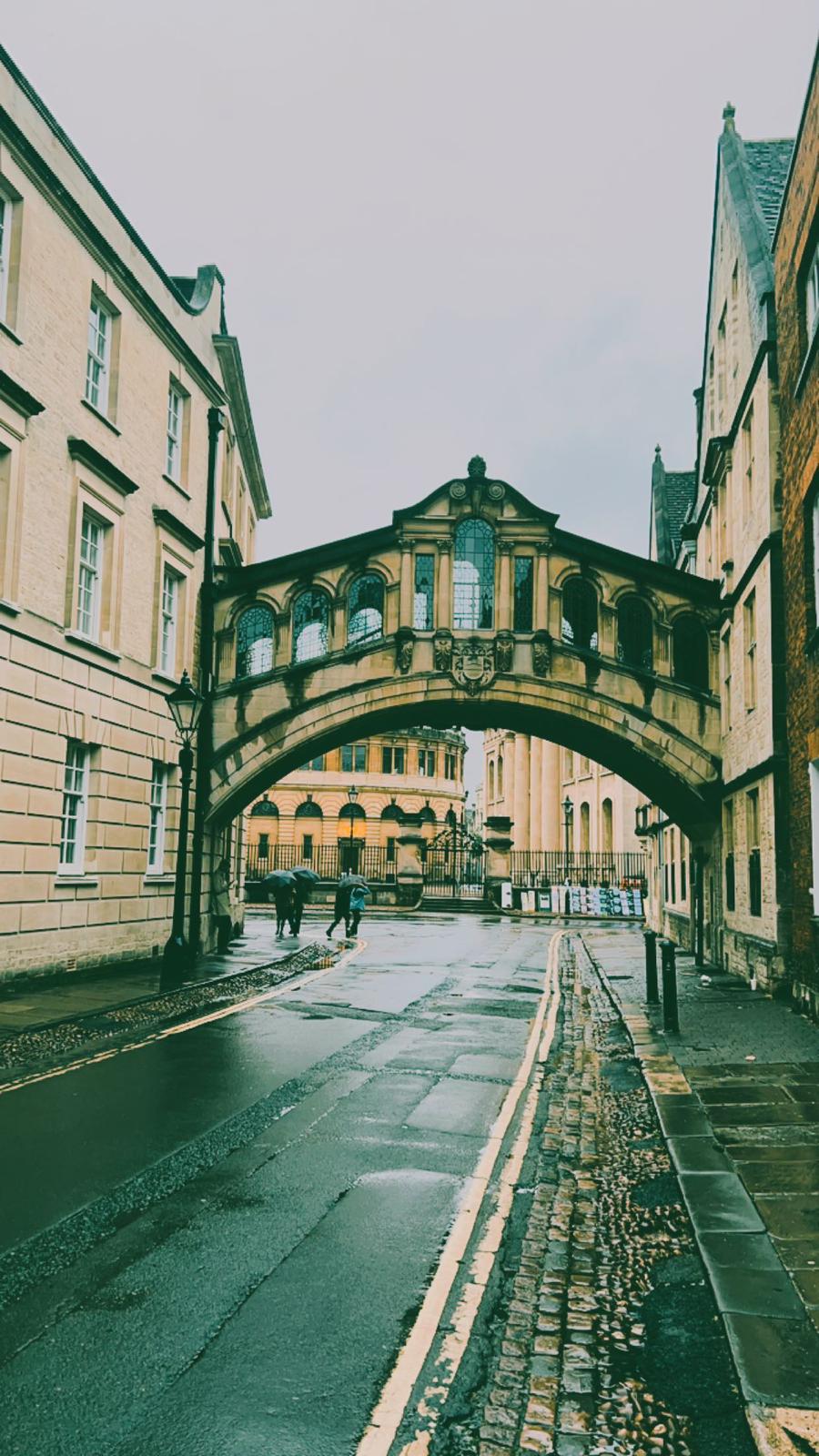
Many Oxford students probably can’t recall how many times they answered “What is your name?”, “What school did you go to?”, “What degree do you do?, “What college are you at?”, and more in their first few weeks at Oxford. Apart from some of the niche Oxbridge phenomena, this common series of introductory questions is likely a universal student experience. Now, in my second year there is still the odd occasion where I go through this scripted scene. I am not complaining; at this point it seems like a badly-rehearsed skit.
In Freshers’ Week, I met a girl in my college who I found out was studying English and was from Dubai. In that moment, it dawned on me how global this university is and how many new people I would meet. Just a little spoiler: now we are really good friends, have been flatmates for nearly a year and will continue to be flatmates next year. Neither I, nor she, could have predicted this. The serendipity of life.
My time at university has bestowed upon me a new role. I am the sole representative of my family in Oxford. Although it seems like an unusual prospect, this is the case for many. For the first eighteen years of my life, I did not hold the role of ambassador. Most of the people I had met in that part of my life were through my family members. My cousin’s friend, my aunt’s in-laws, my mum’s work friend, my grandmother’s work colleague.
The tables have turned. Now my mum is known as “Eliza’s mum” or my brother as “Eliza’s brother.” I am the point of reference, which is a rather petrifying thought. Even as I conjure that sentence, I can feel the shivers rush down my spine. It means that now I have to take care when advocating for the cause of my family. Not in a serious sense. Please don’t imagine me on Cornmarket Street lecturing people on my family tree.
What I mean is that my presence at this university is chiseled from the fortunes of my forebearers.
Social media, or at least my own feed, has been plastered with videos of a scenic landscape accompanied with a caption that more or less says “You are the manifestation of your ancestors’ wildest dreams.” It gets me every time. A couple of tears race down my face. Some may see these posts and scoff. I understand this. But these posts manage to tug at my consciousness and my understanding of myself.
Perhaps the caption may seem too deterministic, as if the only reason anyone is in the place they currently are in or will be is solely due to their lineage. That is not the case. We should not ignore the places that dedication, hard work, and resilience occupy in the path of our lives. Similarly, this sentiment only appears to encapsulate the positives of life. Where does that caption cover the hardship, tears, failures and setbacks?
Yet, every single one of these videos feels like a brick thrown at me.
I am taken on a journey up through my family tree. My parents, grandparents, great-grandparents. I mentally list the things they did, the things they couldn’t do, their occupations, and the thing most elusive to me: their dreams. This is not a phenomenon unique to me. However, it feels much more visible beyond what is likely normal because of my status as a history student. I know for sure I am not alone because of Bernardine Evaristo’s talk. Given in the Sheldonian Theatre earlier in the month, it was titled “The Girl from Woolwich: A Creative Life”.
In preparation for this, like a diligent Oxford student, I did my reading. Also, like an Oxford student, I run out of time to complete my required reading. I had finished “Girl, Woman, Other” before the talk. A prevalent recommendation from friends, my cousin, and the internet, it was also the recipient of the Booker Prize in 2019. It was my priority reading. The book follows the lives of twelve women and non-binary people, showing how they all intersect in unpredictable ways.
My literary abilities won’t do this work of art any justice. It was prose written like a poem. Could it be likened to an epic poem? I won’t embarrass myself further as my literary knowledge is not expansive enough. Alas, I will leave this question to be answered by greater minds (my English-studying friends included).
I was mesmerised during and after the read. I was speechless, a relative (not absolute) term in my case as my friends can attest. It became my Roman Empire. I cannot help but sound like a cliche when I say that I cannot recommend this book enough.
When I finished, I felt empty yet full at the same time. Empty, because I had depleted my emotional stores by completely subjugating myself to the writing of Evaristo. Full, as thoughts and questions swirled in my head. Quickly, I picked up another one of Evaristo’s works: “Blonde Roots.” Another serendipitous find, as I randomly found it in my local charity shop back home.
Had I been writing an essay, I would have only managed to add “Blonde Roots” to my bibliography by the skin of my teeth. By the time the talk came around I was maybe fifty pages in, but I had invested all my emotions into the stocks labelled “Blonde Roots.” It is different from “Girl, Woman, Other” in many aspects. The former is an alternate history, where the Transatlantic Slave Trade is flipped so that the captors are the black elites from Aphrika and Ambossa, while the enslaved people the whites from Europa. It is one of the greatest works of narrative crafting I have come upon. Bernardino’s ironical and satirical style prompts multifaceted layers of social critique and self-reflection. This is all I can say, given that I have not yet reached the end of the book.
My amazement at Evaristo’s craft did not dwindle after her talk. With every sentence she bestowed upon her audience, my admiration sprouted. She dedicated her talk to her roots. Tracing her family tree many generations back, delineating their trajectory and how they culminate in her. Evaristo spoke with such interest and dedication to her lineage. Yet, it was not obscured by blind devotion; she was impartial and acknowledged the highs and lows. This is clearly reflected in “Girl, Woman, Other:” how the history of each person was told thoroughly but with gaps which reflect the reality of not knowing everything.
It felt good to see that I was not the only one to dive as deep as I can into my family history. Nearly two years as a History student have taught me how to interrogate sources and the writings of historians. But before this professional training, I was the child that constantly asked questions and bothered people, mainly my grandma, to tell me her story, the story of her parents, and any others she knew. During her lifetime, she blessed me with more information than I could have imagined. Nonetheless, it was still not enough. But she was honest with me. When my grandmother did not have an answer, she told me.
My family is skewed in numbers, with more women than men. During family visits, we all congregate in the kitchen, living room or my grandmother’s room and rehash the stories which had been told countless times. Yet, no one is ever tired of hearing them. Nor the habitual revisitation of our photo albums, which have now transformed into a drawer that jams more often that it does not. Black and white photos. Sepia photos. Photos with the particular hue that the 2000s held. I am lucky that I have the ability to pick out my grandmother, at approximately the age of eight, from among her friends. I particularly recall the photo where my grandmother is learning to shoot a gun in a workshop preparing her contemporaries for a future conflict, a normal feature of her times.
The last time we congregated together was in January of last year. My grandmother, aunt, mum, cousin, brother (the only male exception) and I had colonised my grandmother’s room. Her bed and floor were full of us. She was sitting by the table she had her laptop on and was playing one of her games, while recounting stories. The one I remember was about how my granddad and his father-in-law (my great-grandfather) did not get along, leading to some less than pleasant situations. It feels like this only happened yesterday. But I know now that it was the last time that it would happen.
The wonders of retrospective vision. Had I known that this would be the last time I would have taken notes. I would have bugged my grandmother like I did when I was younger, asked all the questions I could and religiously recorded every word she had. Now, I can only rely on what the rest of my family and I recall, while mentally kicking myself for not taking on the project when I still had the chance. I know that I have previously talked about how FOMO can ruin living in the moment and looking back is not healthy, but this is the one thing I will always regret not doing. Frank Sinatra said in “My Way”:
Regrets, I’ve had a few
But then again, too few to mention
To me, this is the one regret that is worth mentioning.
Hopefully, one can follow my train of thought. Being the representative of my family at Oxford makes me feel that I have the responsibility of explaining the choices behind my modules. Especially when they are not the highly coveted ones, but can provide insight into the historical background of my family. I am very lucky that my tutors have been so welcoming to my academic interests. Just this term I wrote an essay on the Jagiellonian dynasty of Poland, because my tutor humoured my interest.
I can’t turn back time. I can’t fully redeem myself but I will try. I hope to write my dissertation on the role of teachers after the Second World War in Poland. It is not yet fully polished, but it is in the works. It won’t make up for the fact that I neglected my responsibilities as a proclaimed historian to document my grandmother’s stories as an oral history later to be used as a source. I won’t be able to interview my grandmother for my dissertation. Nevertheless, her legacy will be embedded within the culmination of my time at Oxford.