
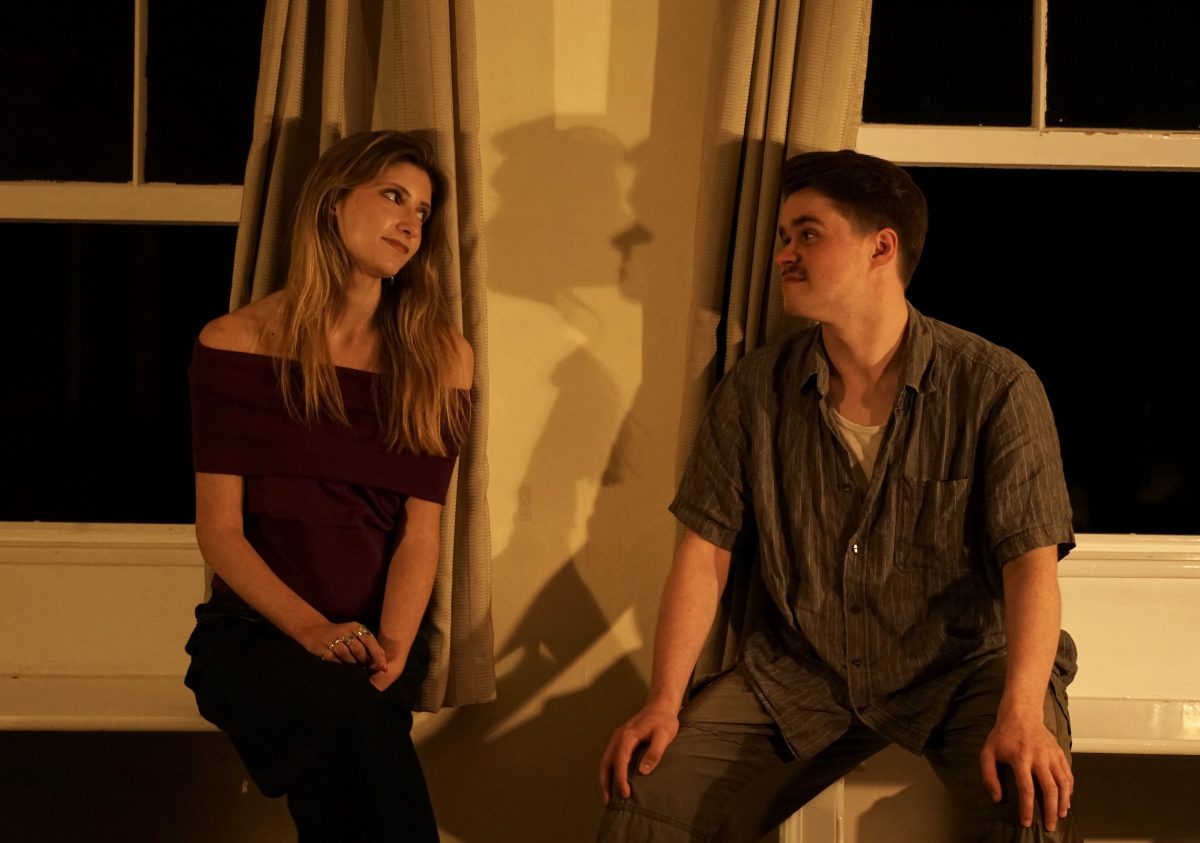
My first thought on entering was that this was the fullest I’d ever seen the Burton Taylor Studio. Not on our side of the theatrical divide (though the audience was certainly buzzing), but on stage. Six performers greet us at the start of Nova Productions’ staging of Constellations, on a BT stage which has furthermore been shrunk by the addition of a partial wall on its left side. Happily for this reviewer’s notes, however, it quickly turns out that we don’t need to keep track of six characters (and six names); the Constellations of writer Nick Payne’s title are rather the multiversal network of possible relationships between beekeeper Roland and quantum physics lecturer and researcher Marianne.
We begin with splinters, with a meet-cute at a mutual friend’s barbecue that doesn’t work out (quite a few times), and then does; they move on to one of their homes and don’t, but sometimes do, sleep together. Dialogue skips across the stage, moving from one Roland-Marianne couple to another to the third. Things settle down after the repeated, repeated scene in which Marianne explains that quantum physics suggests that every possible future is always taking place. Two universes ironically placed back-to-back see her first declare that this gives all our choices meaning, and then that it means nothing matters at all.
It surprised me to learn that this play is usually performed as a two-hander, because the three-couples gambit by co-directors Lauren Lendrevie and Sachi Shah works fantastically. Leya Carter and Alfred Hennel Cole are Marianne and Roland 1; Niamh Hoyland and Alex Silverwood-Cope pair 2; Juliet Taub and Kit Parsons couple 3. It’s fascinating to observe the minutiae of their performances, the little differences of emphasis, the variations each actor brings to the lines that they recite again and again. Credit must go to all of them for the sheer fluidity and poise they kept throughout, especially when one pair loops the same scene twice or more. Carter and Cole switch effortlessly between differing levels of drunkenness as we skip through different versions of Marianne explaining her job. Taub’s delivery of the exact same line, in which she laments her poor choice of trousers for a dance class three times in quick succession (with one word changing), was seriously impressive. The play is full of these little moments of mastery.
That things remain comprehensible at all is due also to the precision of the staging. The BT is zoned between a sofa, a coathanger, and a dining table, a set-up split into three distinct locations by the lighting. The partial wall allows for entrances and exits, so that the couples can move across the stage to bring a welcome visual ebb and flow that never feels awkward, and which adds yet more details. How do Marianne and Roland’s arguments feel when they are standing? When one is sitting on the floor? When the too-small sofa forces them together? When they are facing each other across a hardwood surface?
The funnel of possibilities narrows down as we progress, as the worlds where Marianne and Roland don’t get together, don’t stay together, are pruned away. Carter and Cole emerge as the focal pair through the appearance of scenes involving the whole stage, suddenly luxurious after we had spent so long in its corners. The two have an excellent rapport: Cole brings a greater sensitivity to his Roland which contrasts nicely with Parsons’ more sullen take and Silverwood-Cope’s bumbling. Carter, meanwhile, tones down the energy of Taub’s and Hoyland’s lively performances to reveal a more softly anxious side to the character. At the heart of Cope and Carter’s couple is a conversation which runs through the whole play, given to us almost in reverse (which plays fantastically with Constellations’ themes of temporality, of course). I don’t want to spoil it here; but the lightbulb moment is jaw-dropping, and merits another round of praise for the fantastic work lighting designer Ted Fussell has done here.
I mean it as a compliment when I say that this play felt much longer than its hour-long runtime would suggest. We move from comic juxtaposition (Roland’s speech about bees’ single-minded purpose is a particular highlight) to a more contemplative mode as the pacing slows, as the repetitions are stripped away, and the play reveals its emotional weight. Technically excellent, dramatically fascinating: Nova Productions’ first play is a very confident start indeed.
[Constellations, staged by Nova Productions, is playing at the Burton Taylor Studio, 12th-16th May, 2026]