


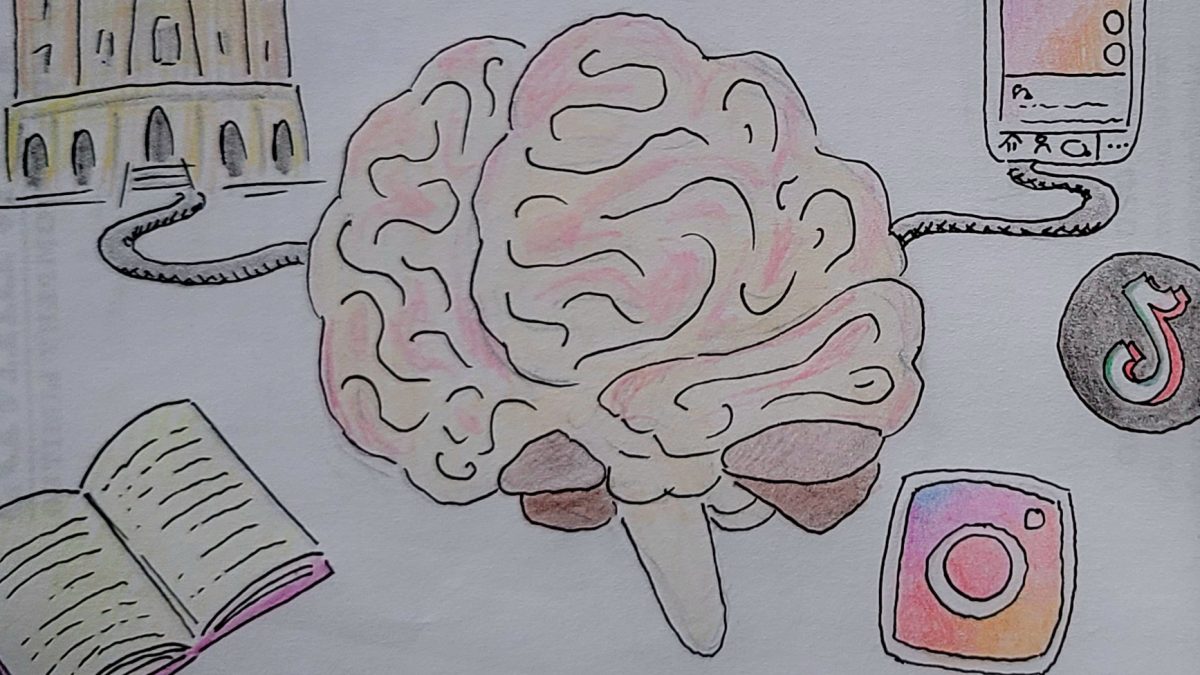
We all know “six-seven”, so let’s not beat about the bush. There are often little chuckles when looking at a battery percentage, or stolen glances when someone in the group unintentionally mentions those two infamous numbers, side by side. It has slotted itself into our vocabulary, whether we like it or not. Slang like this can be found everywhere in our daily lives: telling a friend to “lock in” in the library, talking about someone’s “rizz” on a night out, or calling an older friend “unc”. Even in one of the world’s most renowned academic institutions (no bias, of course), we use slang from the internet in the same places in which the most renowned writers, scientists, or even Prime Ministers, have discussed revolutionary ideas. This begs the question as to whether this ‘brainrot’ slang is simply a part of the modern era, where the lines between what’s online, and what’s reality, blur, or if it’s a genuine cause of concern. Should (meaningless) internet jokes have the real-world consequences that they do?
This brings us to the differences between Gen Alpha and Gen Z. While our generation makes “six-seven” jokes, it is not as big a part of our lives as it could be. We acknowledge it to be what it is: internet slang. Where we can separate using slang in casual hangouts from a serious academic discussion, Gen Alpha takes it much more seriously. “Six-seven” is becoming widely used not just on the internet, but in primary school classrooms, and in the playground. I’m sure we’ve all seen the viral clip of Prime Minister Kier Starmer making a “six-seven” joke on a visit to a school – and if you haven’t, I highly recommend it. This validates the use of this language in academic settings, endorsing its use in the future. So, we are seeing a shift from internet culture remaining where it belongs, to a reality where it can now be heard by children on the street. By older generations, this is largely viewed as the “degeneration” of the online cultural landscape, but this may have begun years ago.
Despite seeing slang originating from TikTok or Instagram Reels as ‘cringe’, we see jokes from Musical.ly or Vine as ‘nostalgic’. It is known as a kind of ‘Golden Age’ of the internet – just because we grew up with it. There is little that distinguishes this from modern ‘brainrot’ aside from the fact that the jokes are no longer made for us. This allows us to see its real-world consequences; in the same way older generations may have looked down on us for saying “yeet” or “dabbing”. Though we see ours as nostalgia, and, therefore, as having meaning, the rise of illogical ‘brainrot’ started years ago. Truthfully, I cannot think of much meaning behind the 2010s ‘cinnamon challenge’, which not only rotted people’s brains, but also their health.
These trends have been around since the beginning of the internet, and it is unlikely that they are on the path to extinction. Yet, with the growth of the internet in this time, the sensation that is ‘brainrot’, specifically from Gen Alpha, has only grown. But now, it is inescapable. While 2026 may be the new 2016, the changes in ‘brainrot’ are obvious. We see ours as the ‘original’ or ‘nostalgic’ internet culture, and we are correct in some respects. There is nostalgia in not being addicted to your phone, and in having time to spend online being a privilege. But, for “iPad kids”, this is more of a right than a privilege, as internet use has become so ingrained in our daily lives. And so, even six or seven-year-olds with access to technology cannot avoid their fate.
Even so, this fate is legitimised by public response to these jokes. In understanding the slang, we encourage its use. Whereas, for Gen Z, this was disparaged, and so, our slang lost its place. With “six-seven” being voted the Oxford Children’s Slang Word of the Year, not only is its prevalence amongst all corners of the internet acknowledged, but also its use in public. As a result, by people trying to understand younger generations and their jargon, the lines are most certainly blurring the boundary between the end of online jokes and the beginning of real-life, 21st century vocabulary. There is now a smaller gap between professional vocabulary and casual idioms, as the use of the internet for both of these has breached any barrier that existed.
In this way, they are no longer classed as ‘internet memes’, but as parts of popular culture. This has already grown significantly, since Gen Z ‘brainrot’ began, opening the door for TikTok sounds to be used in everyday conversation. For example, by 2025, the ‘Italian brainrot’ trends had become mainstream on a variety of social media platforms. Consequently, it has transformed into an aspect of pop culture that unifies people. Instead of befriending someone by enjoying the same hobby or music artist, connections are now formed on a brief glance or laugh on seeing or hearing the numbers “six” and “seven”, one after the other. This makes uncomfortably clear the modern world in which we are living, where authentic bonds can be generated from an online spectacle.
Whilst dependency on the internet has become inevitable, we are coming to a tipping point in the crossover between online and real life. This is where it stops being restricted to online circles, but actually rots our brains by affecting academic settings and in-person social situations. Although it would be foolish to think that we can ever escape the inside jokes that are yet to be created, that does not mean that they should cross the threshold into the real world. Their unavoidability should not give them the power to form such an important part of daily life; be that professional, or otherwise. It is our choice – and that of future generations – to prevent the presence of the internet in places that it need not always be welcome.
I can’t imagine that “six-seven” will be a permanent feature in our vocabulary, and, since countless Gen Z slang has run its course over the years, it is more than likely that this will do the same. And this is exactly how it should be.
So, while more jokes like this may come and go, we should let them. We should take the time to relish in the humour of it (whatever it may be), and we should allow our minds to find joy in it – not simply to rot.