


This year, a once-banned move in figure skating made its dramatic return on Olympic ice: the backflip.
A backward somersault on ice was first performed in a major competition by Terry Kubicka (with a two-foot landing) at the 1976 World Championships, and subsequently at the 1976 Winter Olympics in Innsbruck, Austria. Due to safety concerns and the risk of head injury, however, the International Skating Union (ISU) was quick to ban somersault-type jumps the following year.
Apart from officials fearing that the move could encourage increasingly dangerous acrobatics, they also argued that it disrupted the traditional structure of skating routines, which tended to be more graceful and structured around balletic and controlled jumps, rather than acrobatic tricks.
Ever since, the move has been banned. Until 2024, that is, when the ban was lifted and legalised as a choreographic element, making Milan 2026 the first Winter Olympics where the backflip was permitted to be performed again. While a backflip can contribute to a skater’s components score – awarded for musicality, artistry, and skating skills – it has no base value as a technical element, and hence is only really performed for crowd reactions.
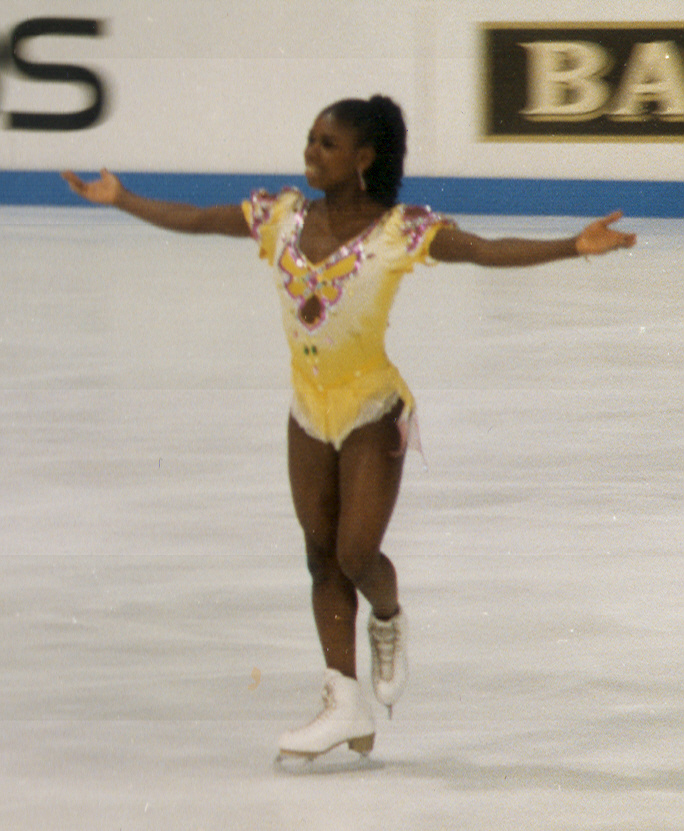
Decades prior to the move being legalised, however, one skater dared to defy the rules: Surya Bonaly. A nine-time French champion, five-time European champion, and three-time World silver medallist figure skater, Bonaly’s skating style was atypical for women’s figure skating routines. Her performances consistently pushed technical and artistic limits, and she quickly became known for challenging aesthetic norms. In competition, judges repeatedly deducted points, citing her defiance of typical skating aesthetics.
On the other hand, in every competition, Bonaly was the only black athlete in a predominantly and traditionally white sport – and the only athlete disproportionately losing points. As an act of protest, Bonaly once refused to step onto the podium when she won silver instead of gold.
At the 1998 Winter Olympics in Nagano, Japan, Bonaly predetermined that she’d be bound to lose points, and that judges would likely use her unconventional style as an excuse to mark her down. She decided that she’d lose on her own terms. As a statement against judging bias, Bonaly performed the first and only illegal backflip on Olympic ice. Most impressive of all, unlike her predecessor, she landed on one blade.
Her backflip was a powerful statement in the face of judges who conformed to a particular aesthetic style. Her iconic backflip is remembered as a defining moment of athletic protest, and instantly became one of Olympic skating’s unforgettable images. Unsurprisingly, Bonaly received deductions, toppling to 10th place.
The 2026 Winter Olympics marked a new era for the backflip, which is now recognised as an artistic feat. Among the figure skaters who performed backflips this year were American athlete Ilia Malinin, (son of Russian-born former Olympic skaters Tatiana Malinina and Roman Skorniakov), and French athlete Adam Siao Him Fa. In a gala skate performance, both athletes performed a synchronised backflip. While skating runs in the family for Malinin, it was Siao Him Fa who revived the backflip on ice by first landing the move in high-profile competitions again, including the 2024 European Championships. Siao Him Fa was penalised 2.0 points for this, but still finished with Gold.
It was in protest that Bonaly landed her backflip twenty eight years ago. Years of discrimination boiled over into a bold defiance of the sport’s rules, costing Bonaly well-earned points. Today, however, skaters freely perform this very same move. To me, the legalisation of the backflip on ice is a delayed recognition of Surya Bonaly’s powerful legacy: breaking rules to initiate artistic breakthrough.