


David Mamet’s Oleanna is a difficult play. Difficult in that it raises hard questions about how we respond to claims of sexual harassment and imbalances of power. (Questions which a steady drip of articles in our student newspapers demonstrate are as unfortunately relevant now as they were when the play was written in 1991.) But difficult too in that this show felt like both a meaningfully challenging, and yet sometimes frustrating, watch.
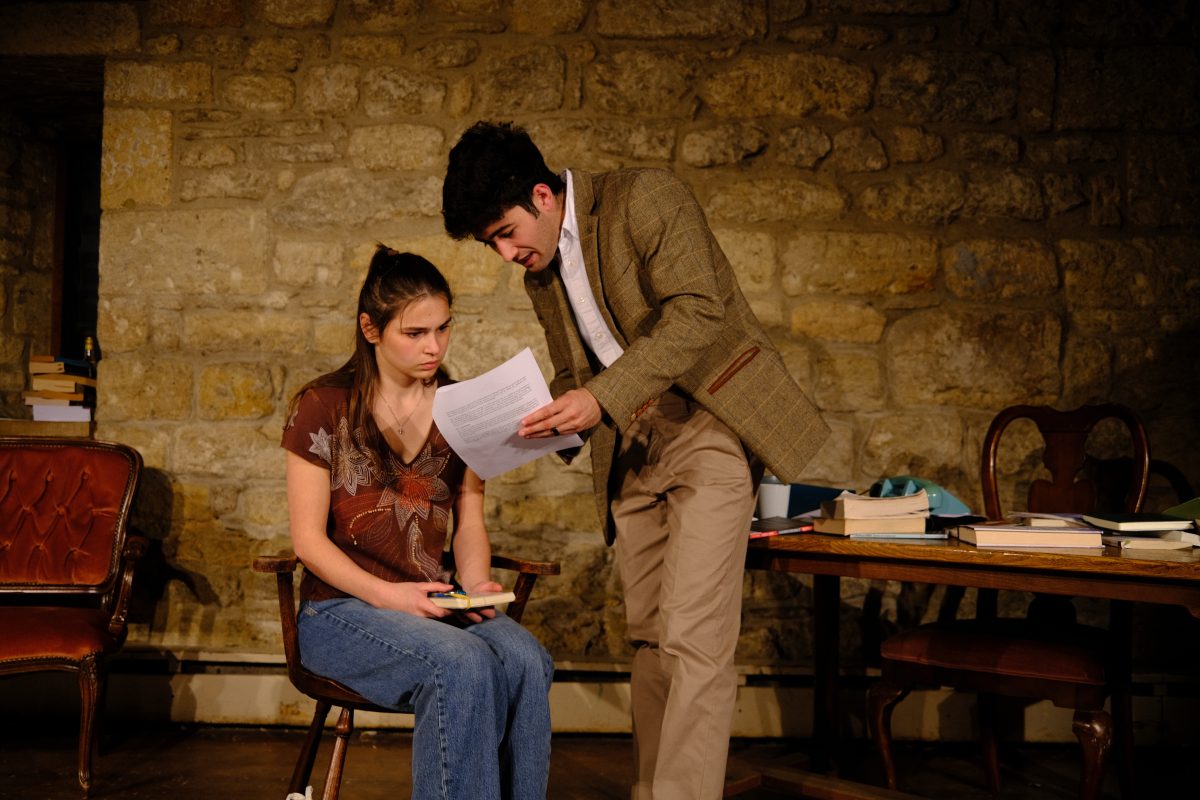
We watch three meetings between student Carol (Laura Boyd) and her literature professor John (Alec Greene) play out before us. The first, nominally some kind of work review, quickly devolves into John lecturing Carol on his educational philosophy and attempting a misguided and uncomfortable programme of personal mentorship. In the second, we learn that Carol has filed a formal complaint against John, accusing him of sexism, elitism, and making unwanted sexual advances towards her. Events spiral further; the second scene’s ending results in a new charge of attempted rape, and the third… Suffice it to say that fight co-ordinator Jack Stockdale-Haley’s excellent work fully merits their inclusion on the programme.
Any student production of Oleanna will come with heightened stakes; Oxford, with its highly personalised teaching which often sees these exact methods of one-on-one teaching, is a uniquely fraught location. The choice of New College’s Long Room, with its bare stone walls and open rafters, highlights that distinctive Oxford element, complementing the antique nature of John’s office furniture to create a set (designed by Clara Sancha) which melds the play’s 90s American setting with our modern student experience.
It is a fairly simple one. The lighting too (designed by Alexandra Russell) is minimal, limited to a slow blackout at each scene’s end. That is entirely fitting, as the play’s central purpose is to focus our entire attention onto the two characters before us.
Boyd and Greene use the small stage space excellently. The story can be tracked as much in their movements between chair and door as in their actions, with a particularly startling example coming in the third scene, where Carol takes up the corner spot next to John’s desk for the first time in a brazen assertion of authority. Boyd’s physical transition to reach the strength of this moment is exceptional, never entirely dropping the little halting movements that characterise Carol in the first scene, but folding them into a new posture of defiance. Her quiet disgust at the beginning of the second scene, before we even know of the official complaint, demonstrated an equal grasp of emotional subtlety. Greene brings a genuinely vicious edge to John’s most frenetic outbursts, meanwhile, which at times caused me to jump in my seat. His need to control the situation is visible from the very start, in his calculated interruptions, in the flair of his pronouncements; but Greene carries off too the character’s incredibly thin skin, the ease with which he is unseated from his usual place of calm.
It is all the more frustrating, given the heights both performances do reach, that there seem at times to be mismatches of words and action. Carol throughout asks John to simplify his language, to use ‘model’ instead of ‘paradigm’. In the first scene, when John starts to compare the wages of college-educated and non-college-educated workers, she has a second breakdown at the mention of any statistics, for fear of not understanding them. But that all-encompassing fear of intellectual failure, especially acute in the first scene, sat uneasily alongside the fluency her dialogue achieves in the later scenes. It’s a sense heightened by the fact that her tirades against John’s privileged position rest on the exact intellectualism (feminist in her case, though using similar rhetorical strategies to John) she earlier abhorred. The most damning of John’s statements, those which do push him over the edge of tolerability, felt forced upon the character at times. A more damaging instance for me was the script’s reference to a wider group of students Carol is representing, who have also submitted complaints based on events in John’s classes. It seemed to speak against this production’s positive focus on the personal dimension of the two characters’ relationships, the foregrounding of the individual over the collective. It also unsettled the show’s greatest strength: the decision it forces upon its audience.
Because every time I think to criticise this play, both in the moment and even now, there is a hesitation. After literally having seen everything you could possibly want to know about the situation, I found myself thinking that the thrust of Carol’s allegations after the first scene was merited, but that it was a touch overblown. It is here, for me, that the heart of the play lies: in the moment where the allegations are revealed and we are made to consider, truly, what we thought we just witnessed. All the subtleties of character the two actors conveyed become fuel for audience introspection. Are the difficulties I experienced my fault? The play begins and ends with admissions from the two that ‘I don’t understand’. Did I not understand?
BLVD Productions and director Charlie Lewis have taken on a mammoth task in Oleanna. It is a play which is incredibly dependent on the most minute aspects of the actors’ performances. There is no hiding place for them, with both on stage for the play’s full runtime. And though I had my frustrations with aspects of character and script, it cannot be denied that they have fully succeeded in prompting the conversation and audience reflection which is so critical to the play’s mission. For that, cast and crew are to be wholly congratulated.
[Oleanna, staged by BLVD Productions, is running at the Long Room in New College, 29th April-2nd May, 2026]