
Stanley Arlidge
Once again, the eyes of the world have turned to Minneapolis. This January, the killings of Renee Nicole Good and Alex Pretti by masked Immigration and Customs Enforcement (ICE) officers have dominated the front pages. Following the strongest public backlash of Donald Trump’s administration so far, the president now claims to want a “softer touch”. His “border tsar”, Tom Homan, has recently announced the withdrawal of 700 ICE officers from the city. Kristi Noem, Trump’s cabinet member responsible for ICE, has mandated that officers in Minneapolis wear body cameras. These changes should help to calm the situation, and may halt Trump’s tanking approval on the issue. However, they will do little to heal the political faultlines which created the crisis.
These faultlines were on display in the reaction to the death of Renee Nicole Good on 7 January 2026. Good, a mother of three children, was trying to interrupt an ICE raid when she was approached aggressively by officers. When she attempted to drive off, she was shot at least three times. Jonathan Ross, the officer who shot her, and the administration hold that she was trying to run over the officer, justifying the shots as self defence. However, video analysis (which everyone should watch) carried out by The New York Times has called this into question. The gulf in these responses to the same body of evidence showcases the division in American society. It suggests that many judge evidence, not on its merits, but on how it fits into preconceived notions of American society.
Vice President JD Vance labelled her death a “tragedy of her own making” and blamed the ideology of a “lunatic” left wing fringe. The administration followed up, not by cooling tensions, but by doubling down on ICE’s activity in Minneapolis. Operation Metro Surge, an enforcement operation begun in September targeting Minneapolis, was to include 3000 officers. These 3000 officers, typically wearing masks and operating in blacked out cars, outnumber the city’s police force three to one.
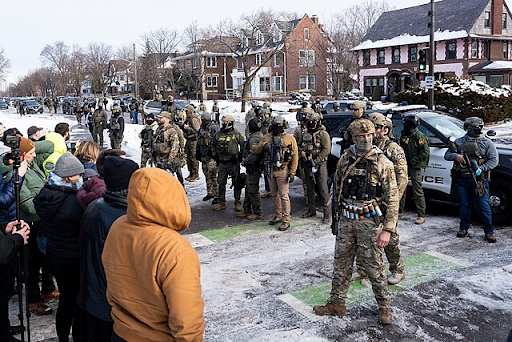
The reaction of ordinary citizens of Minneapolis to this force has created scenes across social media reminiscent of a city under occupation. Several groups, often pre-existing anti-ICE protesters with swelled numbers following the influx of agents, have organised the opposition against ICE. They have developed a swathe of techniques aimed at making it as hard as possible for agents to carry out their work. These include roving teams of “ice watchers” who track ICE agents and warn residents with whistles when agents are in the vicinity. They also film agents in action on their phones, resulting in a plethora of videos flooding social media.
None of these tactics are new. They have developed across many Democratic controlled ‘sanctuary cities’, such as LA, New York, and Chicago. These sanctuary cities, of which Minneapolis is one, refuse to enforce federal immigration law. As such, they are the number one target of President Donald Trump’s ICE-spearheaded deportation raids. As the stories of these raids show, similar events to those in Minneapolis occurred throughout 2025. In October 2025, American citizen Marimar Martinez was shot six times by an ICE officer who accused her of attempting to run him over with her car. The case against Martinez (who survived) collapsed after it emerged that the officer involved had sent messages to his friends bragging about the shooting, writing“five shots, seven holes”. It is hard not to see echoes between this story and what happened to Good.
This is not to dismiss the violence in Minneapolis. Conflict between ICE and citizenry in the city reached another level. This was tragically demonstrated by the death of 37-year-old ICU nurse Alex Pretti on 24 January. Pretti, who was armed (as is legal under Minnesota gun laws) but did not brandish his weapon, was shot multiple times by ICE agents while trying to stop the agents from arresting a woman. He was filming during the altercations by multiple eyewitnesses. Pretti had previously been involved in other skirmishes with agents, including one just eleven days before where video evidence appears to show him wrestled to the ground by ICE agents after kicking the taillight of an ICE SUV. His death, now ruled a homicide by the Minnesota medical examiner, is the tragic consequence of the escalation of tensions with ICE that, while latent all of last year, was by the death of Good.
Pretti’s death appears to have marked a turning point. It has led even some of Trump’s most loyal supporters to question the wisdom of the president’s violent crackdown on migrants. Republican Senator Bill Cassidy has called the events “incredibly disturbing”. Even Fox News, which generally stays clear of outright criticism of the president, has adopted a more critical tone towards the administration on this issue. Democrats have been much less guarded. Minneapolis mayor Jacob Frey and Governor Tim Walz have demanded the removal of ICE from Minneapolis. Bruce Springsteen, a vocal democratic supporter, accused ICE of “gestapo tactics” at a recent concert.
Most importantly, the reaction of the American people has been unequivocal. Trump’s support on the issue of Immigration, once his strongest issue, has collapsed. Polls by IPSOS show his approval rating on the issue has hit 39%, the lowest in either of his two terms. Pretti’s killing seems to have had a particular impact. While a clear majority of Americans think both the killings of Good and Pretti were unjustified, opinions are much stronger in the case of Pretti. Worryingly for Trump, the change has been particularly notable among Republicans. Thus, it is unsurprising that the president has sought to project a “softer touch” in the past few weeks.
Yet, it ultimately appears unlikely that anything will change. The damage to Trump’s brand across key parts of the coalition he used to defeat Kamala Harris has been marked. But, as conservative New York Times columnist Ross Douthat notes, swing voters have never fit into Trump’s theory of government. Trump has always governed for his base. As such, confrontations between this agenda and the blue cities in which it is implemented will continue. Even if events in Minneapolis do quiet down, the tension and division which they have created within American society over ICE will not. Unless there is a drastic shift in Trump’s own style of government, there is little reason to hope ICE stays off the front pages anytime soon.