
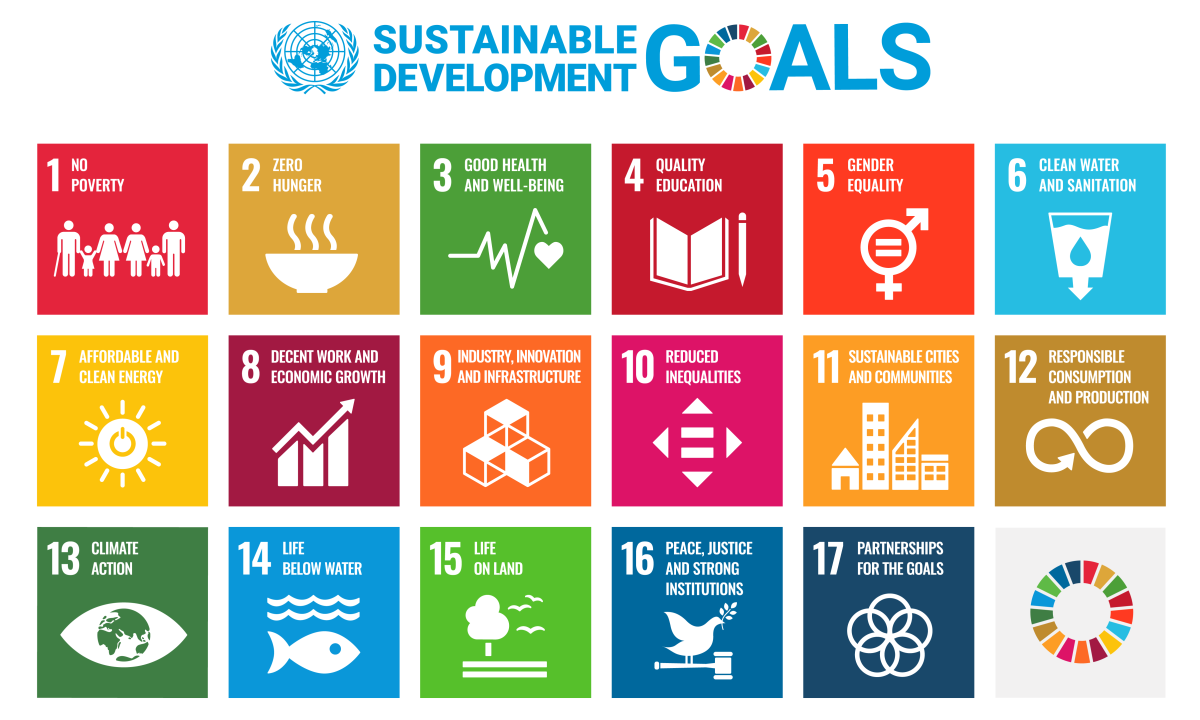
To mark the tenth birthday of the publication of the UN Sustainable Development Goals, Secretary-General António Guterres delivered a “stark assessment” on their progress. While the SDGs, aimed at social, economic, and environmental development, have “improved millions of lives,” he admitted, “the current pace of change is insufficient to fully achieve [them].”
Adopted by all UN member states in 2015, the 2030 Agenda for Sustainable Development sought to secure “peace and prosperity for people and the planet,” articulated through 17 Goals further subdivided into 169 targets. Their short titles are shown in the visualisation.
However, with only five years left until the 2030 deadline, just 35% of SDG targets are on track or making “moderate” progress. Nearly half are moving too slowly and, alarmingly, 18% are in reverse. What Guterres does not acknowledge, however, is a growing scholarly consensus: there is a contradiction inherent in the goals themselves.
In 2019, economist Jason Hickel argued that the call for humanity to achieve “harmony with nature,” central to Goals 6, 12, 13, 14, and 15, cannot be reconciled with Goal 8’s demand for sustained global economic growth of 3% per year. His research concluded that “global growth of 3% per year renders it empirically infeasible to achieve (a) any reductions in aggregate global resource use and (b) reductions in CO2 emissions rapid enough to stay within the carbon budget for 2°C.”
Hickel’s reputation as an eco-socialist has attracted scepticism from right-wing critics. Yet he is far from alone. Economists across the political spectrum have argued that the SDGs represent an internally incoherent enterprise. Writing in Current History just two months after the goals were announced, Professor William Easterly highlighted what he saw as their central fallacy: in development, asking “what should we do?” is not as helpful as it seems. He translated the manifesto from UN-speak, stating “The UN SDGs summit recommends actions that failed to happen after being recommended in many previous UN summits.” Action plans only matter if people recognise and implement them. Judging by recent progress reports, they have not.
We have long recognised the UN’s limited effectiveness in political and military affairs, particularly when permanent members of the Security Council – who hold veto power – are unwilling to support intervention. Its environmental priorities now appear similarly subordinated to the economic interests of powerful nations. Yet even in member states where support for climate action is strong, such as Labour’s push for green energy in the UK, cracks of contradiction have begun to show.
In 2025, the Great British Energy Bill, championed by Ed Miliband, led to the installation of solar panels on 11 schools, with more expected this summer. It was followed by last-week’s call for a “Rooftop Revolution,” under which homeowners can apply for low- or zero-interest loans to install solar panels through the Warm Homes Plan. Backed by £15 billion, the scheme aims to accelerate progress towards Goals 7 (Affordable and Clean Energy) and 13 (Climate Action), offering a cost-effective, renewable energy source that reduces reliance on Russian oil.
However, Miliband’s push for a clean economy has faced significant backlash. The government’s initial plans to import solar materials from China, which produces 80% of the world’s solar panels, came under scrutiny when it emerged that 40% contain polysilicon linked to Uighur Muslim forced labour in Xinjiang. In response, the government amended legislation last April, requiring Great British Energy, the state-owned energy company, to ensure slavery and human trafficking are not present within its supply chains.
Yet, when questioned in the Commons on Wednesday, Miliband did not confirm whether the same ban would apply to solar panels purchased under the Warm Homes Plan, which could see up to five million homes fitted with the technology. When pressed a second time on whether “not a single aspect” of the plan would rely on forced labour, he again stopped short of ruling it out, instead blaming the Conservatives for the “system” Labour had inherited and claiming colleagues were still “working” it out across government.
This situation is far from unique. Commitments to particular SDGs often indirectly jeopardises others – in this case, Goals 8 (Decent Work and Economic Growth) and 16 (Peace, Justice and Strong Institutions). The paradox is global. Cobalt mining for electric vehicles and hydroelectric dams that damage and displace Indigenous communities – such as the ongoing Castanheira Dam development, which would flood an area the size of 9,500 football pitches, force locals to relocate, and threaten 97 species of migratory fish – present similar trade-offs.
In 2015, ethicist Francesca Pongiglione took a more optimistic view, suggesting that contradictions should be resolved by prioritising human development goals that are compatible with, and even facilitate, sustainability objectives. Without multilateralism and dedicated partnerships for implementation, however, such resolutions remain unlikely.
There have been regional successes. Carbon pricing, private clean-energy investment, and job creation demonstrate that progress on Goal 13 is possible. But at whose expense? Hickel argues that scaling down resource consumption, rather than pursuing aggregate growth, is the most feasible way to meet climate targets. Such a commitment, however, is anathema to the pro-growth, anti-regulation interests that dominate American politics – not to mention China’s development strategy.
Across the Atlantic, Mark Carney’s speech in Davos urged Europe to reconsider its relationship with the United States, declaring the old world order dead. If that is true, are the commitments made in the relative harmony of 2015 similarly doomed? Perhaps, as Easterly predicted, they always were.
As 2030 approaches, we must think more critically about how to implement goals consistently, both within and beyond national borders. Asking “what should we do?” may yield answers, but without concrete action they will remain forever theoretical.
We have been brought together by a city renowned for thinking, debating, and theorising. But if we want to promote genuine change then we must take, rather than consider, action.
For research and UN SDG resources, see RELX and The 17 Goals.