
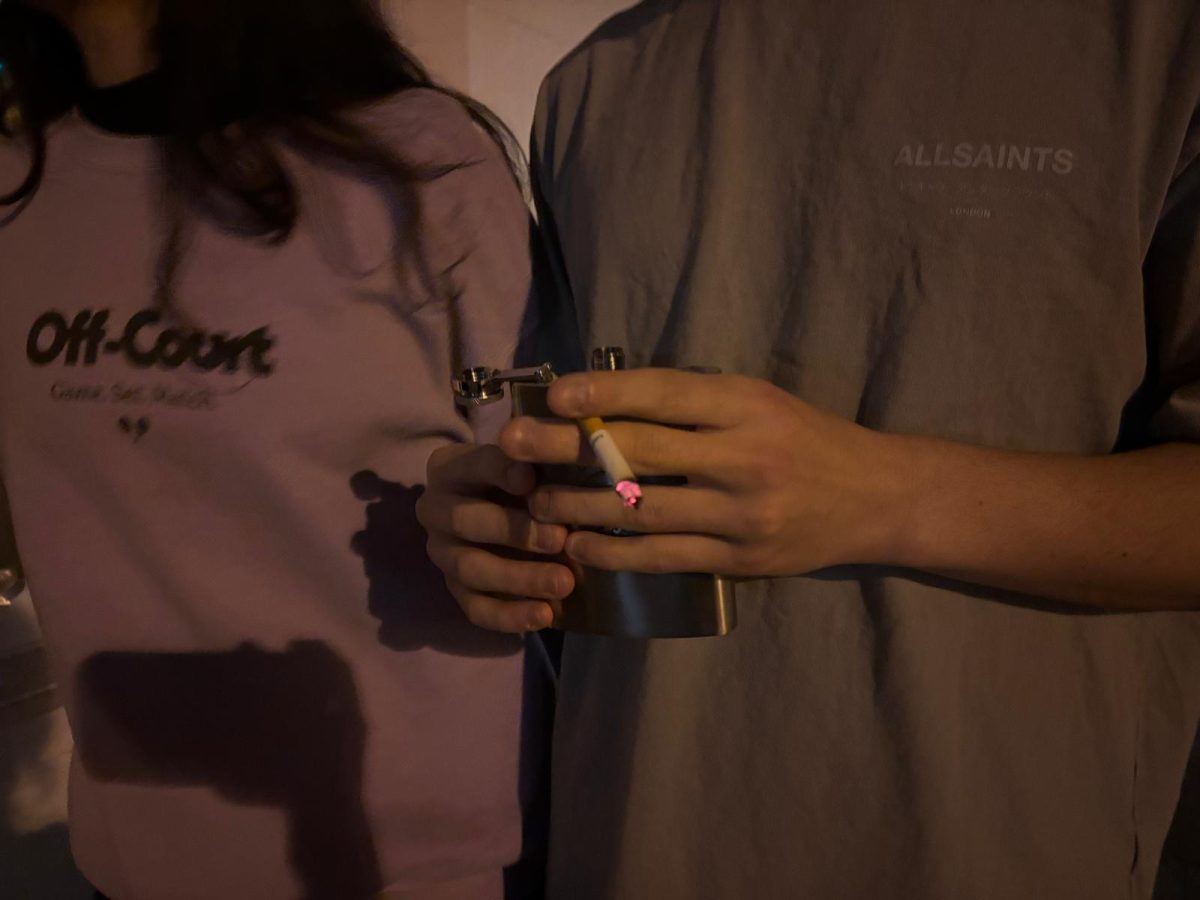
Week 3 was a little while ago now, so forgive me for asking – but did Oxford’s theatres seem a little smoky to anyone else? First, there was Company, in which Orla Wyatt’s character Joanne lit up amid the hedonism of a club night. Then, in The Glass Menagerie, smoking seemed a habit for Oli Spooner’s Tom, and became the source of some domestic tension when his colleague came around for dinner. And, in the first scene of Red, ‘[t]he scent of cigarettes lay heavy in the air.’ Though I didn’t see the latter myself, it seemed a startling outburst of nicotine given that we’ve only now hit the Fifth Week Blues.
Smoking on stage has been a disputed topic for as long as smoking has been a disputed activity, but the modern iteration of the debate begins with the introduction of the ban on smoking in enclosed public spaces in 2007. Though an exemption was made for the stage when necessary to the plot, clearly its intent to eliminate or at least vastly reduce exposure to ‘second-hand smoke’ can come into conflict with staged cigarette use.
It’s an issue that was very much at the forefront of these productions’ concerns heading into the show too. Speaking to the Blue, Company’s production manager Felix Westcott detailed the extensive precautions the show had to take, especially given the Oxford Playhouse’s more stringent safety requirements. This involved planning for the worst-case scenario of a fire on stage: to contain this, ‘[the l]ighter and lit cigarettes [were] to always stay upstage of the iron curtain and […] be kept in constant eyesight of at least one stage manager with easy access to a fire extinguisher.’ This would allow for the audience to be protected from any fires by the iron fire curtain. Strict rules were also in place for the handling of lit cigarettes, and all involved were trained. Perhaps most importantly (from the perspective of actor health), the production used nicotine- and tar-free herbal cigarettes, although director Joshua Robey told us that the production still received complaints about the smell even with the venue’s ventilation system turned up!
Quite a major undertaking, then, to safely portray a character smoking on stage. So, why did Oxford’s directors bring the whiff of smoke back to theatres? Well, one obvious answer is that all three productions are period pieces: Company from the 70s, Red following mid-century artist Mark Rothko, and The Glass Menagerie set before the outbreak of the Second World War. It’s easy to forget, as a majority-Gen Z audience, how smoke-filled the 20th century was. Rates halved between 1950 and 1990, well before the indoor smoking ban came into effect; even since current students were born, 2024 saw the lowest proportion of smoking adults since records began in 2011 (10.6%). Presenting characters smoking as an idle activity, or without any raised eyebrows from others in the scene, can play a vital role in establishing a show’s period, and features automatically in many scripts written at the time.
The other keyword in smoking’s artistic contribution is atmosphere. It is a pleasure- seeking activity, dangerous, exciting – but, significantly, without the legal repercussions of drug use or the unpleasantly immediate side-effects of drunkenness. That, at least, is the association that the 20th century has left us with, when, at its peak, nearly 30% of all films portrayed the habit. Interestingly, Company’s team had a slightly different focus: Robey saw it as key to achieving the play’s ‘emerging grimmer realism’. Though in the 70s this may have passed uncommented, Robey’s vision suggests smoking carries a greater association with its darker side for modern productions, regardless of the play’s time period.
It should not be underestimated how versatile a prop a cigarette can be either, and how helpful it can be for an actor in expressing their character. How they handle the lighter; the precise nature of the inhale; where they breathe the smoke: all of this can help convey nuances of attitude and perspective, thereby lifting some of the character-creating burden from the raw script.
But still: why the sudden outburst? Quirks of scheduling have undoubtedly played their part; The Glass Menagerie was originally slated for a Michaelmas run. But perhaps this is more than mere coincidence. Oxford’s theatre scene has in the past week followed a larger trend in culture, as smoking has made somewhat of a comeback on the silver screen too. Cancerworld’s run-down on the topic references Oppenheimer (2023), The Brutalist (2024), and Blonde (2022); to that list could be added last year’s critical darlings Sinners and One Battle After Another. Here we rub up against the contentious issue of the media’s influence on the world. It is a debate we’re most familiar with through tedious culture wars against violence in video games and historic ‘satanic panics’ over games like Dungeons and Dragons. Mark Lawson’s argument when the stage ban was being discussed, sub-headlined ‘It would be ludicrous to censor smoking on stage given our tolerance for sex and violence’, has some force to it too. If we accept that behaviour on stage does not make people more violent, then smoking can surely be excused.
But smoking, it seems, is different. Cancerworld’s article cites a meta-analysis that ‘for every 500 tobacco impressions viewed in movies, the odds of adolescent smoking initiation increased by 39%,’ among a plethora of other studies linking depictions of smoking to real-world addiction. Adolescent smoking initiation is less of an issue in amateur student productions, which tend to attract less of an audience outside the university. But theatre is equally a far more immediate art form than film, and faces exactly the same challenges when it comes to depicting the health consequences many of these characters would, in time, face as a result of their habit. Whether an individual production can be taken to task for cumulative effects like this is a difficult question. If we take on the responsibility of eliminating smoking from the stage, we would need to reconsider how we handle classic playwrights like Tennessee Williams, for whom smoking, as The Glass Menagerie demonstrated, was a key part of their expressive and social toolkit.
On an individual level, staging smoking was probably the right choice for these three productions: their cigarettes were mentioned in the Blue’s reviews, after all! But as for the wider place of smoking in theatres? The latest development came last year, with MP Mary Kelly Foy’s call for a complete cigarette ban as part of an amendment to the proposed laws to extend smoking bans to pub gardens. Though it seems to have gone no further for the moment, her intervention demonstrates that this debate will probably smoulder on for a while yet.