

Thomas Yates
Sudan gained independence from Britain in 1956. Over the 70 years since then, it has been embroiled in variations of civil war for 40. Indeed, the nation knows more war than it does peace. 2023 marked the beginning of a new conflict. Over 1000 days later, in spite of humanitarian disaster, a refugee crisis, and accusations of genocide and crimes against humanity, proposal after proposal for peace has been rejected.
Who is involved?
The current conflict pits the Sudanese army – the Sudanese Armed Forces (SAF) – against the Rapid Support Forces (RSF), a rebel paramilitary group. The RSF developed from the Janjaweed, a mercenary militia of nomads. Fighting against rebels in the Darfur region in Sudan’s west, the Janjaweed effectively provided the Sudanese government with an extra army. However, its approach was heavy-handed. The Janjaweed is implicated in the Darfur genocide of 2003-5 against the non-Arab population – in December 2025, one of its former leaders was sentenced to 20 years in prison by the International Criminal Court on 27 counts of war crimes and crimes against humanity. Nevertheless, considered a useful force to have at Sudan’s disposal, the Janjaweed militias were formalised into the RSF in 2013. It has been under the control of General Mohammed Hamdan Dagalo – known as “Hemedti” – since its inception.
In April 2019, a popularly-backed military coup ousted long-standing president Omar Al-Bashir, who had governed the country since a coup of his own in 1989. Having little association with Al-Bashir’s regime, Lieutenant General Abdel Fattah al-Burhan of the SAF was put in charge of a new transitional council. His deputy was none other than Hemedti of the RSF.
This council was intended to combine the leadership of the military and non-soldiers, but civilian participation did not last long. Prime Minister Abdalla Hamdok, an economist, was ousted by the RSF and SAF in October 2021. As a result, important financial aid from the World Bank and International Monetary Fund was withheld, leaving Al-Burhan and Hemedti with no other choice but to reinstate the prime minister. However, given that at this stage he was clearly acting as a puppet leader subject to the whims of the military, Hamdok resigned for good in January 2022.
In 2023, the military alliance itself showed cracks. Neither leader wanted their army to be subsumed by the other. Shooting between the two sides first took place on 15 April 2023; the RSF then moved to take as much territory as quickly as possible and seized the capital, Khartoum.
What does the conflict consist of today?
Khartoum was recaptured by Al-Burhan’s forces in March 2025, and at long last the military government moved back into the devastated capital earlier this month. However, much of the Darfur region, the traditional stronghold of the Janjaweed and the RSF, remains in the RSF’s hands. Many towns experience lengthy sieges as the RSF tries to plan a strategic path back to the capital, whilst the SAF does what it can to block their approach. Notably, the RSF took the Darfur city of El Fasher in October 2025, ending a siege of over 500 days. More recently, fighting has centred on the Kordofan region, in the country’s south, to the east of Darfur. The RSF announced that it had taken the strategically-located city of Babnusa in West Kordofan on 2 December – a claim which the SAF disputed. Holding Babnusa would give the RSF further security over their Darfur territories.
Cities are not the only target, as Sudan’s wealth of natural resources brings conflict to even rural areas. The SAF relinquished control of Sudan’s largest oilfield, Heglig in South Kordofan, to the RSF on 8 December 2025. Kordofan is also plentiful in gold, as is Darfur. Even before the civil war, Hemedti was making a fortune by using the RSF to control the country’s mines.
The war has in fact spread across borders; not all the fighters have ties to Sudan. In December, the US announced sanctions on a network believed to be training and sending Colombian ex-servicemen to fight as mercenaries in the conflict.
Labels of Genocide and War Crimes
Tens of thousands have died since the outbreak of the war. This includes a concerningly high number of unarmed civilians killed by the RSF. An eyewitness testimony from El Fasher has described how “the RSF were killing people as if they were flies.” At least 116 civilians in the Kalogi area of Kordofan are believed to have been killed by the RSF, which includes 46 who lost their lives due to a drone attack on a school. RSF violence has also been notable in Darfur. From 2003, the Janjaweed carried out scorched earth tactics in Darfur on behalf of the government. This targeted the non-Arab population and involved the burning of villages and poisoning of wells, actions that were labeled as genocidal by the UN in 2004. Now, history seems to be repeating itself. Amnesty International’s researchers have confirmed multiple attacks in Darfur against the Masalit people. This has included a shooting inside a health clinic in the town of El Geneina in May 2023, which killed a doctor and 13 patients. This is a level of violence beyond the scope of ordinary warfare.
The SAF, too, may be implicated in war crimes. Barrels of chlorine appear to have been dropped on RSF troops to the north of Khartoum in September 2024 – the use of chemical weapons is prohibited by the Chemical Weapons Convention, which is observed by Sudan as well as 192 other countries. SAF aircraft have also dropped bombs indiscriminately on civilian areas, including on schools, markets and refugee camps.
A Humanitarian Crisis
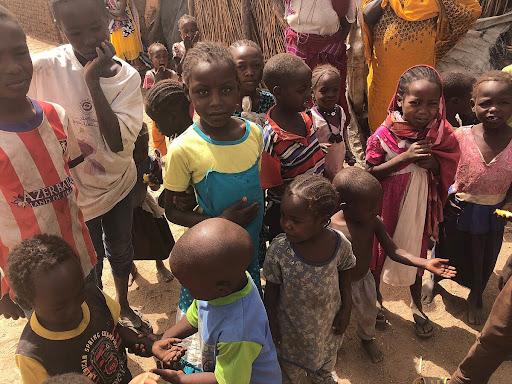
Huge numbers of people have fled their homes to escape violence, or have been forced to move because their home has been destroyed. In total, over 13 million people have been displaced in Sudan. Since the end of the siege on El Fasher, more than 100,000 people have left the city, including hundreds of unaccompanied children. However, the camps within Sudan are overcrowded and unhygienic, while the UN has warned that displaced people are more likely to be subject to human trafficking, for sexual purposes or for forced recruitment to a militia.
Given that even hospitals appear to be treated as a valid target, medical aid can be hard to come by. Over 70% of Sudan’s hospitals have been destroyed, which has contributed to a surge in cholera, with 120,000 cases reported. The lengthy sieges on towns make it impossible for supplies to reach civilians trapped inside, although the RSF has denied blocking aid.
The UN’s World Food Programme (WFP) has estimated that 21.2 million people in Sudan are highly food insecure; this equates to 45% of its population. It has confirmed famine conditions in the cities of El Fasher and Kadugli (in South Kordofan), and more people are believed to live with famine in Sudan than across the rest of the world combined.
As conflict continues, problems will continue to mount. The WFP believes that its food stocks will run out by the end of March without an extra $700 million in funding. The Chief of the World Health Organisation, Tedros Ahanom Ghebreyesus, gave an estimate of 33.7 million people needing humanitarian aid this year. An end to the fighting is of the utmost urgency.
How can the conflict be brought to an end?
Attempts have been made to resolve the conflict, but as of yet, none have produced any results. The RSF agreed to a three month humanitarian ceasefire in early November 2025 – but fighting continued in spite of this. Though the USA was already trying to broker peace, Donald Trump has now involved himself personally in the issue, posting on Truth Social on 19 November that “tremendous atrocities are taking place in Sudan. It has become the most violent place on Earth.” He will face an uphill battle to make the difference, however. On 23 November, al-Burhan described the latest deal proposed as “the worst ever,” accusing it of bias.
The problem stems from the different countries involved in the agreement. Currently this centres around the ‘Quad’: the USA, the UAE, Saudi Arabia and Egypt. The UAE and Saudi Arabia have not always been on the best of diplomatic terms – they backed different sides in Yemen – and this case is unfortunately no different. Saudi Arabia and Egypt have backed the SAF, whereas the UAE is believed to be supporting the RSF through arms and drone strikes, because it benefits from Hemedti’s control of Sudan’s gold supply. The UAE denies this, but until the different conflicts of interest within the Quad – whether they are perceived or real – are overcome, we should expect accusations of ‘bias’ to continue to fly. Trump’s challenge will be bringing all sides eye-to-eye.
The war must end as quickly as possible, but foreign in-fighting regrettably means that the threads are ever harder to untangle.