
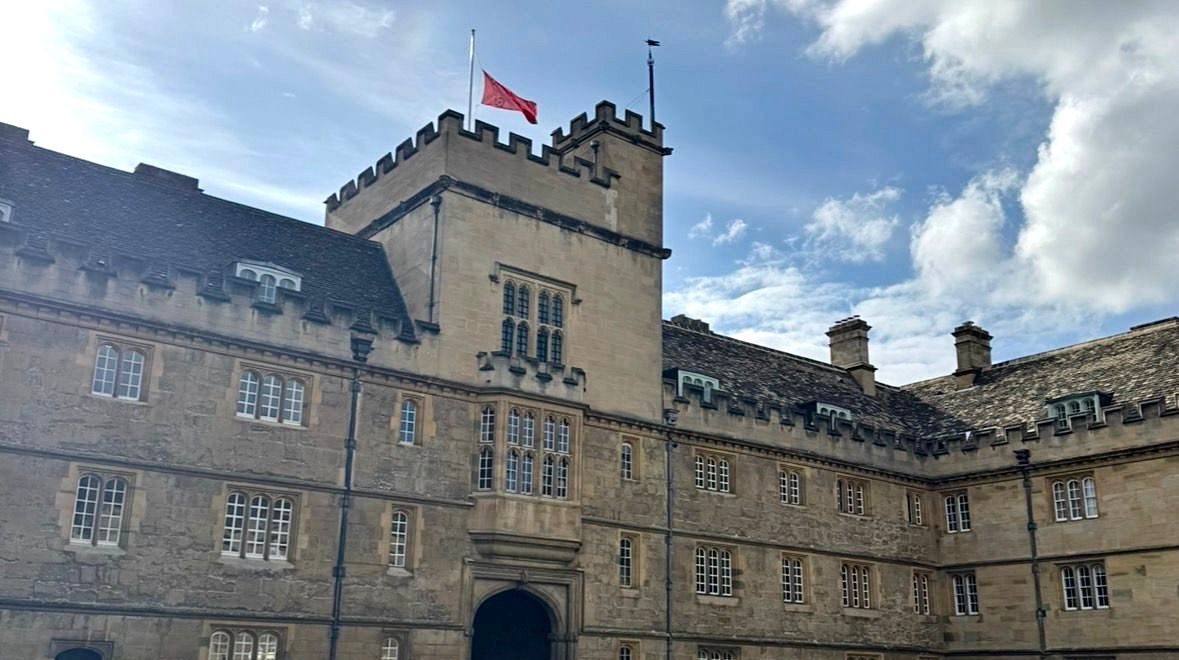
On Friday 6 March, in Wadham’s Hollywell Music Room, a panel discussion was held in honour of International Women’s Day. The panel consisted of Lucy Lake, CEO of Campaign for Female Education, and Tehila Sasson, Wadham-based Associate Professor of Modern History. Within these blue walls, the discussion ranged from feminism in practice to the future fight for gender equality.
A Wadham alumna, Lake became the CEO of CAMFED in 2012: a pan-African, grassroots movement focusing on enabling and empowering girls’ education and female leadership to tackle poverty, inequality, and injustice. CAMFED has supported over 7.8 million children to attend primary and secondary education in Ghana, Tanzania, Malawi, Zambia, and Zimbabwe. Thinking about post secondary education, the campaign provides young women with financial training and support to pursue higher education and employment. A mentorship programme ensures that individual success leads to community regeneration. Under Lake’s tenure, CAMFED was awarded the Hilton Humanitarian Prize, and received a UN Global Climate Action Award. In 2020, Lake was awarded the Yidan Prize for Education Development for her contribution to gender equality in education. Three years ago, Lake stepped away from CAMFED, but continues to campaign for individual and institutional change to support gender equality in education.
Sasson’s area of expertise is the British Empire and international order from 1850 until the present day, focusing on the intersectionality of institutional inequalities, the development of economic thought and its convergence law. Her practice draws from a variety of archival sources, ensuring that Britain’s history exists within its imperialist landscape. Serving as a co-editor of the journal Modern British History, published by Oxford University Press, Sasson also sits on the editorial board of Bloomsbury Press’ Histories of Internationalism series, providing cutting-edge research on the modern history of international cooperation and internationalising ambitions. Currently, Sasson is working on two new projects: one considers the political aspects of financial exclusion in Britain and the alternative financial schemes that Afro-Caribbean communities developed in response; the other investigates the effects of ownership of natural resources on international politics in the 20th century.
The panel opened with a focus on how their work related to gender. Lake offered her experience working in education in Zimbabwe following her graduation from Oxford University. There she found that cultural sentiment clashed with recent publications in Human Sciences: it was not that families were unwilling for their daughters to attend school, but rather that families could not financially support this endeavour. Concluding that girls’ education had to be the starting point for social change and gender justice, Sasson introduced her academic relationship with gender as a historian. She highlighted the intersectional quality of any advancement of gender equality, pointing to different means by which “inequality is articulated”. In academia, Sasson related her undergraduate experience where women were a “category of analysis”; it was the likes of Judith Butler and Wendy Brown that transformed her understanding of this categorisation.
Moving deeper into the conversation, the panel was asked how their time at Wadham College shaped their understanding of gender and the trajectory of their work. Reflecting on her time as an undergraduate in the early 90s, Lake stressed the radical, progressive reputation Wadham had, and continues to maintain. She was also struck by the “action that was taken for inclusion”: there was a room dedicated to the provision of feminine products, battles included a tampon levy to protest the tampon tax, tuxedos were banned during formals, which were also made more affordable. Now such ‘formals’ are gone entirely, replaced by standard-priced ‘dress up dinners’. The community and institutional action occurring in Wadham then seemed “quite radical” to Lake. Now, at a highly vulnerable time for gender justice globally, she was less concerned with “breaking glass ceilings” and stressed the necessity to “reinforce concrete floors”.
Sasson joined Wadham a year and a half ago, and opened the discussion to the community of the University, including lectures, professors, and researchers. Overall, there is an overarching lack of female representation in faculties. Nevertheless, Sasson appreciated the “interest and passion” of students and colleagues in gender history. Considering how to orient herself as a feminist within Oxford, she stressed her impression of the University as a “student-led institution”, a place in which we students must work to establish the terms of debate, and set forth our own agenda.
Here, the interviewees set forth their own radical agenda, turning questions onto their conveners, Annabel Wortsman and Jasmine Shakman, Wadham’s Womxn’s Officers. Considering the culture and community of Wadham now, Wortsman valued students’ “every day questioning of what gender is” and ability to “envision the radical”. Jasmine turned a spotlight to the hope we have for the future, looking to the “resiliency” of our generation. Friends, and inter and intra Collegiate communities, are essential to this resiliency and hope – “feminism doesn’t just exist in places of institution, but also the personal”.
Questioned on what contemporary feminism should focus on, relating to their personal and work experience, Sasson replied that she “doesn’t need to dictate, but I can tell you what I am thinking about as a feminist”. In the past 6 years, Sasson has become a Mother and moved countries. Consequently, she was deeply impacted by the Care Crisis. The structure of our current economy relies on a sector of care that produces revenue by means of “invisible labour”. This labour, Sasson noted, is predominantly provided by women, and while the economy demands this work, it fails to provide adequate support or reward for the ‘invisible labour’ workforce. According to Sasson, this leads to “certain economic crises” and an intersectional marginalisation of women on economic, social, and political strata.
This far-reaching problem requires a “holistic” feminism, according to Lake. Focusing on education, she pointed to “disturbing” changes in young people’s attitude towards gender equality. King’s Global Institute for Women’s Leadership and Ispsos’ 2023 International Women’s Day survey has illustrated a growing backlash against gender equality: 54% of candidates believed efforts have gone far enough, and that the empowerment of women now risks the discrimination of men. Lake was most concerned as these increases are “not being seen among older people”, instead it is Gen Z that are shifting their opinions, evidenced by The Guardian report that almost a third of Gen Z boys and men believe that a wife should obey her husband. Lake contends this data raises desperate questions of what “toxic narratives” our educational systems are failing to equip students against.
Leading from ideas of individual and collective responsibilities, the conversation shifted to consider the practicalities and effects of bottom up and top down change. Starting with supporting girls’ education, Lake faced the top down model with cynicism where finance proved to be the “core factor” in families “having to make a choice, if you can call it a choice”, stating that they are facing a “culture of poverty, not a poverty of culture”. Lake highlighted the essential role of individual expertise and lived experiences within any top down model.
Sasson stressed that “social movement should push and radicalise the agenda”, pointing directly to massive gender inequalities in AI. Recently, Grok AI has faced legal controversy over its deepfake undressing videos. Jess Davies, journalist and campaigner, was a victim of this practice and reported to the BBC that “it is a sobering thought to think of how many women including myself have been targeted”. Private industry, according to Sasson, must “set up a different infrastructure to regulate this behemoth of a thing”.
Considering the potential for positive change and risk of mismanagement posed by NGOs, Lake stressed the need for organisations to cater for the “most marginalised” to ensure everyone feels their benefits. Setting forth the “prism of sex, money and power”, Lake expressed that while cash-in-hand NGO work intends to implement local change, it risks creating the perfect scenario for exploitation. She emphasised a change in mindset: “girls are not beneficiaries of support, they are entitled [to it]. It is not about power over those girls, it is how we can be accountable to them”. Sasson pointed to the notorious paedophile and sex trafficker, Jeffery Epstein, as a “symptom of broader exploitation”, exposing a crisis of abuse and exploitation by those in unchecked power.
Sasson also stressed the limited accountability NGOs are held to, citing the 2018 Oxfam sexual exploitation scandal in Haiti. Despite large NGOs acquiring funding through governments, the organisations are rarely regulated by external bodies. Sasson promoted an immediate change to the regulation of NGO actions and agendas, especially considering how grass-roots movements and NGOs converge.
Moving towards the audience Q&A, the panellists were asked what actional outcome their audience can take to contribute to the fight for gender equality within the local and/or global context. Sasson related that she felt it “a bit un-feminist of me to say what you should do”, but that she encouraged all students to “think about how they can change the world”, to “follow what you find really important and push for it, read more about it, organise around it. This is your job as a student”. Lake stressed the importance of finding ways of relating one’s own personal experience and histories to these social issues and concluded the session addressing the audience: “we all have power, how do we use it?”.
Opening the Q&A, questions of managing disagreement within feminist communities and the routes that Sasson and Lake took to their jobs were raised. Rather than the division natural to a Q&A set up, the discussion became much more conversational with a lot of focus on Wadhamite experience now. One member of the audience expressed that “if people are not saying something, it does not mean it is not happening”; another reflected that the discussion was “impassioned, honest, and difficult”.