
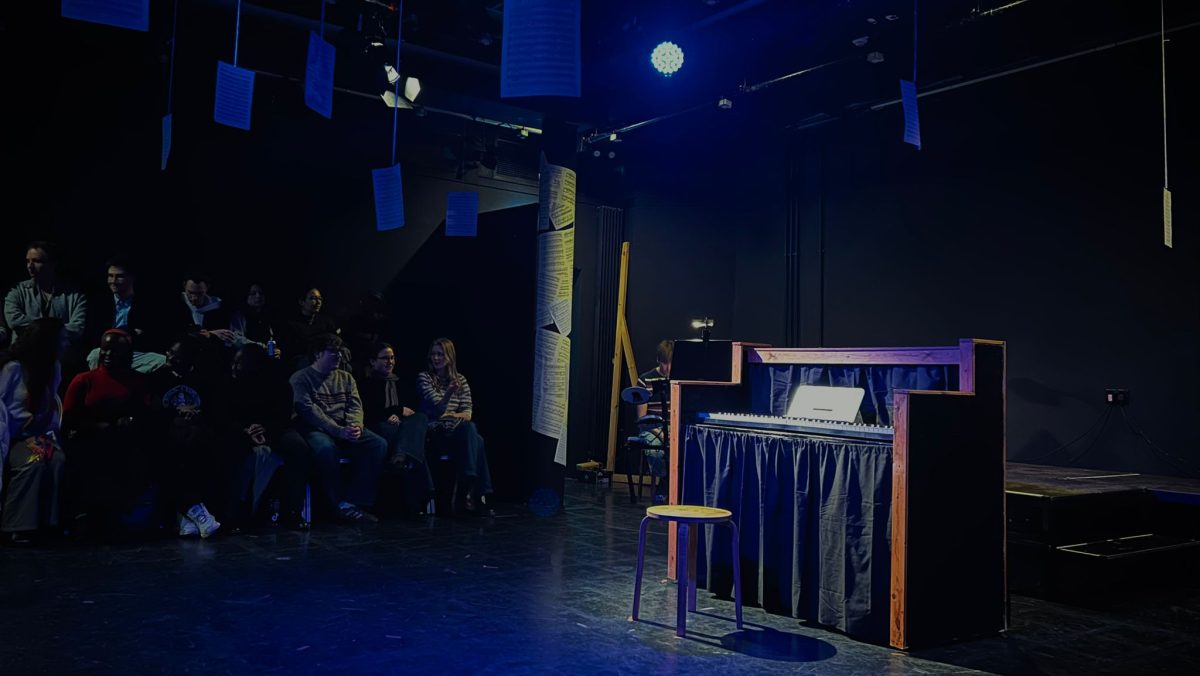
The blackbox studio of The Pilch is awash with blue. Sheets of music are suspended dreams, spinning on threads around a solitary piano, or spangling walls and columns. Then: darkness. Backlight. The ticking begins.
Tick, Tick… BOOM! is a semi-autobiographical story about ambition, the struggle between creativity and stability, and the experience of a man stepping into his thirties. This man in question is Jonathan Larson (played by Laurentian Jungkamp), who later became famous for creating the musical Rent. Tick, Tick… BOOM!. This dramatises the eve of Jon’s 30th birthday, and explores his relationship with his girlfriend Susan, a dancer who wants to leave New York City and her job teaching ballet to ‘rich, untalented kids’ in favour of a more peaceful and domestic life; Larson also explores his relationship with his best friend Michael, a former actor who has successfully transitioned to the corporate world and recently moved out of their shared apartment.
From the beginning, Laurentien Jungkamp brings Jon a frazzled charm, and his quieter demeanour feels appropriate to the intimate setting of the blackbox. (The only small gripe I have is that Jungkamp’s American accent felt unconvincing at times, though this is only slightly distracting.) Katie Gill, who plays Susan, is an absolute powerhouse, switching effortlessly between vocal and emotional registers. Always giving the impression of having total control over her performance as well as the overall tone of the scene; Gill matches this with her delivery of emotional variability as Susan, while then the doubling of parts in the show also allows her to shine in smaller comedic roles such as the irritated and buzzword-addicted marketing lead at Michael’s company, or Jon’s deadbeat agent Rosa Stevens. Noah Rudder, like his character Michael, is a deeply impressive actor who manages to convey great emotional nuance: from facial expressions to nervous tics, Rudder embodies whatever emotion is called for in the scene. The slow shift from Michael’s outward confident assurance at the beginning to exasperation and vulnerability towards the end of the musical was very well done. The confrontation between Jon and Michael, during which the latter finally reveals that he’s ‘sick’ (implying that he has received an HIV-positive diagnosis), was performed brilliantly: the shock of the reveal creates an (at least momentary) emotional wall between the two characters that the actors’ performances render palpable and heart-breaking.
This moment marks a turning-point in Jon’s emotional journey as he then sings a ballad reflecting on their friendship from childhood, and decides that he wants to spend his life pursuing his passions. The fact that Michael’s HIV status is seemingly used as a plot device to further Jon’s emotional development doesn’t sit quite right, especially given the fact that the musical is implicitly set against the backdrop of the AIDS crisis—but this is a limit of form (with Tick, Tick…BOOM! being a semi-autobiographical musical) and by no means of this production. The fact that the production still manages to deliver satisfying emotional closure to the narrative despite this, is a testament to the cast’s strengths.
In addition, this production further uses the quirks of Tick, Tick…BOOM!‘s formal elements to its advantage, including its use of doubling: the cast only consists of three people, so both Gill and Rudder play multiple roles. The quick changes are creative and entertaining, but the production is also not afraid to poke fun at itself by meta-theatrically gesturing towards its actors’ multiple roles. This creates thematic coherence and highlights emotional parallels in the story: during Gill’s beautiful performance of “Come to Your Senses” as Karessa (the lead actress of Superbia in Jon’s workshop), she removes her jacket and hair clip. The costume change seemingly signals a diegetically impossible slippage of the identity of the character Gill is portraying. Instead of Karessa performing a song from Superbia, the audience now sees Susan genuinely delivering a heart-wrenching ballad about drifting apart in a relationship to Jon, who sits rapt below the raised platform functioning as a stage (but still on display to the rest of the real audience.) This clever subversion of an established theatrical practice which is built into Tick, Tick…BOOM! (and which the audience has spent most of the musical using as a framework for dramatic interpretation) blurs the line between the musical and the musical-within-the-musical, intensifying the musical’s emotional effect.
In a related vein, the production also at times draws attention to its limited cast for comedic effect—for example, the scene depicting Jon’s awkward experience in the marketing department features involvement from the band, who contribute inane suggestions towards the naming of a cooking oil-substitute. This is the only time the band participates as ‘actors on stage’, and it serves to enhance how stifling Jon finds the corporate world.
The production also makes good use of spatiality. Often, actors traverse the whole stage-space, and Jungkamp in particular makes sure to walk up to and lock eyes with audience members as he delivers his narration (“Jonny’s up and pacing,” he sings in “Jonny Can’t Decide”), leaning into the confessional mode the blackbox studio lends itself to. The use of spatiality also stretches beyond the stage and up towards the ceiling. As the musical goes on, characters pluck suspended sheets of music from the air, flashes of white disappearing from view like burst bubbles. While the musical swings like a pendulum between agitated excitement to doubtful despair, this slow deconstruction of the aerial set seems to reflect the fear of time stealing away one’s dreams. Yet, the musical reveals itself to be fundamentally committed to hope: in the last musical number of the show, the cast comes together to sing an energetic finale (“Louder than Words”) that calls for the triumph of “love” over “fear.”
In a final, short scene, Jon faces down the dreaded happy birthday song invoked in the opening number (“30/90”) by hesitatingly playing it on the piano. The darkened studio hushes its audience into the reverence of ritual, and Susan walks in with a cake and a single lit candle. Right before the end, Jon seems to stumble into a dissonant chord, subdued amidst the simple melody; then, he settles the tune into a perfect cadence, and turns to blow out the candle. As he does, the faint, remaining stagelights are swept into darkness. The soft dissonance of the piano lingers in the bittersweet hope of Tick, Tick, BOOM!: a suitable ending for a story as much about the waning of dreams as their fulfilment.
[Tick, Tick… BOOM!, staged by Piezoelectric Productions, is running at Michael Pitch Studio, 11th-14th February, 2026.]