
Environmental sustainability is slowly becoming synonymous with the St Anne’s brand, and no one knows more about it than John Banbrook. Through his work as the Domestic Bursar, Banbrook has helped to make St Anne’s one of the leading colleges in environment-focused development and innovation.
It is clear that St Anne’s environmental policy is student driven. Speaking to the Oxford Blue, Banbrook recalls how, shortly after he began his role, the environment representative of St Anne’s Junior Common Room provided him with a list of demands on behalf of the student body. He describes this as “the turning point”, that defined success as integrating environment and sustainability issues into the fabric of the college’s governance structure. From this, an environment committee was established in college, and an action plan of seven core pillars was produced. This environmental policy has since been presented to the governing body every Trinity term, to measure progress and reassess schemes and goals.
One of these seven pillars, and arguably the most immediately visible to a St Anne’s student, is catering. Head Chef Ben Gibbons is described by Banbrook as a “very forward thinking chef”, passionate about locally sourced seasonal produce. Gibbons and Banbrook adapted the generally unpopular and ineffective “meat-free Monday” concept seen at other colleges, and chose to provide a more attractive, less carbon-intensive meat option in its stead. By serving local wild venison as part of the college’s “low-carbon Monday” scheme, the college bought meat that was a product of population control schemes, ensuring that meat did not go to waste, and had a minimal carbon footprint. St Anne’s is also one of 16 colleges to join the OXFarmToFork initiative, which allows catering teams to buy directly from local farmers with approved agroecological farming techniques to protect soil quality and biodiversity.
Climate-friendly alternatives like these have become associated with the St Anne’s dining hall, with their termly low-carbon formals. Working with My Emissions, a data-driven Food Carbon Accounting platform, St Anne’s dining hall menus feature a traffic light system to measure and display the carbon footprint of menu choices. It seems that even by placing the vegan and vegetarian options first upon entering the servery, more and more students are unconsciously incentivised to choose a more sustainable meal option.
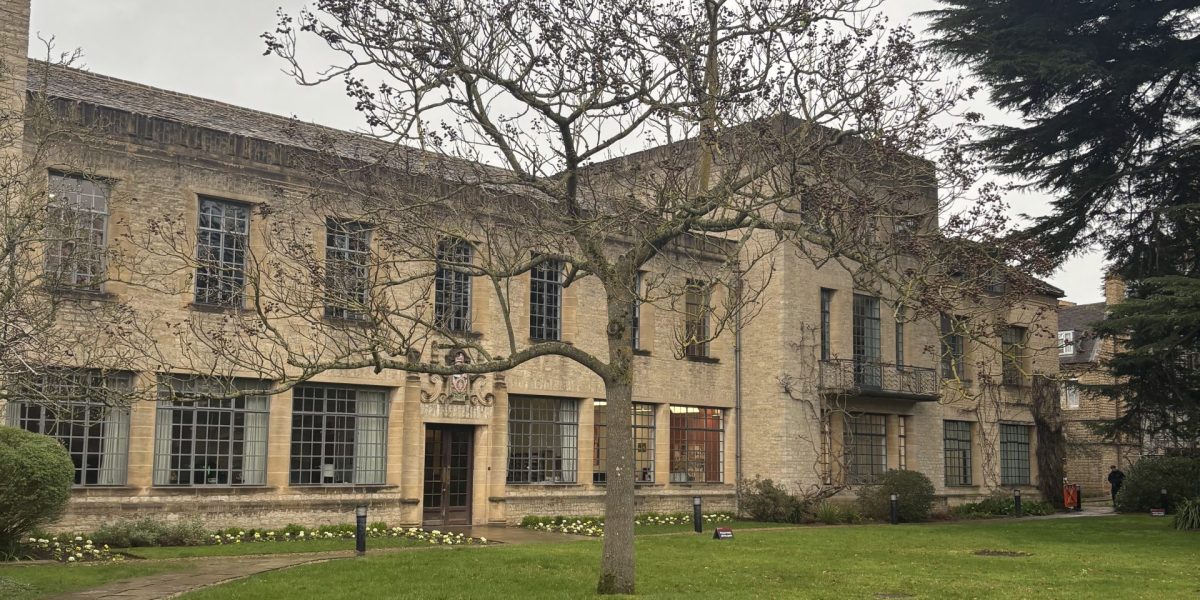
Not only is the ethos of St Anne’s modern, but so is its physical landscape. The college’s 1950s wood panelled dining hall differs drastically from the vaulted ceilings of 13th century colleges like Balliol. Banbrook sees this as providing St Anne’s with a unique opportunity, with it being far easier to achieve sustainable solutions on new or more modern buildings than in centuries old architecture.
Yet St Anne’s is still constrained by a smaller budget than the older colleges – as such, Banbrook is driven by a search for “the biggest impact per pound we spend”. The recently completed Bevington Road project (which saw the restoration and renovation of 165-year-old Victorian properties) highlights the difficulties all colleges face when balancing the need for quality student accommodation with the environmental consequences of construction. With this in mind, the row of 10 houses has been fitted with an energy centre and a Mechanical Ventilation Heat Recovery unit, reusing heat from the air to prewarm hot water for showers and taps. The sustainability of building materials also weighs heavily on Banbrook’s mind, as seen in the investment in new kitchen tables made from the pre-renovation floorboards of the Bevington Road houses, which were repurposed by a company in Blackbird Leys that hires formerly incarcerated people and former addicts.
Banbrook sees the next step for St Anne’s development as expanding these more environmentally friendly solutions to the existing building stock, and “how quickly we can do that, in as affordable a way as possible”. The challenge comes with buildings such as Wolfson and Rayne, two concrete accommodation buildings from the 1960s which are reliant on gas for their energy supply. Significant (and therefore disruptive and expensive) fabric improvements would need to be made to install the air source heat pumps used in the Bevington Road Houses. In compromise, St Anne’s have invested in 130 iSense Smart sensors to collect data on, and reduce, energy consumption.
On reflection, Banbrook credits the college’s environmentalist stance on its inherently progressive history as one of the radical, first female colleges. “We’ve always had to do things differently, since our formation all those years ago”. He’s conscious to remind me that environmental concerns were once “background noise” for both Oxford colleges and the general populace, but now they are inescapable: at St Anne’s “everything is seen through that lens”.
He’s not wrong. In 2021, St Anne’s organised an “In Bloom” ball, focused on sustainability (unfortunately cancelled due to COVID-19). In Hilary Term 2025, the college held a “Carbon Cost of Fashion” exhibition. Cross-discipline subject family dinners have been held, highlighting the intersection of the humanities and STEM through discussions of human impact to nature and the climate. It is clear that considerations of the environment have transgressed beyond just catering and energy during Banbrook’s tenure.
He also attributes St Anne’s progress to the creation of a space where environmentally conscious decisions can be made. To create real change, collaboration and coalition between key figures in college can make huge strides towards creating a climate for innovation. In his role as domestic bursar, Banbrook has used the huge scope of his position to support progressive student policies, and stands as an exemplar for his colleagues and the university as a whole.
St Anne’s College’s approach to the environment is defined by small acts that have worked to benefit both the local community and the environment, whilst keeping college life running smoothly. With people like John Banbrook open to the ideas and innovations of an activist and environmentalist student body, St Anne’s leads the charge in helping to move Oxford in the right direction.