


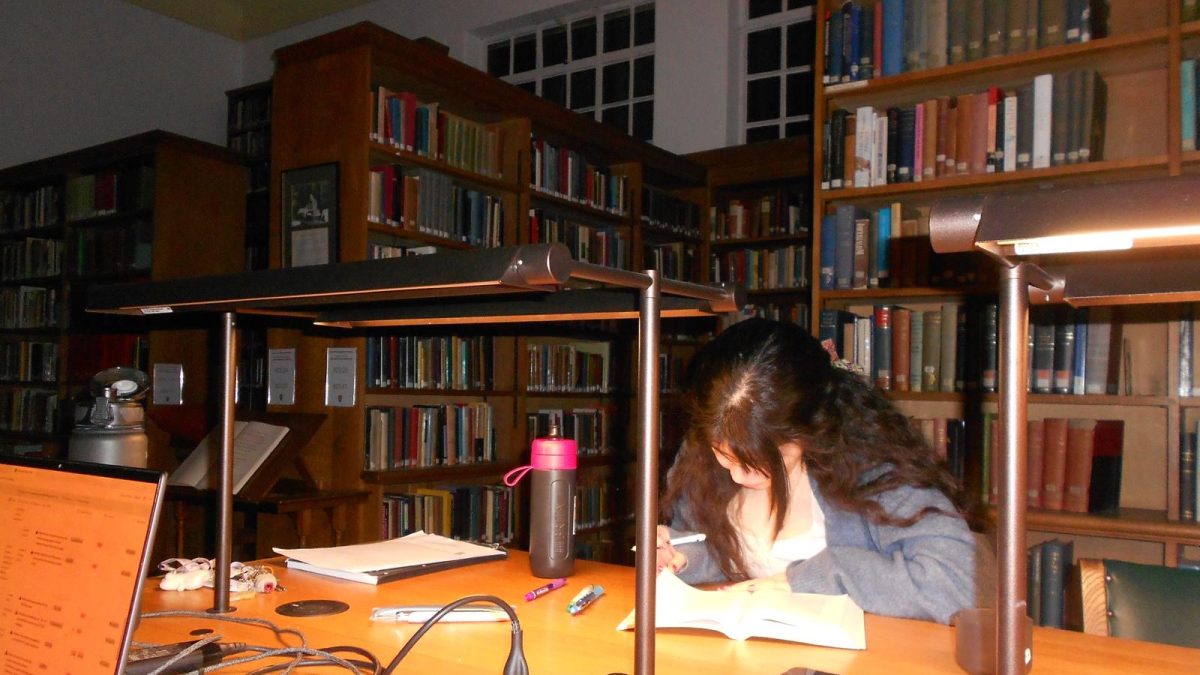
Colour-coding on my calendar determines when I am able to read for ‘fun’ between blocks of Michaelmas, Hilary, and Trinity. Within each term’s time zone, I am in a different space; I cannot read beyond my English degree without a degree of guilt; without it somehow feeling indulgent, or inefficient, to do so. I cannot unwind with a chosen read because if I have time at night to read – which I generally don’t – it is a Shakespearean play I crack open, or a non-fiction book related to my studies, and that means concentrating and engaging critically. I am always either working on an essay, or reading content that could embroider one, so reading during term time becomes a deliberate task, rather than the self-contained escapism it once held. I am constantly rooted to the context which directs my attention; constantly mediated by the space and time characterising these experiences, depending on which stage of life I am at.
I first want to acknowledge I am not highlighting these feelings as a rejection of the reading list system. I have thoroughly enjoyed quite a few of my degree texts and have been able to engage with them critically in a way that has been privileged, unique, and interesting. It has also made me pick up some texts I may not have considered or known of otherwise, especially on theory, which is important towards developing a wider breadth. Enjoying some of these, however, doesn’t mean it has been enjoyable reading. If I have to read with a pile of sticky notes and a pen – while I am aware some people do this for personal interest, it’s just not my style – I wouldn’t count it as recreational. Reading Ali Smith’s How to be Both in first year led me to independently pick up her Autumn over summer; but I would only count the latter as a ‘recreational’ read, mainly because I was reading the former for a prelim. Outside of this academic intent, I feel I can enjoy reading without the stress of needing to use it. For instance, The Poppy War by R.F. Kuang is one of my favourite series, so I wrote about it for my EPQ. On the reread, directed towards post-colonial analysis, I was still personally engaged by the reading, especially with its new nuance and focus, but its direction towards work meant it couldn’t be freed from that end. While I cannot help taking a natural filter of ‘Oxford reading’ and analysis to all my reading now, even with books that I read for ‘fun’, I still count some texts recreational, as being exclusionary from work. Rather than a value judgement, my interest is in how my experience has changed, and the impact of time on these patterns and focus.
If I still had the same freedom as I did in the past, I wouldn’t have chosen to read a lot of the books I’ve read in the past few years. (As stated above, this is not necessarily a negative thing, as it is important to read widely.) I have read ‘ten books’ this year: nine were set reading and only one book was for ‘fun’, but I still ended up writing an article and essay using it. There hasn’t been a single book I’ve finished, in the first half of this year, that has been separated from the temporal situation of my degree. During Easter, I started both Little Women andThe Priory of the Orange Tree for recreation, but finished neither as the vacation, which is full of essay reading anyhow, slipped by too quickly. I now have bookmarks stuck in so many odd places, creating a staircase of these indicators; books explored and set aside for lack of time. According to Goodreads, I currently have twenty-two books on the go: five are unrelated to my degree, twelve are directly related to essays I want to write for finals, and a further five are books I started for my prelims and never finished. I have a fascination with this staircase of bookmarks, of moments paused in the narrative. Unfinished and suspended landmarks, cut off from my reality without the time needed to reach the end.

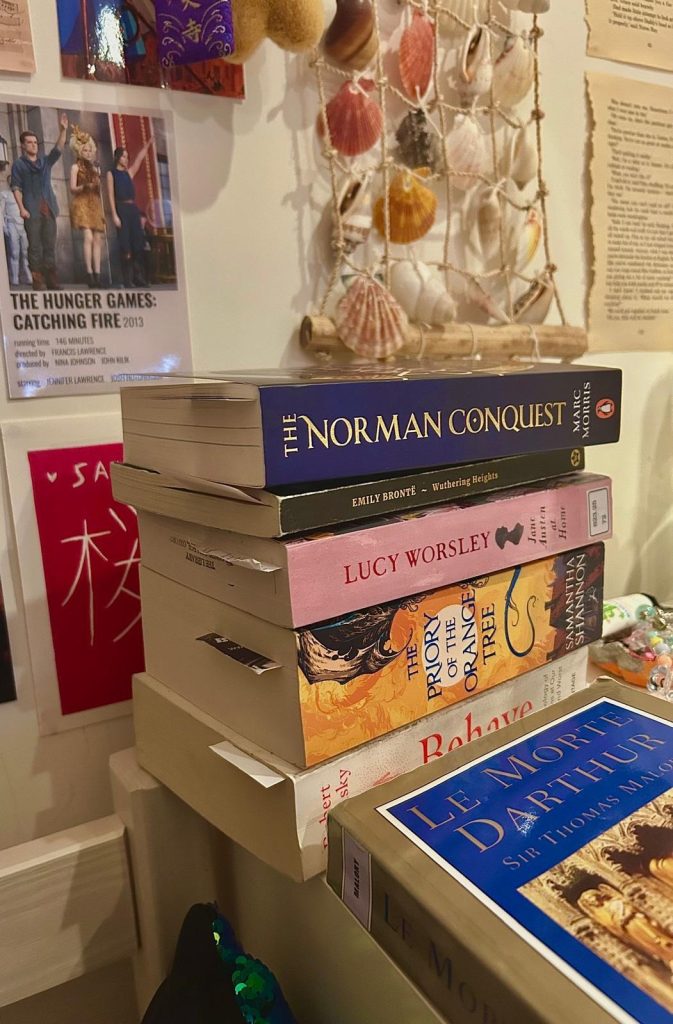
Lots of undergraduates complain to me that they don’t read much for fun anymore, especially at university. They lament how they can’t read more for pleasure; that scrolling is all they have energy for in their off-time. I agree. I often start with good habits that fall apart as the term inexorably churns its way through. The doom-scrolling habit creeps back as I become stressed, hectic, tired. Before, I used to turn to novels to relax; now, it is numbing scrolling, or sorting through texts. My screen time typically drops by 62.5%, at the very least, when I return home.
Of course, I cannot speak for all my peers, but I can assess my own recreational reading patterns, using some quantitative data as someone who tracks my own reading. In lockdown, I was reading over 40 books a year; now, I read about half that (figure 1).

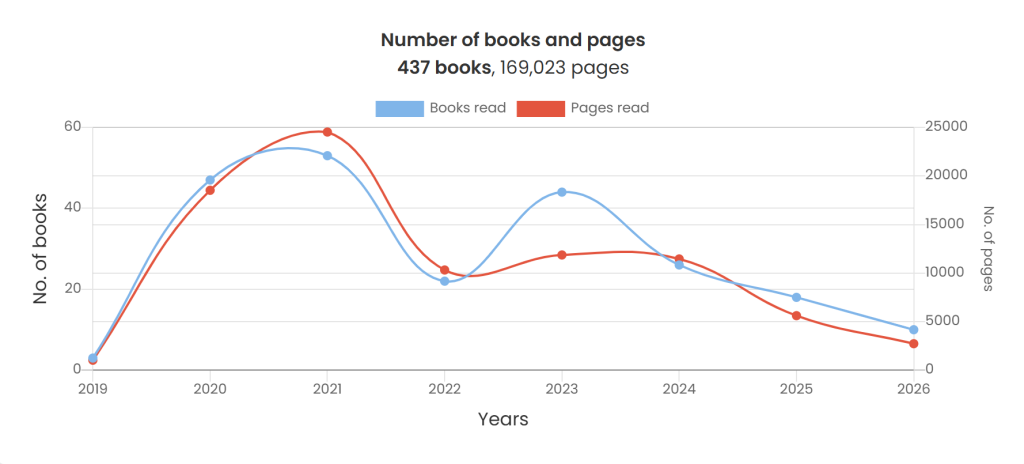
Figure 1: Storygraph reading stats (2019 and 2026 are incomplete).
Lockdown was 2020-21 (according to the Institute for Government); this was the last time I remember reading constantly. I sat my GCSEs in 2022, being in the first cohort to sit the written exams again, and this year was the first drop in my recorded reading. With schoolwork and revision increasing, I started losing the time and mental capacity to read for myself. Even if I read ‘more books’ in 2023, the quantity of pages increased very little; looking at the data from Storygraph, this is the first logged year that their categorisation of ‘classics’ was my most read genre, rather than fantasy or young adult, as in previous years. In 2023, my reads were typically very short, with 64% being under 300 pages: e.g, The Importance of Being Earnest, Dart, The Yellow Wallpaper, Hedda Gabler, etc. These are harder works to interpret but also much shorter, making them easier to digest in starting the A-level shift to classics/literary fiction. In 2022, I may have read ‘fewer’ books than in 2023, but the pages are relatively consistent as only 18% of the books I read were less than 300 pages (and by far, my most read genres that year were fantasy/historical, my recreational favourites).
Although I now sit and read hundreds of pages a week, skimming academic articles, chapters, and primary texts, I never read these as full books, so I cannot log them as such. The number of pages I read now is definitely enough to rival 2020-1, and probably surpasses it, but the key point is that figure 1 is a graph of finished reading (I rarely will read more than a chapter from an academic work, and cannot log articles). Lots of this is probably due to what I’m reading, of course. Thirty pages of Wuthering Heights could take me the same amount of time to read as a hundred pages of a fantasy novel; thus, the drop in pages read. From the end of 2022 and 2023, I was repeatedly set texts to read for A-Level English Literature, and from the end of 2024 and 2025 most of my ‘read’ books are university ‘degree’ books. As the reading lists got more extensive and complex through different academic steps in my life, my recreational reading kept falling. Existing in the space of an Oxford term means my reading is now mostly confined to canonised literary books, read in very non-recreational libraries.
This is also reflected in monthly data. Graphs from 2021-2025 all show the same pattern, with reading peaking in July with the new freedom of summer (figure 2).

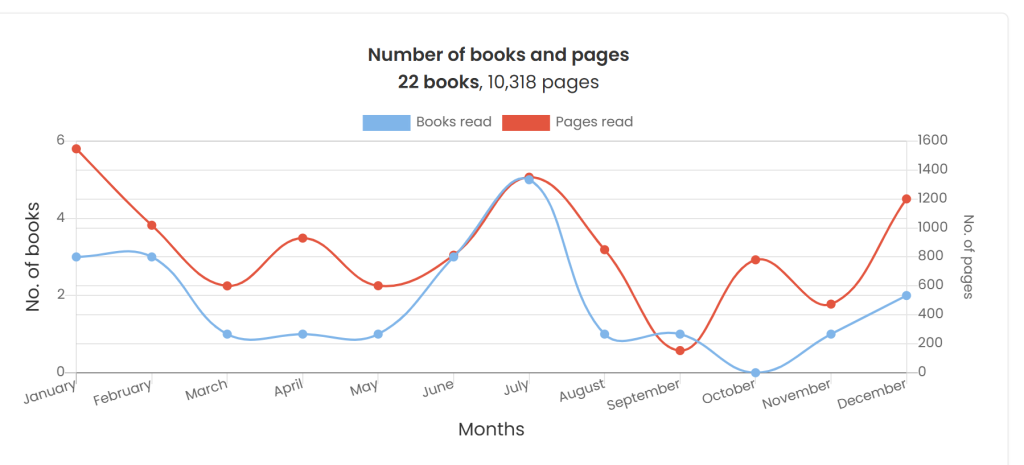
Figure 2: 2022 reading stats
But figure 3, representing last year, shows an interesting new pattern. Although the same peak occurs in July, reading is a lot less distributed, with notable rises occurring in the holidays (mostly to catch up with reading lists), and stagnation in term time. I occasionally have to fill in primary reading during term itself, but it is rare I can do this fully; often, I end up skimming or looking through specific areas of interest, meaning I don’t get to log these as complete reads.

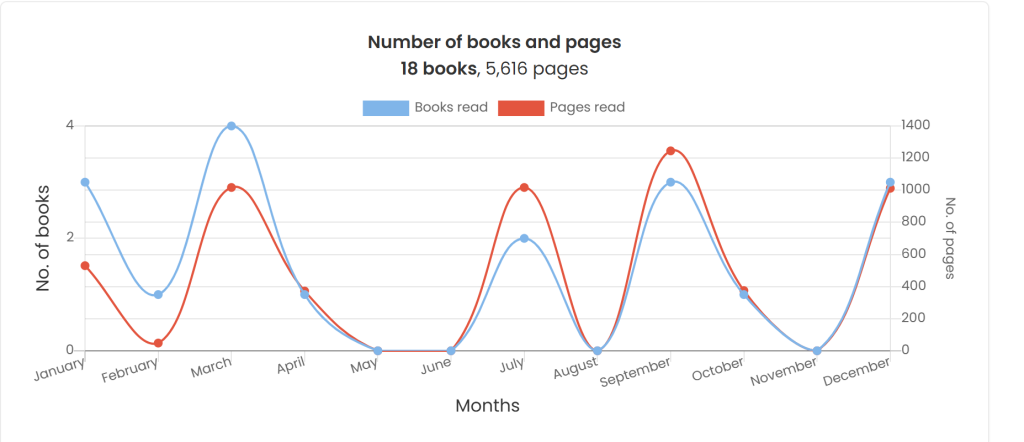
Figure 3: 2025 reading stats. The 2025 terms ran from: January 18-March 14 (Hilary); April 26-June 20 (Trinity); October 10-December 4 (Michaelmas).
The excess of ‘academic reading’ can be contextualised within the ‘academic’ space of Oxford and the subsequent atmosphere, so far removed from my associations with home ‘recreation’. Not only have the texts themselves changed, but some of these new places bring new life to this experience. I did some degree reading in Christ Church Meadows at the start of Trinity, but of course this was then blocked by the rain; I like reading when I’m outside and the weather is golden, or when I’m inside and it’s screaming thunder. I am at the mercy of the turning of the sun, through seasons and days. Reading in an upright chair in the library isn’t the same as being surrounded by a meadow’s moving life, bubbles of conversation floating by and the chatter of nature. It is for this reason I love reading on trains – I take them frequently to and from Oxford – even if I always end up staring out of the window, peacefully watching existence spin out before me with a book thumbed open on a page, to return to whenever I’m ready. I like reading when I am not trying to run an endless wheel of catch-up.
My stagnant university bedroom creates a new, contained bubble. I often make a cup of tea so I can watch its steamy spirals spill into an otherwise solitary space, to hold it in one hand while I use the other to click through tab after tab of JSTOR. Michaelmas is dismal: I have little motivation to get up, and even when I do, I have to use a reading light for most of the day, in the library or my bedroom, lethargic rather than cosy in the constant night. At home, I like to move rooms to follow sunlight, from the bright kitchen during the day, to a reading light in my bedroom. There is no cosy reading sofa in my university house.
I volunteer at Jane Austen’s House, and, during quieter hours, I always have a copy of Lucy Worsley’s Jane Austen at Home with me (unsurprisingly, another book that will now help me with my degree). There was one time when, sitting in the family room, I read as Worsley described Jane’s brother, Charles, and his wife. When I looked up, there he and his wife were, painted and pressed against the wall, a visual representation. There was something so oddly echoic and emotional about it, existing in that space and time, that I clocked reading is not just an experience locked in the mind, hallucinogenic imaginings. It is impacted by the space, the situatedness of the body that experiences. The heaviness of the pages.
Some of my most peaceful memories are at home during secondary school years, curling in bed during winter, reading light perched above my head, tucked under layers of blankets with a cup of tea. Hundreds of pages over hours, self-merging with stories, then drifting into sleep, book open in my limp hand. Even when I’m home now, it is only during summer when I can properly get into recreational reading; the breaks after Michaelmas and Hilary are loaded with imminent vacation reading I feel I cannot comfortably intersperse with others. I cannot unravel to an early time when I would carry a book everywhere I went; when I would toddle after my dad into bookstores, under the privilege of a family that wanted to foster my interest. I used to read everywhere, but a book has become a phone, constantly checked to make sure I’m not missing anything in the busy whirl of an Oxford term. I have a sense of constantly running against a clock, trying to stopper the throat of an hourglass.
It isn’t just the experience of time or space itself that is impacted: reading on a laptop for an essay is very different to reading on paper, but it often feels necessary for efficiency. Typing out quotes from a physical copy word-by-word is time consuming and makes me susceptible to human error, but the speed of copy-paste comes at another expense. On a laptop, there are other tabs to open and things to do: admin and catch-up and queries. It’s never just me and the words anymore, mutually enjoying one another’s company. Academic words are delivered through blue light, sending me to sleep tossing in my bed, turning over these thoughts.
My reading habits change with the sun and seasons; shift and spin, up and down. I hope they will return someday when I can close the Oxford reading lists, bringing back the escapist respite I feel has somewhat escaped me. Even when I read with my new perspectives and interests, these will hopefully no longer be restrictive, tinged by a temporal academic goal.