
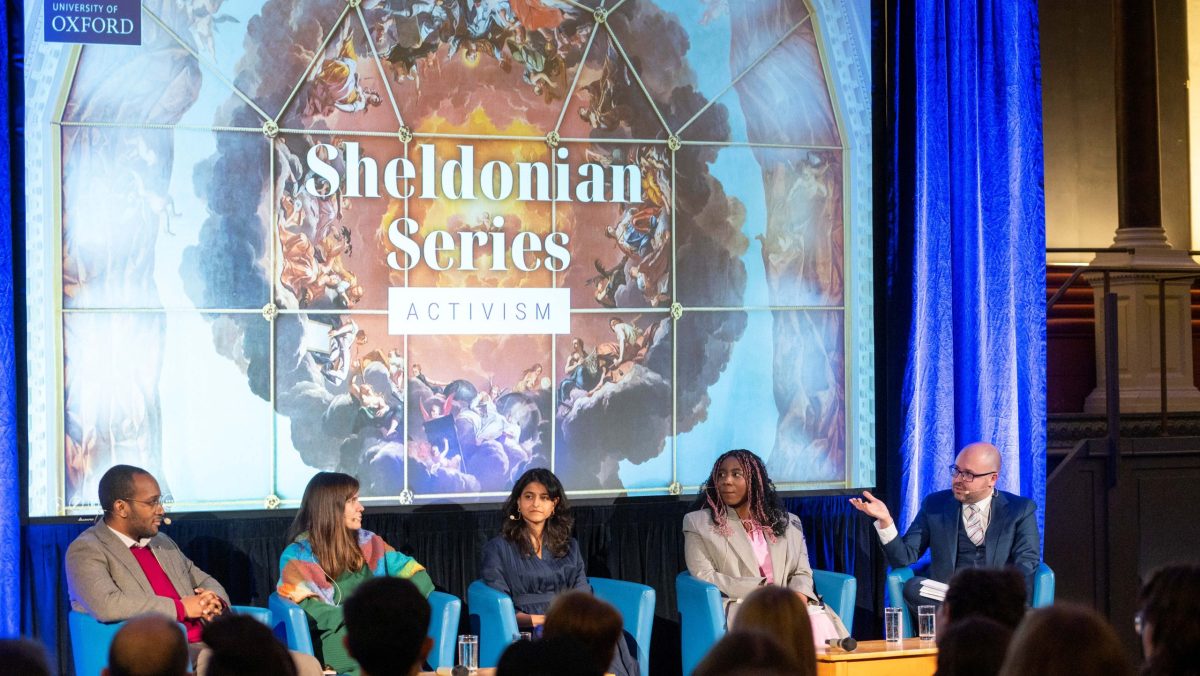
Hilary term’s instalment in the Sheldonian Series convened on 4 February, discussing ‘The Power of Activism’. The series is the Vice-Chancellor’s initiative, gathering a panel of differing voices aimed at promoting dialogue on the “big issues of the day”, and representing the University of Oxford’s commitment to “free and inclusive speech”. Speaking at Wednesday’s event, Vice-Chancellor Irene Tracey said that we live in “very uncertain times”, but encouraged people not to feel “helpless” and pointed to activism’s power in history, such as the women’s suffrage movement and campaigns for civil rights in the U.S.
The question of what makes activism successful entered the discussion from the start. Shermar Pryce, the President of Communities and Common Rooms in the University of Oxford’s Student Union, argued that activism needed to be “more than just a protest”. He pointed to Footballer Marcus Rashford’s campaign for the last government to provide free school meals to children during the holidays as a success because Rashford pushed the government to reverse its initial decision. However, he contrasted this with London’s largest ever protest, the 2003 ‘Stop the War’ demonstration, pointing out it failed to prevent the invasion of Iraq. Speaking on why the march failed, he said that activism could not always just be “noise”, and must affect the institution being lobbied.
Still, not all of the panel interpreted ‘failed’ activism this way. Dominique Palmer, a Climate Justice Activist, argued the success and failure of activism was difficult to measure. She maintained that while activism may fail to change policy at first, it can still change people’s minds and, even if unpopular, plant the seeds of change. She said that, in the long-run, failure may be key to success.
The relationship between activism and democracy was frequently returned to in the discussion. Oxford Professor of Political Science and International Relations, Federica Genovese, argued that there is a core relationship between activism and democracy. She asserted that a society’s capacity for organisation is highly correlated with the rule of law and democracy. Genovese argued that the protests in the aftermath of the UK’s ‘Brexit’ referendum were a sign of “democracy cracking”. When pressed by Pryce on this point, she clarified that she did not think the protests themselves were anti-democratic, but believed instead that they were “symptomatic” of democracy under strain.
Perhaps the night’s key question was which methods of activism were legitimate and which were illegitimate. Could breaking the law, or disrupting public order, be justified in the right circumstances? Early in the discussion, Munira Mirza, former Director of the Number 10 Policy Unit under Prime Minister Boris Johnson, pointed to disruptive protests over climate change as “counterproductive”. She went on to argue that legitimate activism applies pressure, whereas illegitimate activism seeks to coerce and impose its views on others through intimidation or harassment. She said that protests by farmers over government plans to raise their inheritance tax were examples of legitimate activism because they had allowed themselves to be policed effectively, asked for permission, were balanced in the number of days they blocked roads, and “kept public support” throughout. She contrasted this with climate activists who have sat in roads, “blocking ambulances” from reaching hospitals.
Palmer challenged Mirza’s assertion that disruptive protest can be “counterproductive”, arguing that, in the past, activism which has affected change came in many forms. She highlighted the tendency to view past examples of activism with rose-tinted glasses, when in reality protest has often been unpopular. American civil rights activist Martin Luther King Jr. was heavily disliked by many during his lifetime, Palmer said. Yet his legacy lives on and he is now widely viewed positively as a key figure in changing minds and pushing for civil rights legislation.
The legality of activists’ methods was a recurring issue at the panel. Baroness Shami Chakrabarti, a Labour peer in the House of Lords and former director of the advocacy group Liberty, joined discussions through video messages. She said that although there were legal limits on activism, the ethical limits were key as activism can be unfairly repressed. However, when deciding to break the law she said that safeguarding human life is essential, and that activists then take on “more responsibility not less”. Following on from this, Palmer directly argued that such repression was now taking place in the UK, and therefore the relationship between the law and activism could not be viewed as “black and white”. She also claimed that breaking the law could be non-violent, through civil disobedience, pointing to “property damage”, unmandated protesting, or breaking into a location. She referenced here the infiltration of Israeli defence company Elbit Systems in Bristol by activists associated with Palestine Action.
In stark contrast, Mirza said that there is no “crackdown” on protest in the UK currently, eliciting some protestations from the audience. She said that activism should stay within the law as the UK is a democracy, and when there is a breach of public order the police should intervene. Nevertheless, she insisted that her position is consistent, believing that unlawful protests for Palestine are wrong, and viewing violent protests outside hotels housing asylum seekers to also be unjustifiable.
The topic of Palestine Action, the UK Government’s decision to make it a ‘proscribed group’, and subsequent protests were not directly addressed until near the end of the panel, and then only briefly. The speakers were asked by an audience member about their views on the recent protests, in particular the arrests of older people, involving protestors holding signs reading “I oppose genocide. I support Palestine Action.” This prompted clapping from the audience alongside a shout of “Free Palestine!” With time running out however, and moderator Dr Julius Grower taking two other questions alongside this, only Palmer answered directly. She stated that she understood why people felt the need to protest in this way because their right to protest is being reduced, and reiterated that when such rights are being stripped away, breaking the law can be justified.
The next panel in the Sheldonian Series will take place in Trinity term. The topic will be ‘The Power of Satire’.