
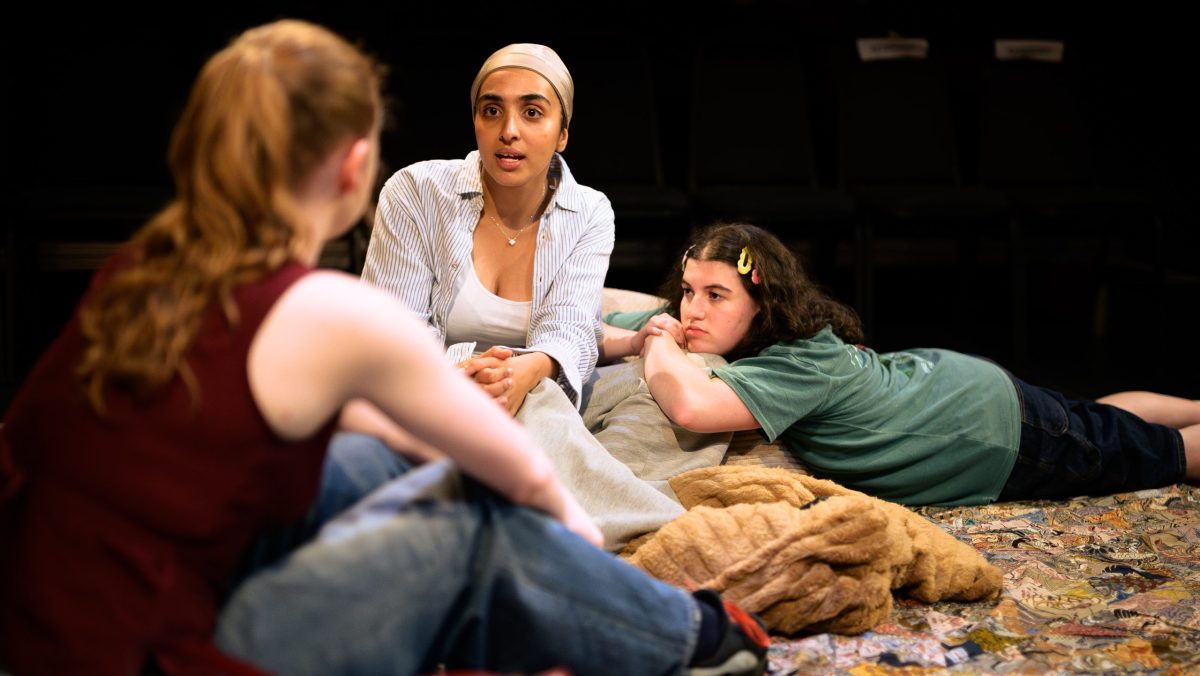
Scenes With Girls is a whirlwind, explosive depiction of female relationship dynamics. It centres around best friends Tosh (Juliet Taub) and Lou (Sanaa Pasha), as they navigate the unending conflict between the types of love and dependency which hold them both captive in different ways. When I get to the BT, the theatre is packed – a sold-out first show – and, as we squish together on the chairs which are organised immersively around three sides of the stage, it feels like an intrusion into Eden.
Before the show begins, Tosh and Lou — or, given their natural, realistic conversations, is this still Taub and Pasha? — chat amongst themselves, scroll Instagram, then get up to play Just Dance. They lounge on beanbags, roll over one another, and display immediately a familiarity and comfort which both saves and endangers their relationship throughout the play. The stage is illuminated in a cosy pink glow, and pink lighting becomes a motif throughout the show for a rosy, idealistic, fantastical reality; the bubble of codependency which Tosh and Lou inhabit. Lighting designer Kai Wray has done a fantastic job at creating this sense of immersion, which is broken down through the use of harsh reds and greens during moments of conflict.
Taub’s performance as Tosh is a delight to watch. Her fluidity of movement, alongside her eagerness and humour, create a sense of the candid even within the absurd. When talking about a man exploding into confetti, she speaks with a sincerity which makes her imagination a credible, palpable reality. Later in the play, the audience is left breathless through her emotional breakdown, and her reliance on Lou often veers towards heartbreaking. Pasha as Lou similarly commands the stage with a more alert physicality, opting for beanbags rather than lowering to the floor, and speaking with relish about her theories. Pasha’s wide-eyed enthusiasm and her depictions of Lou’s intense need to deconstruct the experience of sex are incredibly engaging, and the actors bounce back and forth between each other with ease and candour. Therefore, their fights sting with heightened intensity. Rosie Morgan-Males has directed such a believable codependency that it is impossible to look away, or to escape the bubble.
Enter Fran (Georgina Cooper). Fran doesn’t get it. Cooper’s naive portrayal is heightened by her slightly awkward positioning: elbows and knees pointed inwards as she perches on a beanbag, as if trying to take up less space in the world in which she’s a conscious intruder. Her performance is hilarious, with the fracturing of the Tosh-Lou bubble allowing the audience to laugh with the pair against Fran, and the sense of her externality is magnified through her misguided attempts to fit in. “That’s so funny”, she repeats, trying to fathom the meaning of Lou’s deconstructions. Tosh and Lou believe that, in having a boyfriend, Fran’s held captive by The Narrative – an overwhelming force of normativity they seek to reject. Tosh says that Fran’s probably “eating up his lasagne/eating up his language”. It is paradoxical that she uses language to represent emptiness, when so much of her and Lou’s dialogue is a back-and-forth of linguistic jokes, “self-editing”, and conscious seeking of the “better” word. They are consistently seeking to describe an abstract, but they are hostile when confronted with a reality.
Everything in this play was incredibly well-orchestrated and intentional. Costume Designer Clara Woodhead captures with subtle brilliance the distinctions between the pair of friends, with Lou’s changing outer layers creating a sense of her restlessness, her oscillations between men, and her consistent underlying sense of unfulfillment. At her most vulnerable, she is in a dressing gown, wrapping it around herself like an intimate source of comfort as she tries to convince herself: “I don’t even want monogamy”. Tosh barely changes – her costume, or her mind. Her relationships outside of Lou are barely palpable, so she is more unwavering, more dependable – until she begins to resent the imbalance of their friendship.
Sound Designer Ice Dob’s choice to incorporate thumping techno beats between most of the scene changes facilitated some of the comedy, as the scenes often ended with an amusing abruptness, only to then switch to a sudden blackout and club-like atmosphere. This intensity and the tonal shift it creates serves to further embed us in the balancing act the play continuously creates between explosive intimacy and casual, realistic moments of friendship.
I was surprised to learn that Morgan-Males, and producer Emily Cullinan, doubled as the set designers, because it was so well crafted and intentional that I wondered how they found the time. From Tosh and Lou’s collection of books, mostly about sex, to an ever-present collection of birthday cards, to the bathroom set in miniature, barely divided from the rest of the stage by one vertical panel, they have poured time and attention into crafting a tangible and overwhelmingly intimate space. It is believable that Tosh and Lou inhabit a world without doors. The lack of division between bathroom and living space only serves to further represent their all-consuming intimacy.
There is a breaking point to this intimacy, however. Boy, played by a rotating cast, is first seen obscured completely by darkness. Without spoiling too much what his role represents for the characters, it is clear that his intrusion is a catalyst. When the scene moves, he’s bathed in an obscuring, mysterious dark green glow, while Tosh is in a glaring spotlight. Morgan-Males has also played with levels during this scene – he towers above a crouched Tosh. We’re reminded of sexual and emotional power dynamics, reminded of the echo of Tosh’s own words that “boys and girls are completely different things”. It is up to us to decide whether Boy serves a positive purpose in the world of Tosh and Lou, and whether this differs from the reality of heterosexual relationships.
The audience are left with a stream of questions, and one audience member tells me they are going to “rethink a lot of things about my life”. I have to agree. Tosh and Lou’s dynamic, so expertly handled, is explosive, and requires a lot of rethinking to unpack. Are they safe, or dangerously codependent? Is this life, paradoxically within and without heteronormativity, sustainable? Is this real girlhood? Is this enough?
[Scenes With Girls is playing at the Burton Taylor Studio from the 9th-13th June.]