
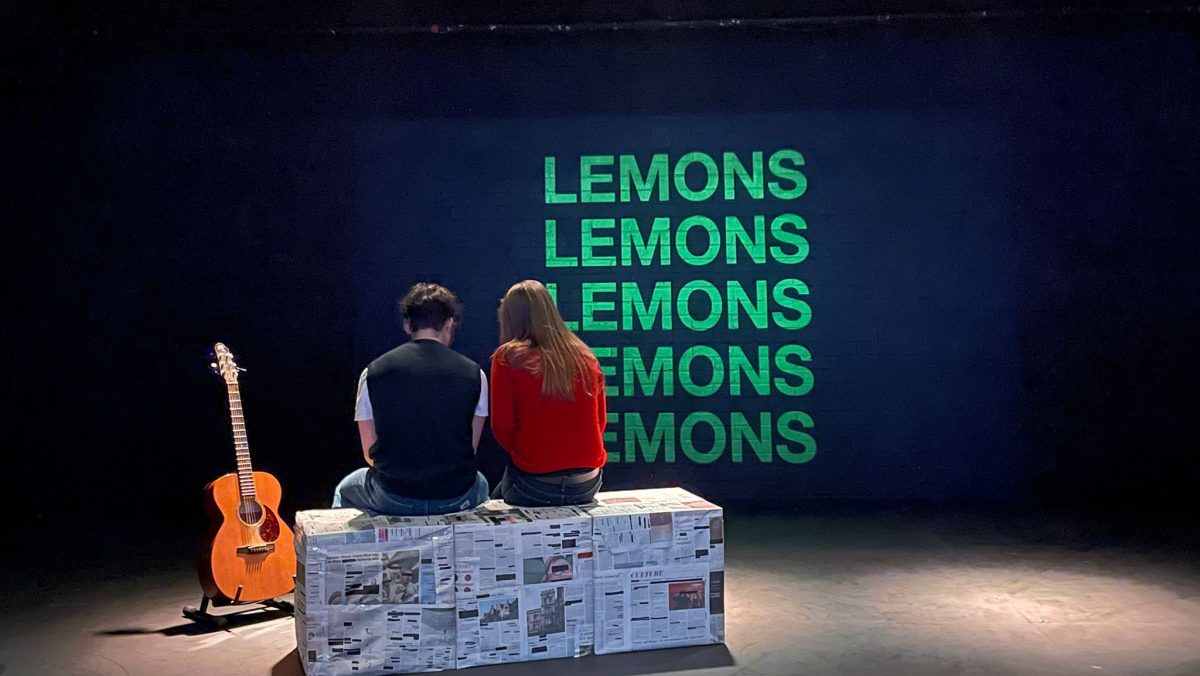
Lemons Lemons Lemons Lemons Lemons (or Lemons x5, as it has become known in the OxBlue writers’ room) is, fittingly, a play about words and how we use them. Its central idea is to apply the platform formerly known as Twitter’s one-time limit of 140 characters to everything. Under the Hush Law/Quietude Bill, as it is variously called, our two protagonists, Bernadette (Caeli Colgan) and Oliver (Kit Rush) are only allowed to speak 140 words per day.
The title stems from a particularly flagrant misuse of that allowance, as Bernadette comes home from work one day with words to spare and finds Oliver unable to talk to her. It’s an interesting conceit, but thankfully one the play doesn’t stay with the whole way through. Rather, Lighthouse Productions have done an extraordinary job of staging the cacophony of flashbacks and flashforwards that make up Sam Steiner’s 2015 play.
This is the first review I’ve written in which I simply have to start with the lighting. The Burton Taylor is a black box, repeated costume changes are infeasible in a live show, and the transitions between ‘scenes’ are deliberately seamless. Under these circumstances, how is one meant to communicate the multiple timelines at play? Lighting designer Yasmin, with exceptional credit to any other crewmembers staffing the light and sound desk on the night, manages to differentiate these moments effortlessly. With faultless timing through the whole play, yellowish natural lights signal the time before the Hush Law, colder blue signals the time after. It feels important to reiterate just how tight the timing is here. Due to the concept’s nature, the script is an incredibly fragmented one: a series of out-of-place vignettes, some only a few seconds long. That there was never any confusion over when or where we were, even if the cue was merely a slight change in an actor’s body language, speaks to the effort that has gone into this production. However, when a series of these played out in succession, which happened more than once, the action risked becoming a little aimless. The script’s sketch-like nature also unsettled my sense of how close we were to the end; a few moments which seemed to have the air of a coda turned out to be just another scene. An overall structure is preserved, though. Every so often, videos and photos illuminate the BT’s back wall in act-break interludes, courtesy of videographer George Robson and sound designer Grace Yu. The nostalgic shutter sound accompanying the interludes’ black-and-white photos on themes of protest, communication, and children provides a vital grounding-point for the political side of Bernadette and Oliver’s story.
That story begins in a pet cemetery, after Bernadette and Oliver meet at the funeral of Bernadette’s friend’s cat (though we only see this later in the play). We experience the entire narrative of their love story, sometimes through montages of a certain phrase (‘I love you’, ‘let’s talk about this later’), sometimes in moments of incredible stillness. Credit goes to movement directors Benjamin Phillips and Elektra Voulgari Cleare for the simple, graceful dances accompanying the couple’s journey. The music provided by composer Oli Spooner for the montage scenes is also a cut above anything I’ve previously heard in student productions, and deserves plaudits.
As for the people we see on stage; Colgan and Rush (who is making his Oxford debut) are simply exceptional. At the play’s midpoint, they expertly manage a transition between two scenes of Colgan’s character crying, in a masterful display of emotional control. The excitement shared between the two is eminently believable, too. Oliver, a musician, gets some moments of music nerdery which Rush plays excellently, and at one point Colgan even joins him on the guitar (always a nerve-wracking prospect on stage). Every scene post-Law begins with them saying how many words they have left; how much of themselves they have left to give to the other. What we see is two characters literally developing a love language. Bernadette explains the process using a novel box-grater metaphor: each relationship has its side of the grater, its own particular patterns. To mix them up is to invite confusion; and so Bernadette and Oliver have to develop a new one.
They have their difficulties, too, and these are sensibly explored in the pre-Hush scenes, where they can be given the depth they deserve. Bernadette’s standing as a lawyer is a point of tension. So too is Oliver’s relationship with his protest-marching ex Julie (played by Voulgari Cleare), who appears projected onto the back wall during one of the video interludes. It comes to a head in the moments before the Law becomes reality, a frenzied five-minute rush, both characters desperately trying to get everything out before they can say no more. But the play, their life, does not end there. They muddle through, carry on.
The genius of the Hush Law, from a dramatic perspective, is its ability to condense. In 80 minutes, we see the whole scope of Oliver and Bernadette’s relationship, with a respectable dollop of musings on democracy and the nature of free speech. All in all, directors Alys Young and Ivana Clapperton have put on an outstanding show. The challenges presented by space and script are risen to with glorious assurance: every member of this cast and crew has excelled. Lemons, the BT’s first student show of 2026, has thrown down a truly formidable gauntlet for the plays to come.
[Lemons Lemons Lemons Lemons Lemons, staged by Lighthouse Productions, is running at the Burton Taylor Studio, 27th-31st January 2026.]