


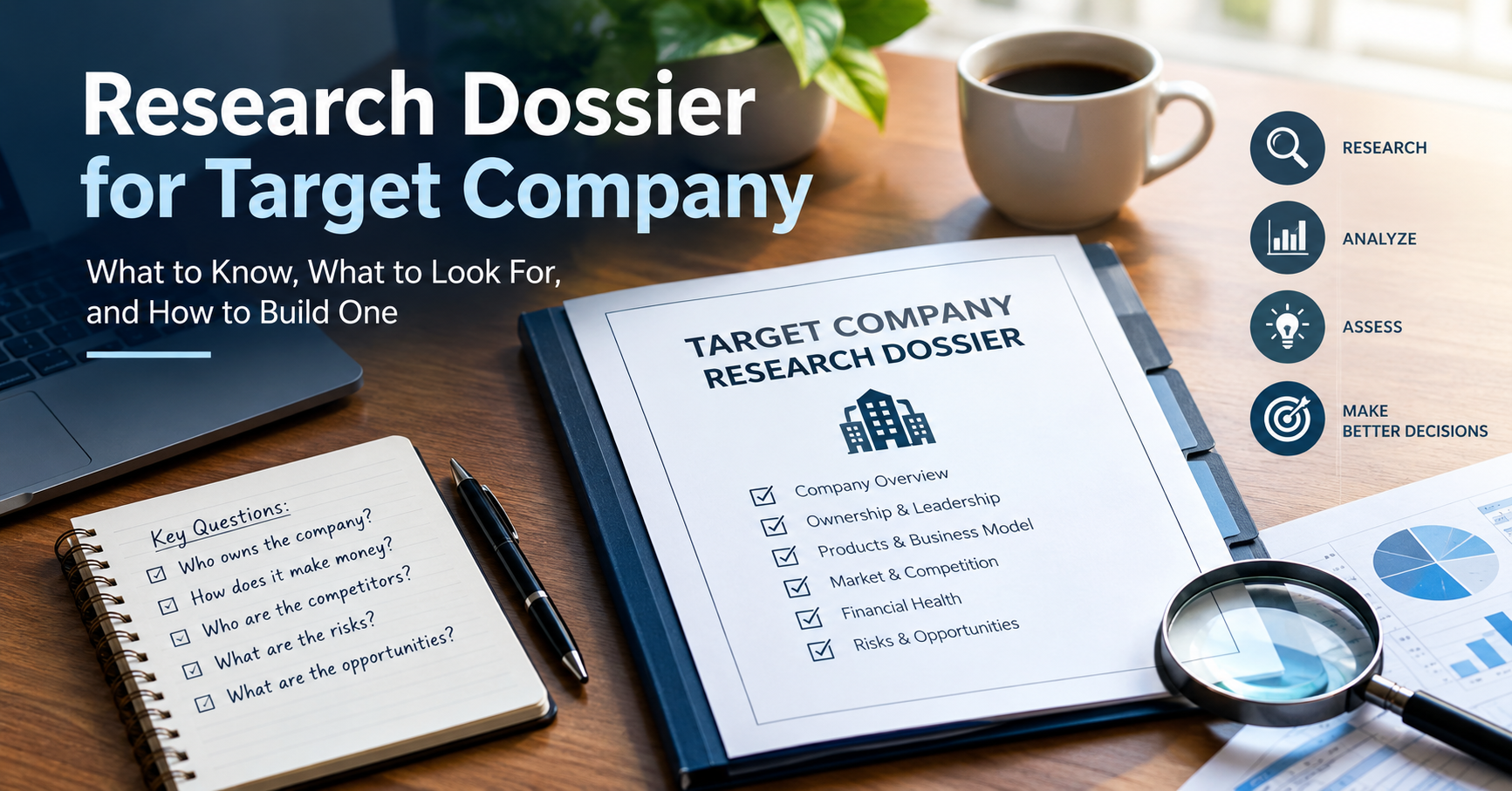
When a business is considering a partnership, acquisition, investment, supplier relationship, sales opportunity, or other important commercial relationship, a quick Google search is rarely enough. Public information may tell you what a company says it does, but it does not always tell you how that company actually operates, who influences its decisions, how stable its finances appear, or where the biggest risks may be hiding.
That is where a research dossier for a target company becomes useful.
A well-prepared dossier brings scattered information into one organized picture. Instead of looking at a company website, news article, executive profile, financial document, customer review, and industry report separately, the researcher examines them as pieces of the same puzzle.
The objective is not simply to collect as many facts as possible. The real value comes from understanding what those facts mean when considered together.
A target company may look impressive from the outside but have an unstable business model. Another may have little online visibility but possess strong customers, experienced leadership, and a healthy position within its market. A proper research dossier helps decision-makers distinguish between appearances and evidence.
What Is a Research Dossier for a Target Company?
A research dossier for a target company is a structured collection and analysis of information about a specific business.
It can include basic corporate information, ownership, leadership, products or services, markets, competitors, financial indicators, reputation, customers, technology, legal matters, strategic priorities, and potential risks.
The exact contents depend on why the company is being researched.
An investor may want to understand growth potential and financial health. A sales team may care more about decision-makers, business priorities, existing suppliers, and purchasing signals. An acquisition team may need considerably deeper information about ownership, liabilities, contracts, employees, intellectual property, and legal exposure.
This is why a strong dossier should begin with a clear research objective.
Without one, the project can easily become a collection of interesting facts that never answers the question that actually matters.
Why Companies Need More Than a Basic Company Profile
A conventional company profile usually focuses on information the organization wants the public to know.
It may describe its history, mission, products, achievements, leadership team, locations, and areas of expertise.
That information can be useful, but it represents only one side of the picture.
A research dossier approaches the company from an investigative perspective. It asks additional questions.
How does the company make money?
Who owns it?
Who actually makes important decisions?
Which markets matter most?
Who competes with it?
What does the company appear to be prioritizing?
Are there warning signs that deserve closer examination?
Does information from different sources agree?
What has changed over time?
These questions transform a simple profile into a more meaningful business assessment.
Start With the Research Objective
Before gathering information, define exactly why the target company matters.
This sounds obvious, but it is one of the most important steps in the entire process.
Suppose a company is being considered as a potential acquisition target. Its ownership structure, debt exposure, intellectual property, contracts, employee concentration, and recurring revenue may deserve significant attention.
Now imagine the same company is being evaluated as a potential client. The most useful information could instead include its marketing strategy, organizational structure, recent expansion, technology stack, current suppliers, budget signals, and likely decision-makers.
The company has not changed.
The research objective has.
A useful dossier therefore begins with a short statement explaining what the research is intended to determine.
That statement becomes a filter for everything that follows.
Establish the Company’s Identity
The first section should establish exactly which company is being researched.
This is particularly important when businesses have similar names, operate through multiple legal entities, or use a brand name that differs from their registered corporate identity.
Basic identification can include the legal name, trading name, headquarters, operating locations, industry, website, year of establishment, corporate structure, and relevant registration information.
Researchers should be careful with dates and names because companies frequently rebrand, merge, acquire other businesses, or change legal structures.
A company that appears to have existed for twenty years may actually be operating under its current legal structure for only a few years.
Understanding that distinction can prevent major research errors.
Investigating Ownership and Control
Ownership is one of the most important parts of a company dossier.
Knowing the company’s chief executive is not necessarily the same thing as knowing who controls it.
A private company may have founders, investors, family owners, holding companies, or parent organizations. A public company may have thousands of shareholders while strategic influence remains concentrated among certain institutional investors or founders.
The researcher should therefore distinguish between management and ownership.
Who owns the company?
Who controls voting rights?
Is there a parent company?
Has ownership changed recently?
Are there subsidiaries?
Have investors entered or exited?
These questions become particularly important during acquisitions, investment decisions, and high-value partnerships.
Understanding the Leadership Team
The people running a company can reveal a great deal about its direction.
A dossier should normally identify senior executives and other decision-makers who are relevant to the research objective.
But simply listing names is not enough.
A better approach examines professional backgrounds, previous companies, areas of expertise, tenure, public statements, and major responsibilities.
Leadership changes can be particularly revealing.
A newly appointed chief executive may signal a strategic shift. A wave of executive departures may deserve investigation. The arrival of a senior executive from a competitor could indicate an expansion into a particular market.
Leadership information becomes more useful when viewed as part of the company’s timeline rather than as an isolated list.
Examine the Company’s Products and Services
A company cannot be properly understood without understanding what it actually sells.
The dossier should explain the company’s main products or services in straightforward language.
Avoid simply copying descriptions from marketing materials.
Instead, ask what problem the product solves, who pays for it, how it is delivered, and what differentiates it from competing alternatives.
A company may describe itself as a technology platform, for example, while most of its revenue may actually come from consulting or implementation services.
That difference matters.
Understanding the real business model is more valuable than repeating promotional language.
Study the Business Model
The business model explains how the company turns activity into revenue.
Some businesses depend on subscriptions. Others rely on advertising, transaction fees, licensing, professional services, physical products, commissions, or a combination of several sources.
The dossier should attempt to identify the most important revenue mechanisms.
Researchers should also consider concentration.
Does the company appear dependent on a small number of customers?
Does one product generate most of its business?
Is revenue recurring or primarily project-based?
Does the company depend heavily on one geographic market?
These questions can reveal vulnerabilities that are not immediately obvious from a company website.
Analyze the Target Market
A company does not operate in isolation.
The dossier should explain the market in which the target company competes and identify the major forces affecting that market.
This includes customer demand, technological changes, regulatory developments, economic conditions, and competitive pressure.
The purpose is not to produce a giant industry report.
The goal is to understand how the market affects the specific company.
A strong market position can make a mediocre-looking company highly valuable, while a declining market can create problems even for a well-managed business.
Identify the Competitors
Competitor analysis is another core part of company research.
The obvious competitors are important, but researchers should also consider indirect alternatives.
A software company may compete with another software company, for example, but its customers may also choose spreadsheets, internal development, outsourcing, or simply continue using an existing system.
The dossier should therefore ask what customers can realistically choose instead.
Comparing products, pricing approaches, geographic reach, customer segments, reputation, technology, and positioning can help reveal where the target company stands.
Look Beyond the Company’s Own Marketing
One of the biggest mistakes in corporate research is relying too heavily on information published by the target company itself.
A company’s website is an important source, but it is naturally promotional.
Independent information can provide a different perspective.
Industry publications, regulatory records, court documents, reputable news organizations, customer commentary, professional databases, public filings, and other credible sources may reveal information that does not appear in company marketing.
The goal is not to distrust everything the company says.
It is to compare claims against evidence.
If a company describes itself as a market leader, for example, the researcher should determine what evidence supports that description.
Financial Health and Business Stability
Financial information can be one of the most valuable parts of a target-company dossier.
For public companies, researchers may have access to annual reports, quarterly filings, earnings announcements, investor presentations, and other disclosures.
Private companies generally provide less information, which means the researcher must be more careful about drawing conclusions.
Useful indicators can include revenue trends, profitability, cash position, debt, funding history, major investments, acquisitions, and significant financial events.
However, individual numbers should never be interpreted in isolation.
A rapidly growing company may have weak short-term profitability because it is investing heavily in expansion. Another business may be profitable but experiencing declining revenue.
The context matters.
Research the Company’s Reputation
Reputation can influence sales, recruitment, partnerships, investment, and long-term business value.
A dossier should therefore consider how the company is perceived by customers, employees, partners, competitors, and the broader industry.
This does not mean treating every online review as fact.
Reviews can be subjective, outdated, manipulated, or based on isolated experiences.
Instead, researchers should look for patterns.
Repeated complaints about the same issue may deserve attention. Consistently positive feedback around a particular strength can also be informative.
The strongest conclusions generally come from multiple independent indicators rather than one anonymous comment.
Investigate Legal and Regulatory Issues
Legal research becomes particularly important when the target company is being considered for an investment, acquisition, major contract, or strategic relationship.
Depending on the industry and jurisdiction, researchers may examine litigation, regulatory actions, intellectual-property disputes, compliance issues, government penalties, and other public legal records.
The presence of a lawsuit does not automatically mean a company is unsafe.
Businesses of every size become involved in disputes.
What matters is understanding the nature of the dispute, its significance, its status, and its potential consequences.
Legal information should therefore be presented carefully and neutrally.
Technology and Digital Presence
For many modern companies, technology is part of the business itself.
A research dossier can examine the company’s website, digital products, applications, technology ecosystem, online platforms, and visible digital strategy.
The goal is not necessarily to produce a technical audit.
Instead, the researcher wants to understand how technology supports the company’s business model.
For a software company, technology may be central to its competitive advantage.
For a traditional manufacturer, digital systems may matter more for distribution, customer acquisition, or internal operations.
The relevance depends on the target company.
Hiring Patterns Can Reveal Strategy
Recruitment activity can sometimes provide clues about where a company is heading.
Job listings can reveal which departments are expanding, which technologies are being adopted, and which locations may be becoming strategically important.
A company suddenly hiring heavily in sales may be preparing for expansion.
A business recruiting cybersecurity specialists may be strengthening its infrastructure.
A company hiring extensively in a new country may be establishing a regional presence.
Hiring data should never be treated as definitive proof of strategy, but it can be a useful signal when combined with other evidence.
Look at Partnerships and Customers
Important partnerships can reveal a company’s position within its industry.
Customers can be equally informative.
A company serving major organizations may have a very different commercial profile from one relying primarily on small businesses or consumers.
Researchers should distinguish between confirmed customers and companies merely mentioned in marketing material.
A logo displayed on a website does not always tell you the nature, size, or current status of a relationship.
Where possible, customer and partnership claims should be verified through independent evidence.
Build a Timeline
One of the most effective ways to turn scattered information into understanding is to create a company timeline.
The timeline can include:
- Founding or incorporation
- Major product launches
- Funding rounds
- Leadership changes
- Acquisitions
- Expansions
- Major partnerships
- Important lawsuits
- Restructuring
- Rebranding
- Market exits
Looking at events chronologically can reveal patterns that are difficult to see in a conventional company profile.
A business may appear stable when viewed only in the present, yet its timeline may reveal several major strategic changes within a short period.
Separate Facts From Interpretation
A professional dossier should clearly distinguish between verified facts and analytical conclusions.
For example, a company announcing an expansion into a new country is a fact if supported by reliable evidence.
Saying that the expansion will definitely succeed is an interpretation.
Similarly, an executive leaving the company is a factual event if properly documented. Claiming that the executive left because the business is struggling requires additional evidence.
This distinction protects the quality of the research.
Readers should be able to understand what is known, what is reasonably inferred, and what remains uncertain.
What Makes a Research Dossier Valuable?
A large document is not automatically a good dossier.
A useful dossier is selective.
It identifies the information that matters most to the decision being made and presents it in a way that allows another person to understand the company quickly.
Clarity matters as much as volume.
A 30-page document filled with copied descriptions may be less useful than a concise report that explains ownership, financial condition, competitive position, major risks, strategic direction, and unanswered questions.
The best research does not merely collect information.
It reduces uncertainty.
Common Mistakes in Company Research
One common mistake is relying on a single source.
Another is copying the target company’s own descriptions without testing them against independent information.
Researchers also sometimes confuse correlation with causation. A leadership departure occurring shortly before falling revenue does not automatically prove that the departure caused the decline.
Outdated information presents another problem.
Companies change quickly. A five-year-old executive profile may no longer reflect the current organization.
Researchers should therefore record dates wherever possible.
Finally, researchers should avoid filling information gaps with assumptions.
If something cannot be verified, saying so is better than creating a confident but unsupported answer.
A Practical Structure for a Target Company Dossier
A flexible dossier can contain the following sections:
Company Identity
Basic information about the business and its legal or operating structure.
Ownership and Leadership
Key owners, executives, decision-makers, and relevant background.
Products and Business Model
What the company sells, who buys it, and how it generates revenue.
Market and Competition
The industry environment, target customers, competitors, and positioning.
Financial Picture
Available information about revenue, funding, profitability, debt, investments, or other relevant indicators.
Reputation and Public Record
Customer perception, media coverage, awards, complaints, controversies, and relevant public information.
Legal and Regulatory Position
Important litigation, regulatory action, intellectual-property issues, or compliance concerns.
Strategic Direction
Recent developments that may indicate where the business is heading.
Risks and Opportunities
The strongest evidence-based factors that could affect the company’s future.
Research Gaps
Important questions that remain unanswered.
This final section is often overlooked, yet it can be one of the most valuable.
Knowing what you do not know is essential when making a major business decision.
The Difference Between Research and Due Diligence
A company research dossier and formal due diligence are related, but they are not identical.
Research can provide a broad understanding of a business using publicly available information and other accessible sources.
Formal due diligence is generally much deeper and may involve confidential documents, financial records, contracts, tax information, employee records, intellectual property documentation, and professional advisers.
A research dossier can therefore be an excellent starting point, but it should not automatically be treated as a substitute for legal, financial, or technical due diligence when a transaction involves significant risk.
How to Keep a Dossier Current
A dossier can become outdated surprisingly quickly.
Executives change jobs. Companies acquire competitors. Products are discontinued. Regulations change. New lawsuits emerge. Financial conditions shift.
For an active target account or acquisition candidate, the dossier should therefore be treated as a living document.
Important updates should be dated and incorporated rather than simply added randomly.
A change log can be useful for tracking significant developments.
This approach makes it easier to understand not only what the company looks like today but also how it has changed over time.
Questions a Good Dossier Should Answer
At the end of the research process, a reader should be able to answer several basic questions.
What does this company actually do?
Who owns and controls it?
Who makes important decisions?
How does it generate revenue?
Who are its customers?
Who competes with it?
How strong does its market position appear?
What important developments have occurred recently?
What risks deserve attention?
What opportunities may exist?
What information remains uncertain?
If the dossier cannot answer these questions, it may contain plenty of information without providing enough insight.
Frequently Asked Questions
What is a research dossier for a target company?
It is an organized report that gathers and analyzes information about a specific company for a business purpose such as investment, acquisition, sales, partnership evaluation, competitive research, or risk assessment.
What should a company research dossier include?
It commonly includes company identity, ownership, leadership, products, business model, market position, competitors, financial information, reputation, legal matters, strategic developments, risks, and research gaps.
Why is company research important before a partnership?
Research can help identify whether a potential partner appears financially stable, reputable, strategically compatible, and capable of delivering what it promises.
Is a company website enough for research?
Usually not. A company website is useful for understanding the organization’s stated position, but independent sources can provide additional context and help verify important claims.
How do you research a private company?
Private companies can be more difficult to research because they generally disclose less financial information. Researchers can examine corporate records, reputable news coverage, industry sources, leadership information, public statements, partnerships, hiring activity, legal records, and other credible evidence.
Should negative information be included in a company dossier?
Yes, when it is relevant and supported by credible evidence. Negative information should be presented accurately and in context rather than exaggerated or treated as proof of wrongdoing.
What is the difference between a company profile and a research dossier?
A company profile usually describes the business from a general or promotional perspective. A research dossier is more analytical and is designed to support a particular decision.
How often should a target-company dossier be updated?
The answer depends on the purpose. A dossier used for an active investment, acquisition, sales account, or strategic partnership should be updated when significant developments occur.
Can a research dossier replace professional due diligence?
No. A research dossier can support early investigation and decision-making, but major transactions may require professional legal, financial, tax, technical, or other specialized due diligence.
Final Thoughts
A research dossier for a target company is ultimately valuable because it turns disconnected information into a decision-making tool.
The strongest dossier does not attempt to make a company look good or bad. It attempts to understand the business as accurately as possible.
That means looking beyond the company website, examining ownership and leadership, understanding the business model, studying competitors, checking available financial information, investigating relevant legal matters, monitoring strategic developments, and separating confirmed facts from interpretation.
Just as importantly, good research recognizes uncertainty.
Some information will be easy to verify. Other details may remain unavailable, particularly when researching private companies. Instead of filling those gaps with assumptions, a professional researcher identifies them clearly.
The result is a document that does more than describe a target company.
It provides context.
And when a business decision involves significant money, time, reputation, or strategic commitment, that context can be the difference between acting on a promising opportunity and overlooking a serious risk.