


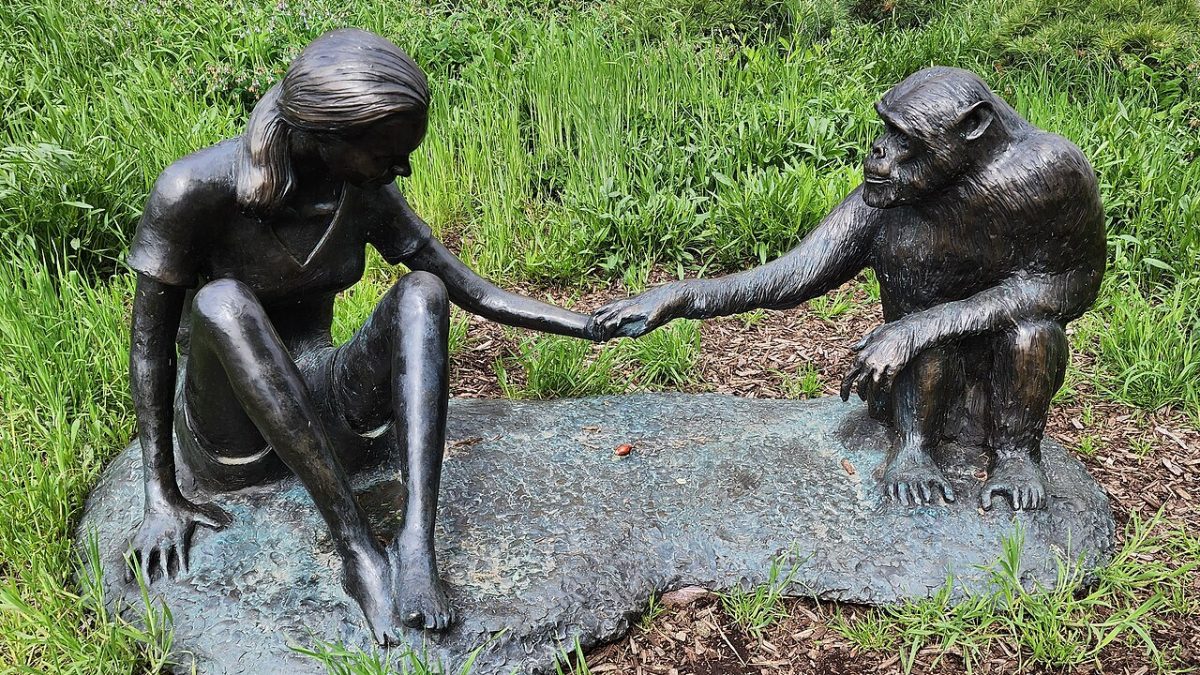
When renowned anthropologist Dr Jane Goodall joked ‘Tarzan married the wrong Jane’ she was completely right. Though I have nothing against Burroughs’ Jane, Dr Goodall was something spectacular.
It is difficult to quantify Dr Goodall’s brilliance. When listening to her talks or reading her books, one is reminded that this formidable force is probably the closest thing we will ever get to a real-life superhero: selfless, beautiful, enthralling, and also funny. It almost feels like one person should not be allowed to be so multitalented.
Nevertheless, although young Jane Goodall had a crush on Tarzan, she was a kind of Tarzan herself. Dr Goodall moved to Tanzania’s Gombe Stream National Park in July 1960 to begin her research, and lived with the chimpanzees for over sixty years. Like Tarzan, she had empathy for the chimpanzees and befriended the ones she liked. Her favourite chimpanzee, David Graybeard, was the first of his kind in Gombe who trusted Dr Goodall. He had a silver beard and brought other chimpanzees to introduce to her.
Similarly to Tarzan, Dr Goodall left Gombe for love, but her love was more diffusive than Tarzan’s. Her love not only extended to all the chimpanzees, but also to all creatures, and people, who could not speak for themselves. For her entire adult life, up until her passing on 1 October 2025, Dr Goodall worked without pause to give a voice to the voiceless. One of the results of her efforts is Roots & Shoots, a global youth programme that enables young people to address social and environmental problems within their communities. This started in 1991 when a group of Tanzanian teenagers came to Dr Goodall worrying about the future. Roots & Shoots now spans more than 75 countries.
Dr Goodall was one of the few students to ever be accepted into a PhD at Cambridge without an undergraduate degree in 1961, which she completed in 1965. She advanced the research that she was doing in Gombe under the tutelage of Lewis Leakey.
In the scientific community, she is most famous for redefining what it is to be a human. Literally. Her discovery that chimpanzees used tools meant that humans – who were defined as creatures that used tools – had to be given a new definition. Moreover, she showed that empathy was not the enemy of science; it could even lead to greater, more rigorous research. Her naming of the chimpanzees was unprecedented at the time but showed a compassion for animals that led to scientific breakthroughs as well as better ethical care.
Dr Goodall was a powerful advocate against animal testing and testified before the U.S. congress in support of the Chimpanzee Health Improvement, Maintenance and Protection (CHIMP) Act in 2000 which successfully led to lifetime support for retired research chimpanzees. A revision in 2007 made sure these chimpanzees could not be taken out of their sanctuary for research purposes. Happily, this led to medical testing on chimpanzees no longer being allowed in 2015. While there is still no official ban yet, the federal government has said they will no longer test on chimpanzees.
Dr Goodall has revolutionised science by redefining conservation, introducing ethology methods, and pioneering long-field studies. Dr Goodall became a United Nations Messenger of Peace in 2002 and has tirelessly gone around the globe bringing attention to the importance and urgency of protecting the environment. In addition to this, Dr Goodall has received a Damehood, Légion d’honneur, Medal of Tanzania, Kyoto Prize, Gandi-King Award for nonviolence, Benjamin Franklin Medal, Prince of Asturias Award, Genesis Award and, most recently, in 2025, the presidential Medal of Freedom awarded by Joe Biden.
Despite being a superhero, Dr Goodall did not disdain the everyday efforts of more ordinary people. For Dr Goodall, every step is important because everybody matters. We need to remember her and follow in her footsteps, to never give up, because, as she has said, ‘Every individual matters. Every individual has a role to play. Every individual makes a difference.’ So together we must be pretty unstoppable.
Together we can, together we will, together we must change the world.