
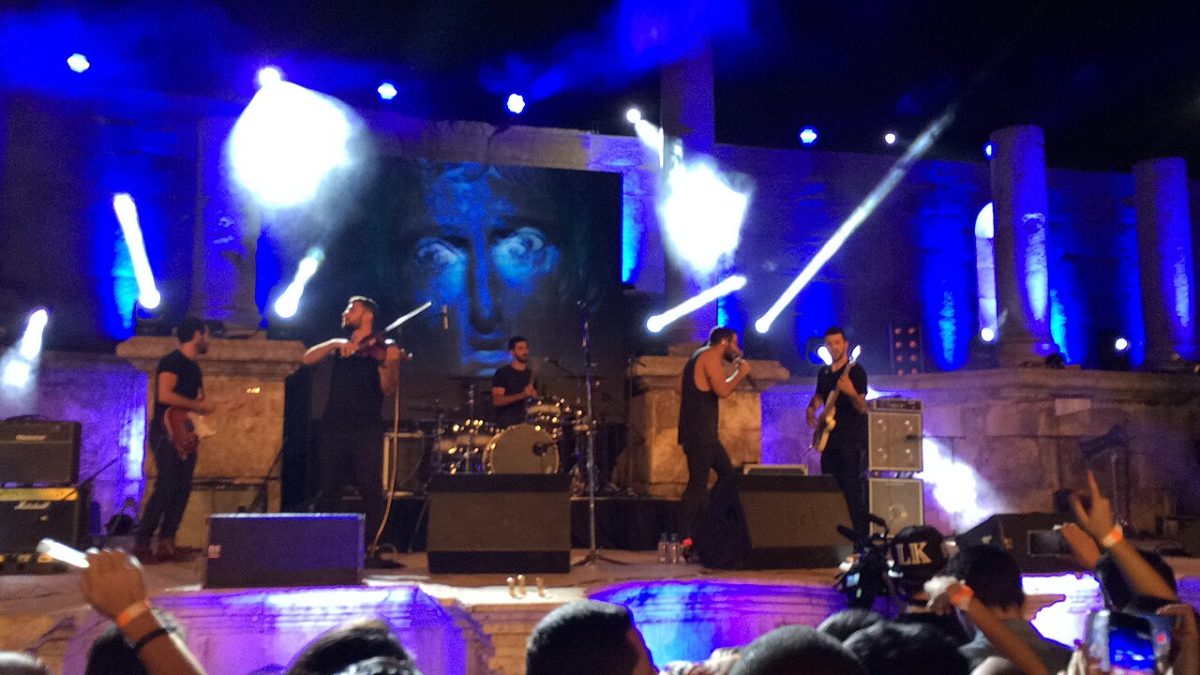
As I engage in my daily doomscrolling, I stumble upon a video with a distinctive theatrical voice and a familiar combination of violin, drums and bass in the background. The voice is lamenting a love story: ‘Abdo, who was infatuated, decided to fast on love’. A new trending song isn’t usually something to note; it seems like we get one every single day. But this stopped me in my tracks.
A Mashrou’ Leila song was trending in Egypt. Eight years after the arrests of their Egyptian audience, five years after Sarah Hegazi’s unfortunate death and three years after the band’s subsequent disbanding.
But let’s backtrack. Who is Mashrou’ Leila? And why is it significant that their art is, once again, coming to light?
Mashrou’ Leila was a Lebanese indie-rock band, formed in 2008 at the American University of Beirut, consisting of lead singer Hamed Sinno, Carl Gerges on drums, Haig Papazian on the violin, and Firas Abou Fakher on guitar and keyboard. The band quickly rose to fame for their unique mix of Arab pop and Western electronica and Sinno’s signature melodramatic voice. In addition to tender portrayals of love, both its joys and its griefs, the band has spoken about everything, from the usage of media to divert the attention of the people from real problems (‘Lil Watan / To my Homeland’) to gun violence, situated within a larger conversation about masculinity (‘Maghawir / Commandos’). Sounds familiar?
Mashrou’ Leila is not the first, nor the last, Arab band to heavily discuss politics in their music. The political nature of their lyrics was part of their appeal, particularly to the younger generation who still carry the enthusiasm of the Arab Spring. However, to quote Sinno, “People like you talking about politics as long as it’s their politics.” And as the band’s repertoire grew, there seemed to be one theme people held a critical magnifying lens to: sexuality.
Sinno is openly gay and non-binary and has not shied away from expressing their identity and more widely discussing queer rights in the Arab world in the band’s music. Their very first album includes ‘Shim El Yasmine/Smell the Jasmine’, a ballad portraying a relationship and potential life of domestic bliss with a male lover. The lyrics reflect the narrator’s longing and grief over the impossibility of introducing this man to his family as his groom, since in Lebanon, as in the rest of the Arab world, same-sex marriage is illegal.
To fully understand the power of their lyrics, it is important to consider the heavily gendered nature of Arabic. Verbs, adjectives, and pronouns all mark gender, which means that the kind of ambiguity often present in English love songs is next to impossible. Historically, many male Arabic singers and poets have used masculine forms, but this is often explained as a poetic convention where the male form is the default. Queer desire can hide in plain sight, as long as the performer never confirms it. However, Mashrou’ Laila’s vocal nature about queer rights, both in and outside of their music, stripped people of the ability to interpret the queerness away as a linguistic quirk. Their choices were intentional. Shim El Yasmine is not about any unrealised love; it is about unrealised queer love.
The band explores the gendered nature of Arabic even further in “Kalam/ S/He”, where the speaker switches fluidly between masculine and feminine forms while addressing their lover. The shifting grammar hints at a non-binary or gender-nonconforming lover, an idea that has never before been presented in mainstream Arabic music. Through songs such as this, we see how vital it is for queer expression to exist within every language, because it is through words that we express identity, and when those words fall short, we must expand the language so that it can hold our realities.
Among Mashrou’ Leila’s incredible collection of queer songs, one stands out, at least in my very biased opinion, as the ultimate queer anthem: “Tayf/ Ghost.” I recommend you watch the video below with subtitles on for the full experience.
Here are some highlights from the lyrics:
“And the men in fezzes took us /
to prisons, to castrate us, to carve medals out of us /
We sewed our flags from the shrouds of our friends’ bodies – the ones who were on death row.”
“And I spent /
My life with my rights mortgaged off to your sentiments (oh, your whims) /
and I was erased /
from the history books, as if history itself belonged to you (and your identity). /
With our hips, we translated for them the verses of Sappho and Abu Nuwas in the tongue of oohs and aahs /
And onto bedsheets we embroidered the same oohs and aahs we chanted at the picket lines”
“The mushrooms have started to grow
Tomorrow, we inherit the earth.”
“Sing with your highest heels on
For now, we still have songs.”
The lyrics speak for themselves and paint a rich image of both grief and resilience, feelings very familiar to the queer community. However, it becomes even richer when we recognise its cultural context. The song was written in response to the police raid and closure of a Beirut nightclub called ‘Ghost’ due to rumours circulated about the sexuality of its patrons, and in crafting this response, the band draws on a tapestry of both Eastern and Western literary references. The most explicit are those to Sappho, a Greek poet whose name gave us the word “sapphic” and who stands as a foundational figure in queer women’s history and literature, and Abu Nuwas, one of the most celebrated and controversial poets in classical Arabic literature known for his homoerotic verse and celebration of male beauty. By invoking both western and eastern literary heritage, Mashrou’ Leila asserts that queer desire has always existed everywhere, directly battling the notion that queer Arabs are “agents of Western imperialism” as they’re often accused of, and insisting that we today are inheritors of this long-lived queer literary tradition that has survived despite all challenges.
The chorus is a reference to Sylvia Plath’s poem ‘Mushrooms’, where she uses the image of spreading mushrooms quietly creeping beneath the surface to depict a silent, but unstoppable, uprising, used in Tayf to depict the growth of queer resistance in the quiet shadows of nightclubs and university classrooms. The song’s outro then goes on to reference the 1997 Egyptian-French Film ‘Al-Masir/The Destiny’, which tells the story of 12th-century Andalusian philosopher Ibn Rushd as he defends freedom of thought against rising religious extremism. In one scene, the poet character, voiced by the famed Nubian singer Mohamed Mounir, challenges religious fanatics and sings: “Sing with your loudest voice / For now, we still have songs”. Mashrou’ Leila spins this, comparing the loud protesting voices with the queer visibility of high heels as they both form acts of resistance against oppression and religious extremism.
Tayf positions queer identity across time. It reminds us of the past and those who came before us, speaks unflinchingly to the present and the challenges currently being faced, while imagining a future where those who have been silenced shape the world.
But of course, their work did not come without consequence. In August 2010, during a performance at the Byblos Festival, Sinno ran across the stage with a rainbow flag handed to him by a member of the audience in the first public display of a pride flag by an artist in Lebanon. The moment was one of pure joy; however, many people have the ability, as Sinno succinctly puts it, to “[take] a work of joy and [turn] it into a source of pain”. When the band was invited back to the same festival for their 10th anniversary, their show was cancelled after a large, organised campaign accused them of blasphemy and “promoting deviance.” The band received wave after wave of threats and screenshots of private group chats in which armed individuals discussed storming the concert with guns. Faced with the very real possibility of bloodshed, the organisers cancelled the event for security concerns. This was part of a wide pattern of censorship and intimidation against the band all across the region.
Another deeply significant moment took place in 2017 during a concert in Cairo, home to the band’s largest fan base, when members of the audience raised pride flags. The band was subsequently banned from performing in Egypt. In the days that followed, alongside a widespread media panic, the police cracked down on the Egyptian queer community. An estimated more than a hundred people were arrested under the “debauchery law”, a set of vague morality statutes used to criminalise same-sex relationships. Among them was only one woman: feminist and queer rights activist Sarah Hegazi.
Hegazi spent three months in prison, where she was subjected to severe physical and psychological torture, including electric shocks. After her release, she sought asylum in Canada, and despite struggling with depression and PTSD in the aftermath of her imprisonment, she continued her advocacy for women’s and queer rights across the Middle East and North Africa. In 2020, Sarah sadly took her own life. Her closest friend and lawyer said in the aftermath of her death, “Every person who ever trolled her, verbally attacked her, is a person who participated in her killing.” Her death cannot be separated from the society that persecuted her, the state that tortured her, or the individuals who insisted on making her life small, impossible, and punishing.
In her final letter, she wrote:
“To my siblings, I tried to survive and I failed. Forgive me.
To my friends, the experience was harsh and I am too weak to resist it. Forgive me.
To the world, you were cruel to a great extent, but I forgive you.”
Tributes to her appeared around the world. Sinno himself sang in her honour, echoing her final Instagram post: “The sky is sweeter than the earth! And I want the sky, not the earth.” A mural of Sarah stands a couple hours’ drive away in Brighton, while murals of her in parts of the Middle East have been defaced. Her story has become a symbol of both the fragility and the courage of queer life in the region.
Mashrou’ Leila disbanded a few years later, citing her death as one of the many reasons. Though we mourn the loss of Sarah Hegazi and the disbanding of Mashrou’ Leila, their legacy endures. Their impact continues to echo across the Arab queer community: in the songs we still play, in the conversations they helped make possible, and in the ongoing fight for a future where no one is punished for simply being.
To circle back to the beginning, when the song Abdo went viral on Arabic social media, most people dancing to it weren’t thinking about politics at all but were simply enjoying a catchy song. This is the kind of quiet, ordinary visibility the band often longed for: a world in which their queerness isn’t erased, but also isn’t treated as the sole lens through which they must be understood, something the band has often expressed their frustration with. It’s important here to highlight that while queer liberation in the West often means celebration and pride, for many in the Middle East, it means being so protected and accepted that it’s the least notable thing about them. Both paths are valid and deserve room in our conversations. And I want to acknowledge my own position here. I have focused heavily on queer themes in this piece as I wove it with “Tayf” at its centre, but Mashrou’ Leila’s artistry cannot be summed up in one song or shoehorned into a single theme. I could talk for a long time about their artistic experimentation, clever references, poignant social commentaries, tender portrayals of the everyday, as well as, of course, their incredible musical composition. After all, the main reason for their rise to fame is that their music is really good, and I hope that after the snapshot I have given you, you continue to explore it further.