
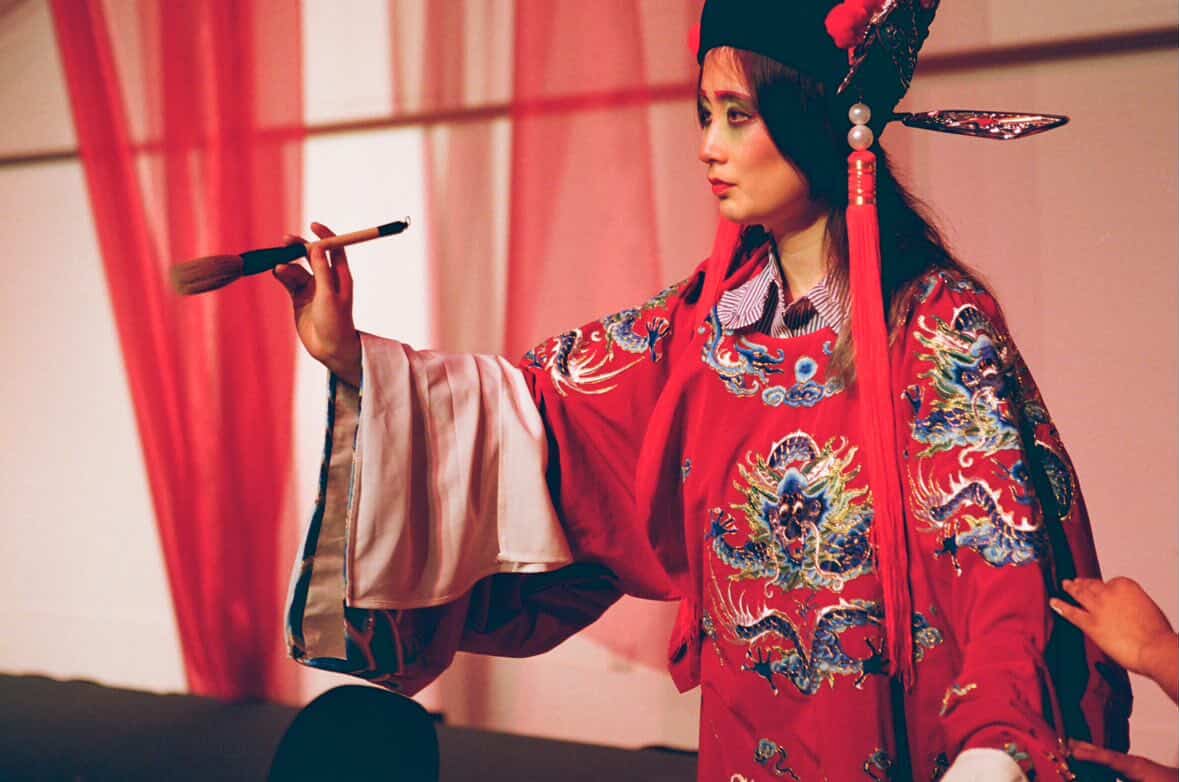
How far will you go to save the one you love? It’s a question commonly asked in fiction, but I’ve never seen it approached quite like it is in Prince Consort Ladygirl. From the story’s outset, the two lovers—Feng Suzhen (Lily Zhang) and Li Zhaoting (Jedidiah Olaleye)—are torn apart by external meddling forces. Feng Suzhen must travel to the capital in search of Li Zhaoting, who has been wrongfully imprisoned. From here, Feng Suzhen runs into quite the colorful cast—both literally, given Jade Bivens’s vibrant costume designs, and figuratively—and the story tumbles into a kind of comedy of errors made unique by its plot beats and various character archetypes.
As Prince Consort Ladygirl is an opera, I feel that it would be amiss to start this review with anything but the orchestra. Although the vivid cotton gauze draped across the O’Reilly’s rafters was helpful in establishing the play’s era and setting, I found that I became truly immersed when the orchestra began to play. The director, William Want, must have understood this as well, choosing to commence the opera with the sound of this resonant orchestra. It was striking to me how quickly just a few chords could transport me to a different time and place entirely, and the orchestra maintained this extremely high standard throughout the two-hour run time. The command of timing and the tonal match with the scene were elements which impressed me in particular. The coordination of the orchestra with the cast was virtually impeccable, both when actors were singing and—something which I found to be even more impressive—when they were moving and speaking as well. Often, I found myself captivated by how the musical director, Jake Fletcher, kept timing exact with precise commands while playing an instrument of his own. Additionally, Prince Consort Ladygirl is an opera with a wide tonal range: scenes can go from deeply emotional to laugh-out-loud comedic in just a few moments, and the orchestra was able to keep up with these shifts brilliantly in a way that greatly enhanced the overall experience. There was never a moment in the show when I found the orchestra to be tonally at odds with the actors on stage.
The singers who the orchestra accompanied were fantastic in their own right: I enjoyed everyone’s vocal performance, but I was especially taken with Lily Zhang’s Feng Suzhen, who, as the main character of the opera, had the most extensive operatic parts. Beyond a stunning vocal range, Zhang performed with such a bold confidence that I could hardly believe it was her first foray into Chinese operatic music. To be honest, I was stunned to read that this was every actor’s first experience with Chinese opera—the acting and singing quality across the board absolutely sounded like everyone was coming into this with years of practice.
There were some technical issues, however, as I found that the voices of the actors were often drowned out by the orchestra, which made it difficult to understand the content of the songs. I recurrently found myself needing a dialogue explanation after an operatic moment had occurred to fully understand the scene before. However, one aspect that especially helped to counter these occasional moments of confusion was the actors’ physicality: throughout the opera, during dialogue and song alike, every actor performed with their whole body—and from this, the emotions and motivations of characters become much clearer, even when their words weren’t necessarily.
This physicality also greatly lent itself to the many comedic scenes in the play, thanks to the work of choreographer Jiasi Li. Not only did Zhang deliver a stunning vocal performance, but I was also greatly entertained by her physical comedy—in her nervous expressions, the inflections of her voice, and her movement around the stage. I also especially enjoyed the comedic performances of the characters played by Peregrine Neger and Sol Woodroffe—not only were the individual characters a delight to watch, but the dynamic rapport the actors had with one another and with the other actors on stage made for some truly hilarious moments. In addition to delivering on physical comedy, I was personally delighted by the anachronistic Oxford-specific additions to the script: Feng Suzhen’s situation becomes all the more understandable when she brings up that ever-so-desirable 15% student discount.
As an opera, this performance was a delightful performance for the ears, but the show was also visually stunning, whether through the subtle lighting cues that communicated a change of scene or the vibrant set design by Rory Clarke. The makeup (designed by Yifan Cheng) was consistently stunning across the cast, with the bold colors always drawing out the emotions in the actor’s features. Of course, this worked in tandem with the characters’ outfits (designed by Jade Bivens), almost all of which I thought matched the character’s personalities exactly. The opulent orange for the Emperor (Peregrine Neger) and dazzling gold filigree embedded in a royal red for the Princess (Tina Zheng) meant that I almost knew what these characters would be like before they ever even said a word. I also feel that I should give every actor kudos for how gracefully they handled movement and gestures with such incredibly long sleeves, making what I’m sure is an arduous task look effortless. However, I think I would have enjoyed a bit more cohesion across the board: a few wardrobe choices felt inconsistent with the rest of the cast. For example, Cherry (Darshini Pitchamootoo) has a slightly more unorthodox dress than the others in the opera, which pulled me out of the immersion a little. However, I cannot entirely fault this choice—if there is anyone in the cast to dress outside the setting, it would be Darshini Pitchamootoo’s vivacious, spirited Cherry!
Of course, every character in the opera is spirited to some extent. A line from the Princess encapsulates my thoughts most succinctly: “imperfect characters don’t preclude a satisfying conclusion.” The beauty of this play is watching and empathizing with these imperfect characters who make you worried, make you laugh, make you feel—and I have greatly enjoyed watching these imperfect characters come to life under the direction of William Want and Red Threaded Theatre. I am hopeful that this is just the first of many Chinese operas to be performed in Oxford, and I am very much looking forward to future productions from this studio.
[Prince Consort Ladygirl, staged by Red Threaded Theatre, is running at the Keble O’Reilly, March 4th-8th, 2026.]