


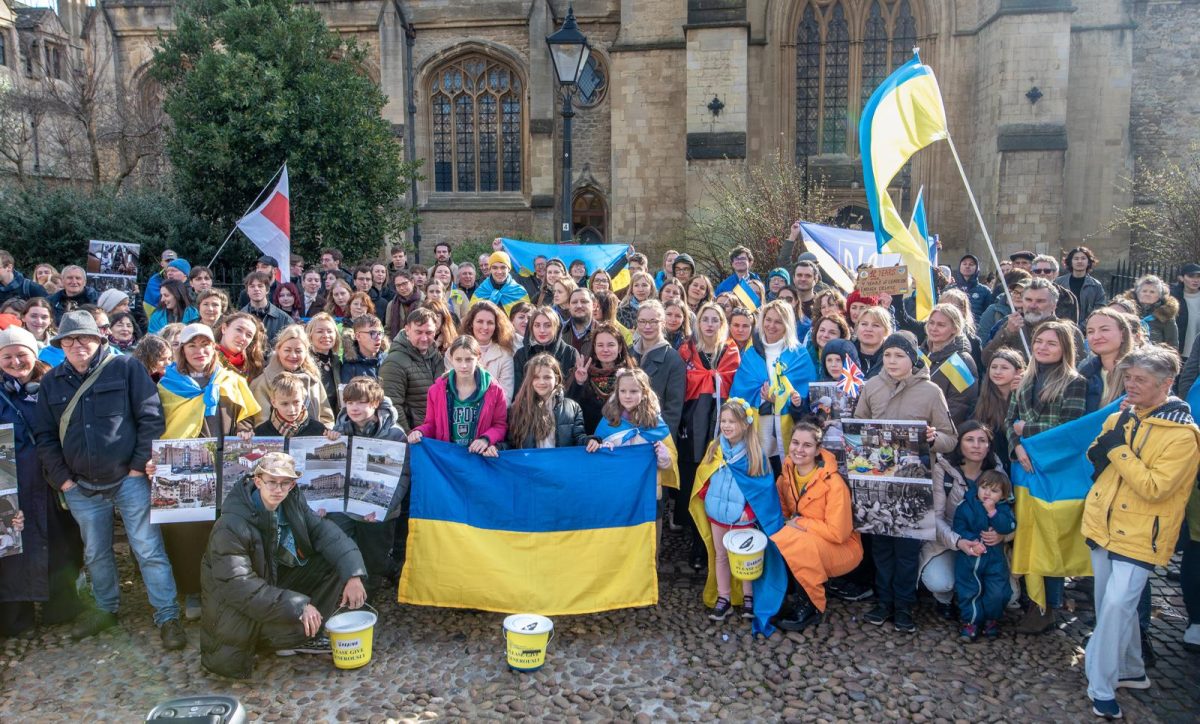
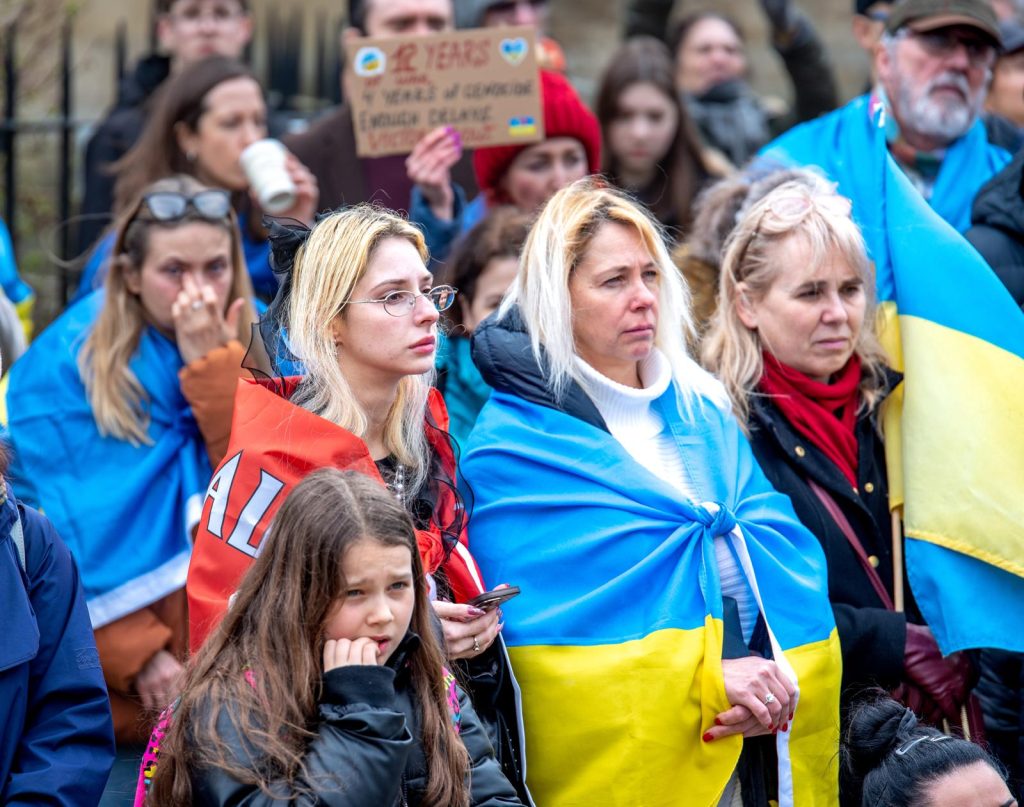
On 22 February 2026, at midday, a ‘rally for peace’ was held by Oxford-based societies, charities, and organisations in support of Ukraine. The groups involved were the Oxford University Ukrainian Society, Razom, a Ukrainian community in Oxfordshire, Ukrainian Medical Charity, Bright Bazaar, Connection Support, Refugee Resolution, Oxford Brookes Ukrainian Society, and Friendship centre.
The rally was held two days before the four-year anniversary of Russia’s full-scale invasion of Ukraine; on 24 February 2022, when Russian president Vladimir Putin ordered up to 200,000 soldiers into Ukraine. Russia had previously seized Ukraine’s Crimean peninsula eight years earlier, following a revolution which removed Ukraine’s pro-Russian president and replaced him with a government more sympathetic to the West. The 2022 invasion, however, was on a different scale.
Putin’s aim was to overthrow the Ukrainian government and return the country to being under Russian influence. Although they failed to do this, today, a fifth of Ukrainian territory is under Russian control. Four years on, the war is still ongoing: Ukraine continues to defend its sovereignty and insist on peace rooted in international law, territorial integrity, and security guarantees.
The rally in Oxford was organised by Justin Robinson, an alumnus of St Anne’s College, who is now a full-time volunteer for Ukraine. In an exclusive interview he explained that, initially, he spent two years volunteering to help refugees, providing them with emergency English lessons so they could find work – as instructed by their social workers. In the two years after that, he focused on organising medical and humanitarian aid, as well as working with the community and refugee support organisation Razom. Through his volunteer work he has got to know much of the Oxford Ukrainian community. He also knows many members of the Ukrainian societies at the University of Oxford and Oxford Brookes University. Therefore, he was in a position to unite many people and organisations and organise the rally.

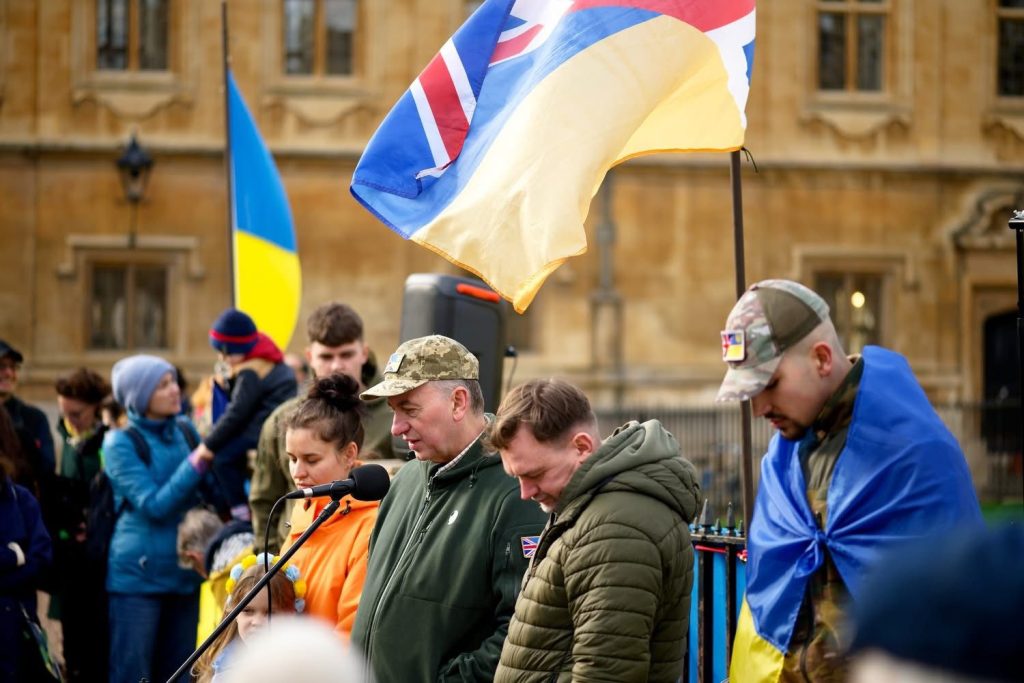
Each group involved in the rally expressed the utmost importance of it taking place, stressing the human cost of the war. According to the Ukrainian Medical Charity, they were holding the rally to show that support still needs to be given to Ukraine, to remind everyone that the war is still ongoing, and to stress that a resolution must be reached. They stated that “support must continue until this criminal invasion ends and a just peace is achieved – with all children, civilians, and prisoners of war returned home.”
In addition, Yaroslava Bukhta, a PhD student of Anthropology at the University of Oxford who attended the rally, similarly reiterated the importance of taking action. She stated in an interview, “Amidst all the conversation about world leaders and their decisions, it is important to remember the human cost of every word spilled in those offices, as well as the impossibility of a long-term peace without justice.” She wanted to remind the public that the war in Ukraine is not just political, but that “occupation means violation of human rights, tortures, and completely inhumane conditions of life.”
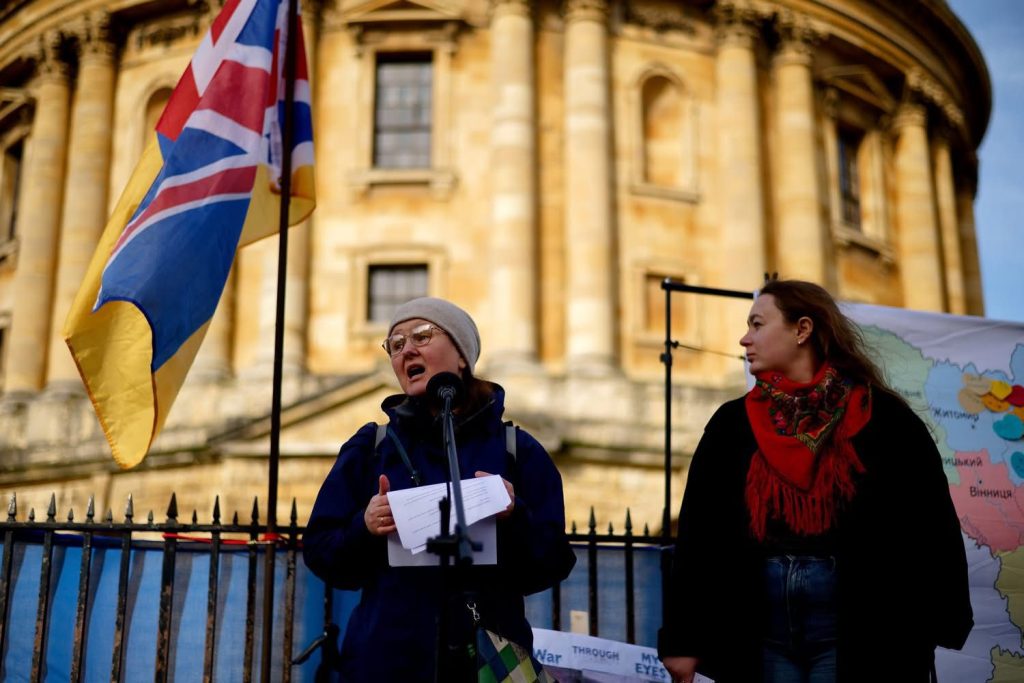
Robinson expressed in an exclusive interview that Ukrainians living in the UK are trying to “work, be responsible citizens, help our economy by working in retail, pubs, restaurants, often over-qualified for the jobs they do but have to contribute to the British economy” and at the same time, they have also experienced significant losses and trauma. He wishes to encourage everyone to offer support where they can within their communities as well as donating and volunteering, stating, “if you know someone who is Ukrainian or if your children know someone who is Ukrainian at school, just show your support…even just one conversation is helpful.”
Bhukta reiterated this, saying that living away from home whilst a war is happening can be an extremely isolating experience, especially in a place like Oxford. She said that when she talks, not just with Ukrainians, but with others from Iran, Afghanistan, Syria, and Palestine, and attends rallies, the conversation is brought into public spaces. In her view, this matters even if the conversations are symbolic gestures.
During the rally there were short speeches from students, volunteers, Ukraine supporters, veterans, and a lawyer: “voices that stand for freedom, justice, and human dignity”, according to the Oxford University Ukrainian Society.
Deputy Lord Mayor Mike Rowley gave a “very powerful speech” at the rally, according to Robinson. Rowley expressed that “Oxford is proud to support Ukraine” and that defending it now is key to protecting freedom for all. He stated that “on one side stands tyranny and dictatorship for us all, on the other side stands freedom, opportunity, the right to live as we choose and to choose our own government”, expressing the importance of defending Ukraine as a means of protecting democracy.
Other speakers at the rally included a woman who was an army medic for ten years, whose husband was also an army officer. Also at the rally was a veteran who fought for three years in Ukraine. Before he fought in the war, he had an office job. One of the other speakers was the brother of a Ukrainian soldier, reading his speech on his behalf.
The speakers evoked a great emotional response from the public: many of the people in the rally were Ukrainian, and they were remembering their loved ones, According to Robinson, some of them had lost more than a dozen friends, family members, husbands, wives, and children.

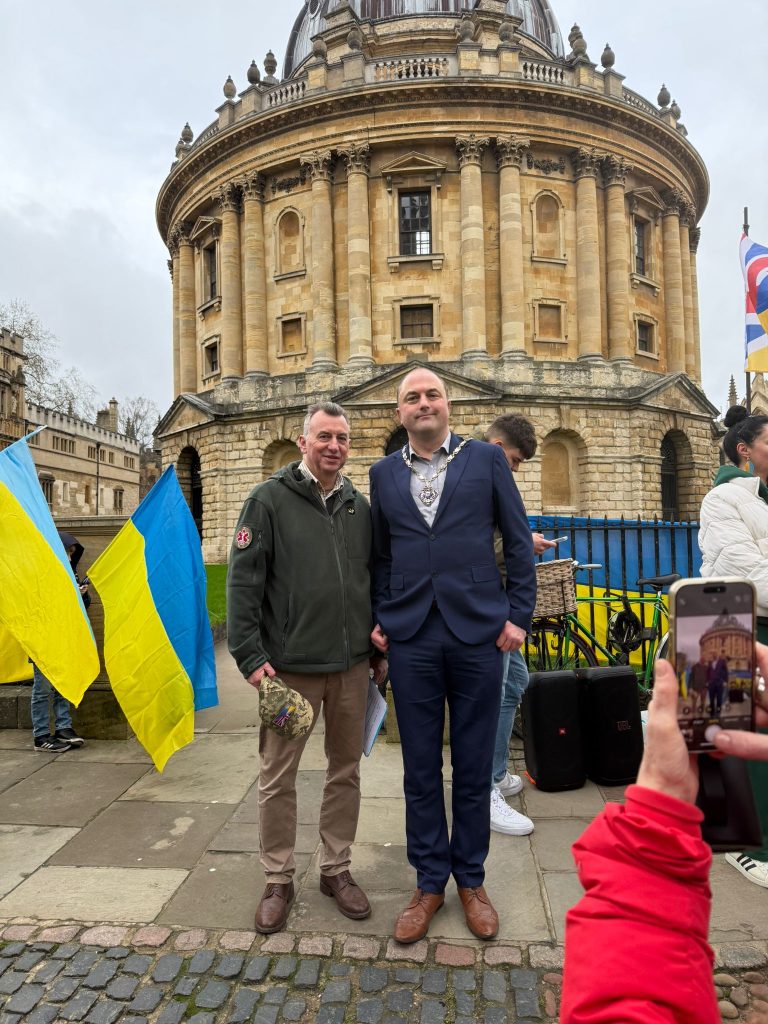
In Bhukta’s view, donating and volunteering is important, but that in addition, the role of students and academics is to encourage a “critical reconsideration of Russian culture and literature, reshaping study curriculums and going through a painful process of decolonisation”, in the hope that this will lead to long-term epistemic justice. According to her, there is enough information to achieve this, but people need to be willing to educate themselves instead of “scrolling past”.
So what does this anniversary tell us about the current position of Ukraine and its future? Robinson is not confident that a resolution will happen anytime soon as the situation in Ukraine is getting worse everyday. He believes action needs to be a priority, especially with humanitarian aid, as people in Ukraine are not only being killed by aerial attacks, but also by damaged infrastructure: many elderly citizens have died during the winter as they lack the resources to stay warm. He explained that there are air raids everyday and night, often at random times.When there are no actual bombs, there are still sirens. He recalled that when he was in Ukraine and came close to the frontline, he could hear explosions every day.
Due to the damaged infrastructure, Ukrainian citizens have no access to education; Robinson has helped tackle this by teaching Ukrainian teenagers. However, he has only been able to start online teaching as the infrastructural damage previously was too bad to facilitate it. Robinson’s dedication is clear: “If you’re going to be a volunteer you need to speak to people and be there… you can’t do everything by email”.
However, Robinson also believes that there are ways to help from the UK and, along with the organisations involved in the rally, he will continue to encourage everyone to help. He stated that, whether you are a student or citizen of Oxfordshire, there are many ways to support Ukraine, such as by contacting the organisations involved in the rally. There are also many British volunteers who fundraise, obtain medical equipment, pack and load medical and humanitarian aid, and drive these materials to Ukraine. Though, Robinson emphasised that anyone can get involved – such as by helping with the packing, which happens in Swindon. He also emphasised the role of women in giving aid, saying that “women do as much, if not more of this work than men”.

Robinson believes the situation is getting worse for Ukraine but also for the UK, warning that we could end up with a Russo-British conflict. He said, “one of the reasons I am doing this is not only for the Ukrainians, but also so that my children and grandchildren will not have to fight against the Russians.” Through raising awareness in ways like the rally, Robinson hopes to encourage people to take the conflict more seriously than they are currently. He says that not everyone realises how bad the situation still is, and believes that the possibility of a Russo-British conflict is not as far-fetched as it seems.
He believes that the solution lies in military pressure: according to him, peace negotiations, directed by the US, have put pressure on Ukraine to defend its territory, when the pressure should be on Russia to leave Ukraine. He noted that Russia is struggling to support the war and replace soldiers who are wounded and dying, and that if international powers were to stop the shadow fleet vessels, they could stop Russia from selling oil and funding the war.
He compared the peace negotiations to “shaking hands with a burglar”: if you make an agreement with them, the burglar will only return. So, he concludes that “any peace that must be agreed must provide justice to the victims of this war or it won’t be a lasting peace.”
Two attempts have been made at negotiating a deal, but both failed. Russia desires international recognition of its territorial gains in Ukraine, including the annexation of Crimea and four eastern regions, whilst Kyiv will never recognise its sovereign territory as part of Russia.