
The Editor’s Note
Welcome back to another issue of Outside OX1! After the winds Storm Chandra brought, resulting in obscurely alternating days of bright sunshine and grey clouds, we have somehow arrived to Sunday and the utter shock of discovering that it is now February. If, like me, you’ve gotten so lost in the busyness of life, why not take a break from all those stressful deadlines and catch up on some of the biggest stories you may have missed this week?
It has been announced that United States ICE agents will be deployed at the Winter Olympic Games that commence in Italy next week. The announcement has faced backlash from politicians and citizens alike, including the mayor of hosting city Milan who declared that the agents “are not welcome”. This response is unsurprising given the Italian public broadcast of ICE agents threatening two Italian journalists in Minneapolis, and following the killing of eight people in the US by ICE agents.
India and the European Union have made a new free trade agreement described as the “mother of all deals” by European Commission President Ursula von der Leyen. The deal will affect a combined population of 2 billion people across economies representing about a quarter of global GDP. Under the agreement, tariffs on 96.6% of EU goods exported to India will be eliminated or reduced, saving approximately €4 billion annually in customs duties on European products.
In South Korea, former President Yoon Suk Yeol has been sentenced to five years’ imprisonment on the charges of abuse of power, obstructing justice, and falsifying documents. Since his declaration of martial law on 3 December 2024, and following his removal from office and subsequent arrest, this first trial is a step towards justice.
ICE Agents to Be Deployed at Winter Olympics in Italy
Lola Dunton-Milenkovic

A unit of US Immigration and Customs Enforcement (ICE) agents will hold a security role in the Winter Olympic Games in Italy, which begin on 6 February.
Sources at the US embassy in Rome confirmed a statement from ICE, which said: “At the Olympics, ICE’s Homeland Security Investigations (HSI) is supporting the US Department of State’s Diplomatic Security Service and host nation to vet and mitigate risks from transnational criminal organisations”. They further added that federal agents would support diplomatic security details, but would not run enforcement operations as “all security operations remain under Italian authority”.
The statement emphasised that the US will set up its own operations room at its consulate in Milan, where HSI investigators will be employed. These investigators “will not be operational personnel like those employed in immigration controls in the United States, but rather representatives exclusively specialised in investigations”. The statement further sought to clarify that agents from ICE’s investigative units are present in more than 50 countries, “including in Italy for years, but do not perform immigration control operations or services”.
Speculation in Italy over ICE’s involvement has been brewing for days, and mounted on Monday when Attilio Fontana, the president of the Lombardy region, announced that US Vice-President JD Vance and Secretary of State Marco Rubio would be protected by ICE “bodyguards” at the Olympics. The newspaper La Repubblica claimed that Italy’s far-right government, which is on friendly terms with President Donald Trump’s administration, had looked into blocking the participation of ICE agents in the delegation. Doing so, however, would have required a departure from the typical protection procedures required for high-profile visits of US officials.
The announcement has garnered significant backlash from politicians. Milan’s mayor, Giuseppe Sala, said the agents “are not welcome in Milan” since they “don’t guarantee they’re aligned with our democratic security management methods”. He further stated, “can’t we just say no to Trump for once? We can take care of their security ourselves. We don’t need ICE”.
Alessandro Zan, a member of the European parliament for the centre-left Democratic party, similarly said that the presence of ICE agents would be unacceptable as “in Italy, we don’t want those who trample on human rights and act outside of any democratic control”.
Two small opposition parties – the Green and Left Alliance (AVS), and Azione – have started petitions, calling on the government and Olympic organising committee to prevent the ICE agents’ entry. “ICE is a militia that shoots people on the streets of Minneapolis and takes children away from their families”, said AVS.
However, Italy’s foreign minister, Antonio Tajani, sought to decrease concern: “It’s not like the SS are coming. Let’s be clear. They’re not coming to maintain public order in the middle of the streets. They’re coming to collaborate in the operations rooms”. In response, spokesman Angelo Bonelli from the Greens and Left Alliance retaliated, claiming “it is necessary to be clear: the Gestapo carried out raids with an uncovered face, while ICE does them with a covered face – and unfortunately this is the only real difference”.
The announcement has sparked uproar in Italy. Since it was first reported that ICE would be travelling with the US delegation, thousands have signed petitions demanding that ICE be barred from entry. Backlash in Italy against ICE mounted after two reporters with the Italian broadcaster RAI were threatened by ICE agents in Minneapolis. The journalists were accompanying a volunteer who was monitoring operations in the city, when armed men approached their car. Video evidence shows the reporters identify themselves in English, before being warned by the agents: “If you keep following us from this point on […] we will break your window and we will pull you out of the vehicle”.
Concern around ICE stems, above all, from the killing of eight people by ICE in 2026 alone. This includes the shootings in Minneapolis of intensive care nurse Alex Pretti on 24 January, and of poet Renee Nicole Good on 7 January. In both incidents, officials claimed that the agents were acting in self-defence – accounts that have been disputed with videographic evidence, and have since caused public outcry. Hence, Italy does not want ICE agents on their territory because, as voiced by Mayor Sala, “this is a militia that kills”.
Long-Awaited India/EU Trade Deal Finally Sealed in the Face of Trump Tariffs
Nancy Gittus
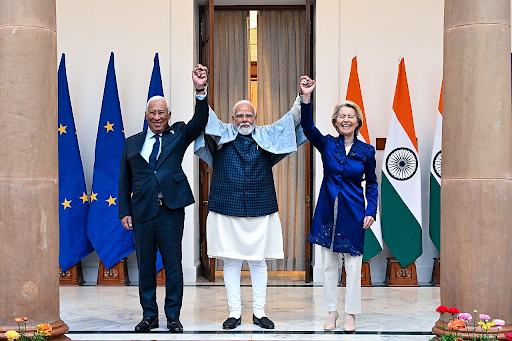

Arms lifted in victory, photos of European Commission President Ursula von der Leyen and Indian Prime Minister Narendra Modi have splashed across the front pages this week. They have, at last, sealed the largest Free Trade Agreement (FTA) ever concluded by either side.
After nearly two decades of stalled negotiations, the resultant product is, as Von der Leyen put it, truly “the mother of all” trade deals. The new free trade zone would include two billion people and nearly 25% of global GDP.
Both sides have agreed to significant tariff reductions. “India will grant the EU tariff reductions that none of its other trading partners have received, dramatically improving market access for EU exports”, the European Commission said. Duties on motor vehicles, which can currently incur fees of 110%, would be cut down to 10%. Tariffs of up to 44% on machinery, 22% on chemicals, and 11% of pharmaceuticals would be eliminated entirely. For the EU’s part, India will be provided with “preferential access to the European markets” for more than 90% of its traded goods. Industries such as textiles, chemicals, plastics, toys, gems, and jewellery will all incur zero duties once the agreement comes into force.
Modi hailed the agreement as a “new era” for India. He emphasised the deal “will make access to the EU market easier for our farmers and small businesses”, a reference to the section of the trade deal specially dedicated to supporting small and medium sized businesses (SMEs). On both sides, there will be key points of contact for SMEs to help entrepreneurs with issues they might encounter when navigating the FTA’s provisions.
Significantly, the deal contains a chapter dedicated to climate change. It outlines commitments in regard to forest conservation, as well as combatting the illegal wildlife, logging and fishing trades in India. The EU also pledged $500 million to enable India to reduce its greenhouse gas emissions and support the country’s transition to long-term sustainable industry.
Although the deal has largely been welcomed, with trade group Spirits Europe calling it “transformational”, there are nevertheless some qualms. Economist Mitali Nikore emphasises that “the EU has very strict regulations, for instance, on environment” and expressed concern that India’s manufacturing sector “might not be fully prepared” for this. Others are worried that the European Parliament may present opposition to ratifying the bill. The parliament recently postponed the ratification of a greatly anticipated trade agreement with Mercosur, a trade bloc of South American economies. However, the India/EU deal is much less controversial than the Mercosur agreement. Both sides have taken care to protect vulnerable industries. Andrew Small, Asia director at the European Council on Foreign Relations states: it isn’t the “super maximally ambitious” version, but it is less contentious as “it cuts around sensitives [sic] on both sides”.
Nevertheless, this agreement has been well-received by many business people in India whose trade with America has recently been hit by 50% tariffs. R.K. Sivasubramaniam, an Indian garment exporter, commented that in the “last six months I think around 30 to 40% of our business [has been] impacted”. Textile worker, Sumil Kumar added his voice to these concerns stating that while he used to make $300 a month, he now earns just $50.
In many ways, however, the upheaval of Trump’s tariffs has provided an opportunity for India to grow and develop trading partnerships with long-standing, stable allies. In the past seven months the country has signed new agreements with the UK, Oman, and New Zealand.
Of course, it is not just India which has been affected by the Trump administration. The American President’s recent threat to impose tariffs on Europe, during the stand off over Greenland, gave the negotiations a last push over the finish line.
The EU and India’s pushback against the US was made clear in a speech by Von der Leyen. She hailed the agreement as “a signal to the world that rules-based cooperation still delivers great outcomes”. What’s more, this strong tie between the world’s second and fourth largest economies may be “only the start – we will build on this success, and grow our relationship to be even stronger”, Von der Leyen added.
Indeed, India’s Defence Minister Rajnath Singh has already begun discussions with the European Commission’s Vice-President Kaja Kallas on a range of bilateral security and defence issues, such as maritime security, cyber threats and integrated supply chains.
Ultimately, as Brahma Chellaney, a professor at the Centre for Policy Research think tank in New Delhi puts it: “In an age of trade wars and great-power coercion, New Delhi and Brussels have chosen not retreat but alignment”. The deal is not simply a Free Trade Agreement; it is an “important political message to the world that India and the EU believe more in trade agreements than in tariffs”. It is, as Von der Leyen states, “the tale of two giants – the world’s second and fourth largest economies. Two giants which chose partnership in a true win-win fashion. A strong message that co-operation is the best answer to global challenges”.
South Korea’s Former President Sentenced to Five Years Imprisonment in First Trial
Noah Allerton
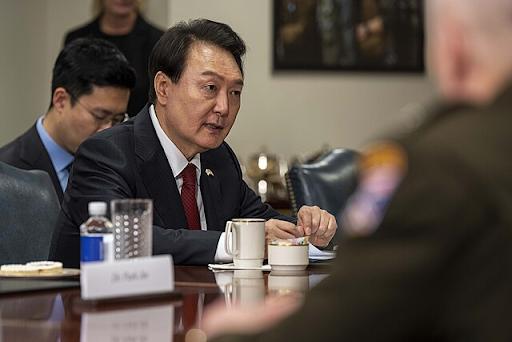

On 16 January, former South Korean President Yoon Suk Yeol was sentenced to five years’ imprisonment on the charges of abuse of power, obstructing justice, and falsifying documents. This trial is just the first of four that former President Yoon has to face, with other charges including perhaps the most serious of all: insurrection. How did we get here?
Yoon declared martial law in South Korea on 3 December 2024, which lasted just 6 hours and 3 minutes. 6 hours and 3 minutes that not only would result in South Korea eventually seeing a change of President, but also in the former President being accused of some of the most serious crimes in the country.
To justify its declaration, Yoon cited that North Korean communist forces posed a threat to South Korea, that anti-state elements needed to be eliminated, and that the National Assembly had become “a den of criminals”. Yoon issued arrest warrants for multiple South Korean politicians, including Lee Jae Myung, the leader of the opposing Democratic Party who had also been his opponent in the 2022 election, and Han Dong-hoon, leader of his own People Power Party. Yoon ordered that power and water be cut off for “progressive” media outlets to ensure they could not broadcast against him.
This was the first declaration of martial law in South Korea since 1980. Through the permissions martial law granted them, the military attempted to enforce the suspension of parliamentary activity. Lee branded the declaration “unconstitutional” given that in South Korea, in order to declare martial law, the National Assembly must be notified. Martial law must also be lifted should a majority of the National Assembly members vote for the suspension.
Despite entrances to the national assembly being blocked, sensational scenes of opposition lawmakers (including Lee) climbing over the barricades in order to enter the National Assembly, were recorded. In Lee’s case, he was livestreaming his own attempt. At 01:02, just 2 hours and 35 minutes after Yoon declared martial law, the National Assembly unanimously voted to lift the martial law, with 190/300 members present. At 04:30, 6 hours and 3 minutes after declaring martial law, it was officially lifted by a cabinet decision.
On 4 December, the Democratic Party announced they would be bringing an impeachment bill against Yoon. The first vote on 7 December failed due to the National Assembly not reaching quorum (the minimum number of members present for votes to be considered valid); Yoon’s People Power Party boycotted the vote. On 14 December, however, all members were present, with 204 members of the Assembly voting Yes. President Yoon was removed from office at 19:24 Korean Standard Time, just 11days after initially declaring martial law.
In South Korea, all impeachments must be reviewed by the constitutional court to be upheld. On 4 April 2025, in an 8-0 decision, the constitutional court formally removed Yoon from office. In accordance with the constitution, a presidential election was held within 60 days of Yoon’s removal; this election was won by opposition leader Lee.
Before Yoon had been formally removed from office by the constitutional court, the Corruption Investigation Office for High-ranking Officials (CIO) attempted to arrest him on 3 January 2025. The CIO alleged charges of abuse of power and orchestrating a rebellion, but had to call off the arrest attempt after around six hours due to being blocked by the presidential security services.
On 15 January 2025, another attempt was made to arrest Yoon. This time, the operation was successful, with Yoon agreeing to cooperate. He alleged that the operation was “illegal” but he was cooperating in order to “prevent bloodshed”. Yoon was released from this initial arrest on 8 March 2025, following the prosecutor-general’s decision not to appeal court orders submitted for the release of Yoon, whose defence had submitted papers for his release on 4 February.
After his formal removal, however, Yoon was arrested again on 10 July 2025. Now a private citizen, Yoon was arrested on the same charges as previously, though this time under the concern that he could destroy incriminating evidence. Legal proceedings continued throughout 2025, culminating in the first sentencing released on 16 January 2026.
The five year sentence Yoon received on 16 January was weaker than the prosecution had fought for, as they had sought a 10 year sentence. In February, sentencing for the charge of insurrection will be released – on this charge, the prosecution is seeking the death penalty. South Korea has had a moratorium on the death penalty since 1998, and groups such as the Anti-Death Penalty Asia Network have called for Yoon to not receive the sentence, but to instead receive penalties that are “consistent with international human rights law”.
For many South Koreans, the removal of Yoon was enough. Crowds “erupted with cheers” upon hearing that he had been removed from office permanently by the constitutional court ruling. The sentencing of Yoon however – both this initial sentence of five years and those that will inevitably follow – demonstrate to future South Korean politicians that trying to consolidate power and bypass democratic functions can be easily foiled.