
First sentences matter. How can you possibly even start a eulogy for a loved one – a parent you have relied on and looked up to your whole life? The pressure to do it just right is unbearable. Louis Benneyworth’s new musical On Some Far Shore (co-directed by Adam Paterson and Madi Bouchta), running at the Michael Pilch Studio theatre, dives into the life of a man in this excruciating situation.
The musical follows Euan (Thomas Perry) during the night before his mother Helen’s (Nicole Palka) funeral. Frustrated and sad, he despairs over what he has written. His girlfriend, Isla (Katie Gill), attempts to comfort him, but fails to get through – partly because she is silently suffering problems of her own. Over the course of the long night we see Euan and Isla navigate their rocky relationship, jumping back and forth between the present and flashbacks as Euan retells the stories his mother used to tell him as a boy: stories which shed light on the man he has become today.
The storyline is tight and well-woven. Given that the whole musical is set in such a small space of time, and that all the present-time scenes occur in the same setting, it is not surprising that the plot is gentle and sparse. This is far from a criticism, though, because the impetus of the play is not geared towards action, but rather to character development which is really well thought through. The changes that occur on stage are not physical: they are how the action has illuminated different aspects of the characters themselves, including their mental states and relationships with one another.
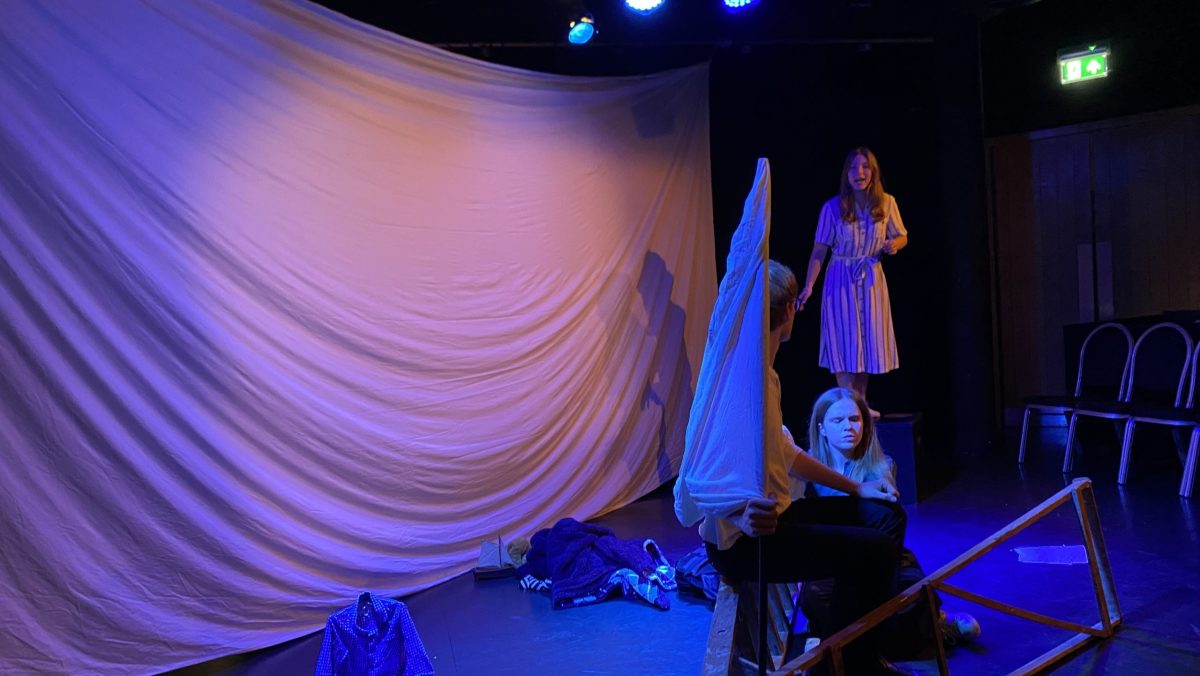
The set is minimalist in feel – as the audience take their seats they are greeted only by a large white sheet to act as a background, a worryingly wobbly ladder, and a black box. Paper is scattered around the floor, littered with Euan’s increasingly deranged attempts at constructing a fitting picture of his mother (‘she loved peanut butter…actually thinking about it she didn’t even like peanut butter…I’m just hungry, THIS IS STUPID’). The split levelling effect created across the ladder, the box, and the floor provides a sense of vertical separation between the different areas of dialogue. Isla ascends the ladder as Euan sings Helen’s stories, indicating she is spectating, but not part of, these memories. Each character has their moment sitting hunched on the box, a position which conveys their vulnerability as they open up their emotions to each other. Euan and Isla’s closest moments, however, occur when they are physically level, nestled together on the floor by the end.
I did feel at times though that the stage looked cluttered – though it started off with only a few items, they kept multiplying across the scenes, some being removed when not needed, but others kept even when they were categorically no longer part of the setting (like the papers, which had a mind of their own slipping across the floor).
The costumes (by Lily Wiltshire) featured a few clever small details, snuck in to help guide the audience. I was very impressed that whenever Helen appeared as a figment of Euan’s memory, she would glide silently across stage just in socks, but that on the occasions when we had a genuine flashback she would stride on stage with shoes on to confirm that she was now real. Similar was the tactic of having Euan change into a blue jumper whenever we were not in the present – simple, yet effective at grounding the audience in the correct timeline.
All three of the actors deserve great praise for their vocal ability. The backing score was not thickly scored (mainly light piano and strings), so they had nothing to hide behind. Perry proved himself a talented and confident singer, maintaining perfect clarity and dynamic control in the frequent falsetto jumps he had to perform. Gill and Palka also gauged their projection to a T: to be able to convey as much anguish as they did at such a moderate volume (considering how close they were to the audience), yet make it feel just as powerful as if they were belting it out on a West End Stage, fully merited the round of applause they received at the end.
However, I was disappointed that quite often the balance of the backing score missed the nuances of the actors’ dynamic control. Instead, it tended to bulldoze through at a steady (and slightly too loud) volume, such that I was straining to hear the actors, especially if they were looking away from me.
Most of the duet songs were very well performed: the highlight of the show for me was Euan and Isla’s shared number, as they stand on opposite sides of the ladder (physically close, yet symbolically apart), and their tunes slip between disjunct lines and a shared melody – embodying their desire to love each other, despite the gulf they feel which exists between their thoughts. Only one song failed to hit home – the duet between Isla and Helen. Even though the backing score was essentially a click-track as it maintained a series of alternative semi-quavers, the singers kept slipping in and out of time with each other and getting ahead of the music, such that when they were singing the same words it sounded like one was always trying to catch up with the other.
The actors also excelled in the non-sung sections of the musical. Helen’s playful and motherly nature as she danced across the stage with a puppet-esque representation of five-year-old Euan was a delight to watch. The relationship between Euan and Isla was well handled: it somehow felt very natural for Euan, a nervous, hand-wringing chap, and Isla, a reserved but caring woman, to feel like a couple, and Gill’s expression was one of genuine eye-twinkling affection in their more heart-to-heart, intimate moments.
No moment displays the web of effects that were brought together in the musical better than the beginning of the number Lullaby. Started off by Euan, reminiscing sadly on the box as Isla watched over him, the melody he began to sing was beautifully transferred to Helen standing behind the white sheet, dramatically backlit so that she was silhouetted to Euan’s side. After the song has swapped to this ethereal voice (representing the memory of it when Helen sung to him as a boy), Euan then joined in again, weaving their voices together in a final duet with his dead mother.
Organised and effective, this was just one of the many occasions when music, lighting, set, actors, and script all came together to create a deeply emotional scene.
[On Some Far Shore is playing at the Michael Pilch Studio Theatre from 9-13 June.]