
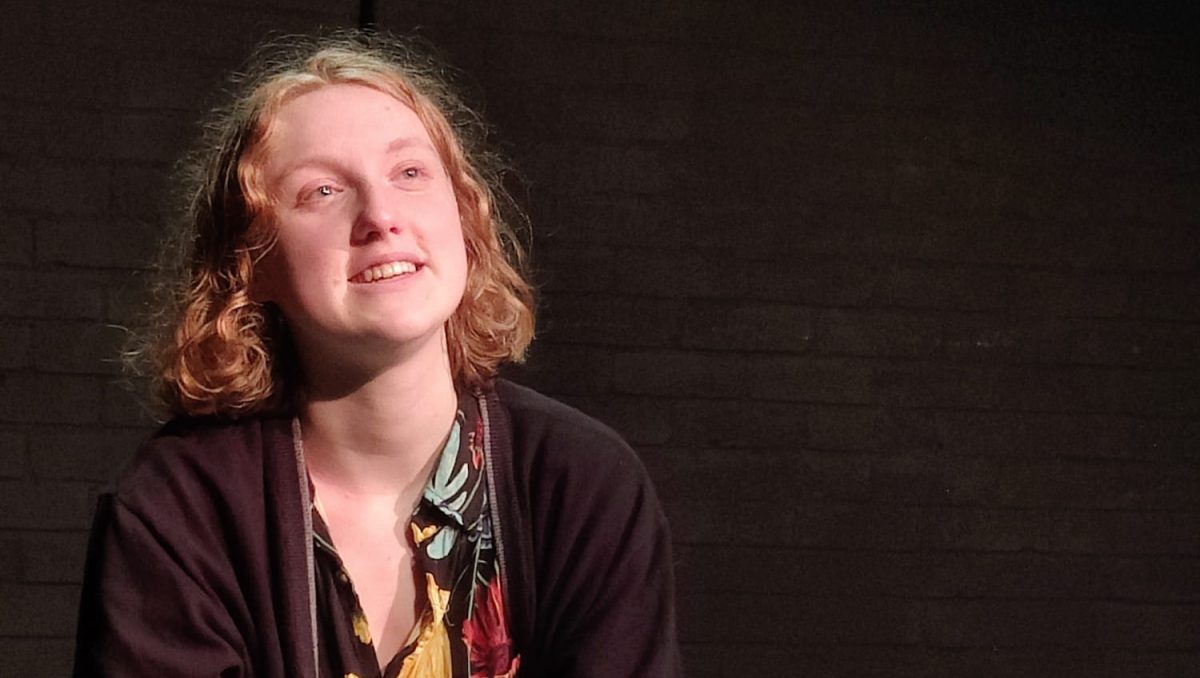
What does it mean to be a person? Interrobang Productions confronts this perennial question in their original play My Dead Mum’s AI Boyfriend, in which we are asked to decide whether an urn and an AI companion count as ‘people’ at a tollbooth. Carrie (Sali Adams), the play’s fourth-wall-breaking protagonist, debates this conundrum with herself, or rather with the disembodied voice of John Locke (Hannah Wei). But it is not through intellectual arguments but through the actions of grieving, loving and forgiving, that this dilemma resolves itself at the end of this heartfelt and deeply funny student play.
The world of My Dead Mum’s AI Boyfriend is populated with bodiless voices. These ghost-like figures usually represent machines, chatbot boyfriends (Billy Morton) and artificially cheerful talking cars (Holly Dodd), speaking and interacting with Carrie across an intentionally bare stage. This is the first time I’ve seen a production make use of the Burton Taylor Studio’s darkness, which serves here to cloak everything around Carrie, accentuating her loneliness. What plays out on this bare stage feels like a one-woman show. This is a very difficult set-up to pull off, and one that Adams excels at, holding the audience’s attention and sympathy with her witty dialogue and stage presence. I say this without discounting the hard work of the voice actors, whose presences are helpfully declared by lighting and sound cues. Clearly, much went into such a deceptively simple setup. Ultimately, the stage design shows a student company making the best of what they have, and it’s admirable. Breaking through the impersonality of the stage with her honesty, she tells the audience the topsy-turvy story of scattering her mother’s ashes. All of these production choices pay off thematically in the end; the lack of any other physical human presence on stage is felt deeply, reminding us that there is no substitute for interaction with real people. Adams mimes and narrates her way across the stark stage, allowing the audience to use their imagination, a form of cognition that AI can never truly replicate.
Another thing that AI can hardly replicate is wit, and if the script of My Dead Mum’s AI Boyfriend is anything, it’s witty. My only criticism is that there might be too many jokes packed in, making it difficult for the audience to prepare themselves for the next punchline. Dilemmas and contradictions inhabit the story as much as machines do. Carrie is critical of her mother for her loneliness and self-absorption in dating Aled, a chatbot, played by Morton with frightening accuracy. The script consistently shows much of her criticism to be hypocritical. Throughout the play, Carrie is shown to be deeply alone, illustrating that the need for companionship that the AI boyfriend exists to fill is a very real one, although some of this loneliness is self-inflicted through her inability to say the right things. This was really a stand-out feature for me, as I feel that the AI debate is deeply polarised, with little room to discuss the real issues in our ability to connect, think or communicate, which tech companies exploit.
Ideas surrounding communication, the conduit of human (or human-robot) relationships, are at the heart of the play. Aled’s speech as half of Carrie’s mother’s ashes are scattered, is nice enough, but ultimately just a collection of empty platitudes, vectors that his language model put together to sound heartfelt. Carrie’s own speech as she scatters the final half into the ocean is at times downright mean and deeply self-contradicting, yet her final ‘I love you!’ captures a truer emotion than Aled ever could. This is what sets humans and machines apart linguistically: Aled says all the right things and never means them; Carrie says all the wrong things and never means them either. Both Adams and Morton portray these contradictions with charm and realism, and the play’s ability to represent these nuances makes for an exciting narrative. The script never feels academic, stuffy or overwhelming due to these complexities, and Adams’ writing is consistently quick-paced and light. This can feel a little inappropriate for a story about grief at times, but a few heartfelt scenes help the play land on its feet by the end. Adams’ script itself is probably the strongest aspect of the play for me, since it delivers on a very interesting but perhaps over-discussed premise in a way that feels new and clever, touching on age-old problems through its contemporary theme.
Let us return to the initial dilemma posed at the tollbooth. What does it mean to be a person? Is it Locke’s view that a capacity for reason and self-reflection defines personhood? Or is the answer to the problem that it is ever-changing, like the story Adams narrates to us, fleeting but beautiful? I’ve never really thought that there are many interesting things left to say about AI, and Interrobang Productions’ My Dead Mum’s AI Boyfriend hasn’t necessarily changed my mind. However, through its thoughtful script, staging and the actors who help bring the play to life in an organic, complex and completely human way, it has shown me how much can be said about people, community, and the nature of love through AI.
[My Dead Mum’s AI Boyfriend, staged by Interrobang Productions, is running at the Burton Taylor Studio, 3rd-7th February, 2026.]