
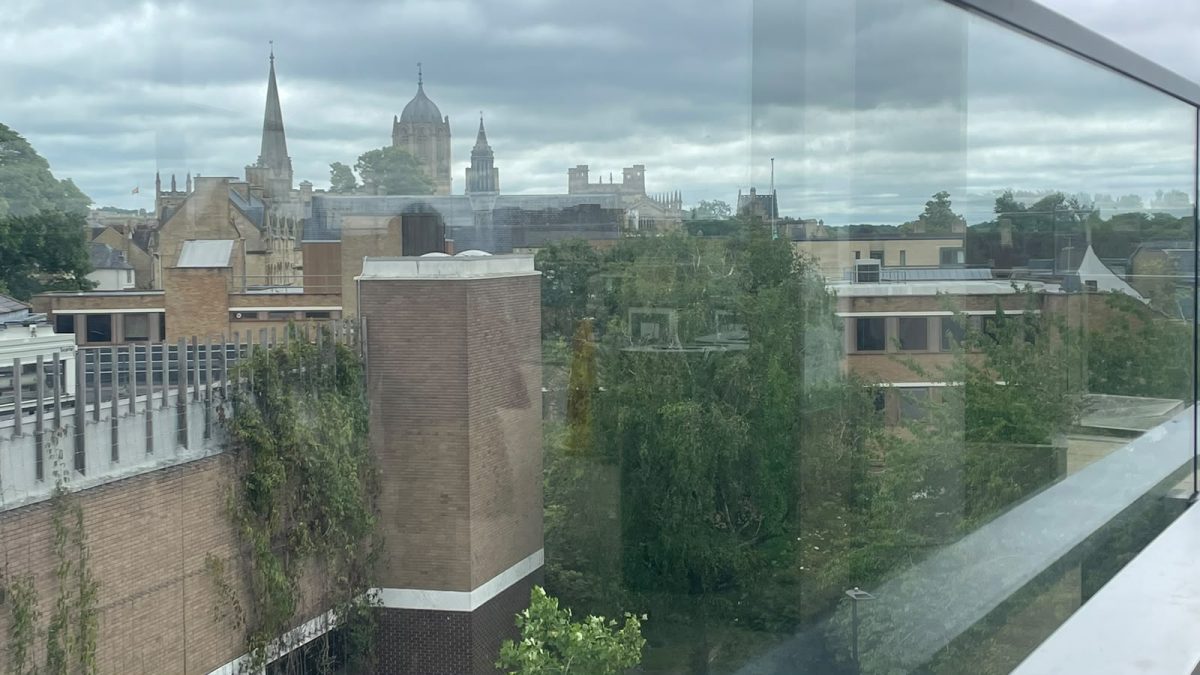
I have a daydream where my classical singing teacher comes to Oxford in pursuit of an euphonic, haunting melody that has sounded in her subconscious ever since my last music lesson. Upon her arrival she hails a Voi (for efficiency’s sake) and speeds down the High Street in desperate search of the origin of her dream. She comes to a quivering halt outside Logic Lane, where, distinguished from the ever-clanging bells that signal diligently the end of every week, the surreally beautiful sound from her slumber floats down from the lecture theatre on the first floor at 10 Merton Street. She is heralded in the waking world at last. It is, of course, my voice that greets her.
It is very difficult to commit oneself to the pursuit of a hobby. There are a range of reasons for this: the tendency, both youthful and Oxonian, to be ambitious; the inescapable overlap between success and enjoyment; the impossible task of achieving a “work-life balance”. In the hyper-compression created by a term of eight weeks, the already-fine line between work and life blurs into practically nothing. Evenings out are sandwiched between days for reading and nights for writing; lunch is the word for both the primal need for sustenance and the opportunity for a tutor meeting, a date, or a break with friends that will revolve conversationally around the work you have “broken” to have a conversation.
The absolutist school of thought holds this sort of breakage to be ill-advised. Why cook at home, so the argument goes, when for practically the same amount of expenditure, you can have a ready meal or something so alleged in your college hall? This sacrifice of the chance to develop a basic skill of life allows you to commit the maximum possible time to your degree – and remember that, for this pursuit, whether it be an end in itself or merely a means, you have invested and continue to invest time, energy, money, and hope.
I sat one classical singing exam – by which I mean I stood, in order to fully engage my diaphragm, before I really knew what that entailed but knew enough to know sitting would cap my mark pretty decisively – in Year 10, and was then faced by the well-meaning question of “now what?”. Strangely, I found that I could not answer. I changed schools for the Sixth Form, but was only down the road from where I had been before. My teacher, my idol and a load-bearing pillar in my life which, even then, suffered from a distinct lack of hobbies, suggested that I make the short commute once a week during lunch hours to continue. For a multitude of reasons, all of which remain even now impossible to articulate, I did not. And so that was the end of it.
Life carried on. Mine, that is.
I started the International Baccalaureate with Mathematics and Philosophy among my Higher Level subjects, and finished with Computer Science and English Literature instead. I then came to read for a degree in Law. Most if not all of what I did in the elapsing time was treated as a means. It is only recently that, in the course of deciding which menacing, overgrown path to pursue into the deep, dark forest of the future after my degree, have I realised how abjectly stupid a decision it was to forego a casting opportunity in my home community theatre because rehearsals might have conflicted with my mock GCSEs. I mean, really – not even the real ones.
The memory of this one particularly outstanding disappointment spurred me on to wonder the breadth of missed enjoyments that I have foregone without even realising it. Why did I think an hour per week was too much a commitment to make for an activity that I enjoyed? At the time, the answer of, “I don’t know what’s next, but I’d like to keep singing for fun” did not come to my mind. If it did, it did not rise to my lips. Why ever not? What is it about pursuing enjoyment that seems to require a justificatory preface?
My thesis is not one implying a value to decentring work or academic commitments. It is one concerned with giving enjoyments and pursuits for pleasure the priority that they are due. It is a sort of Kantian concern for the dignity merited by hobbies merely because they exist and are so. I cannot trace my own line of reasoning and yet I was led – by something that, at least at present, I am forced to conclude must have been sheer impulse, or else, a misplaced sense of intuitive shame – for many years unseeingly closer and closer to a life shaped by one, singular goal at any given point in time. I learned, or was taught, very early that a writer with two or more items in her drafts folder at once was a writer who was going nowhere at all. Being pulled in two directions is destructive for both of them. But real life is not much like journeying through an overgrown, evil, fairytale forest, or whatever ridiculous extended metaphor I employed earlier in this column.
The more apt comparison would be between life and a number of fairytale forests each on a different plane, in each of which one can move at any time and in any direction, independently of any effect on the other planes. Each of these planes represents a pursuit, and some of these can be purely pursuits of enjoyment, at no detriment at all to the “central” goal that defines your life, or to the goals that define any of the other planes.
I have lost track of my metaphor.
But it scarcely matters. The remainder of my planes are left unaffected. I am free to move in whatever direction I please, the only actual constraint being that of time. The time I elected to spend on the ab initio terrible decision to act in not one but two plays, one involving classical singing, this term, was unavailable for movement in other planes. The time I will spend continuing my column in Michaelmas will be unavailable for other things, too. It does not matter. I enjoyed myself. I think that there is value in that alone. I will see you next term, and if my view has changed, I shall let you know.