
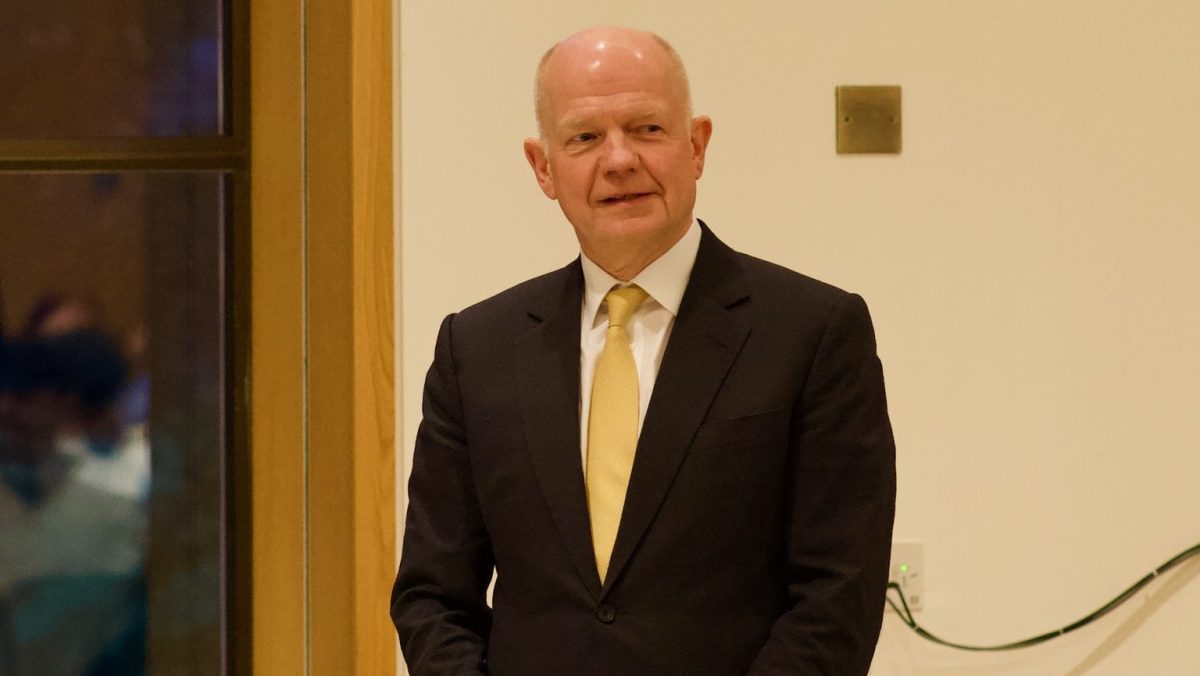
Having returned from the World Economic Forum in Davos, the Chancellor of the University of Oxford and former Leader of the Conservative Party, Lord William Hague, spoke on Thursday evening at the Oxford Politics Society. He reflected on his time in politics, today’s crisis in international order, and the “fragmentation” of UK politics.
For Hague, today’s situation resembles what got him into politics in the first place. The 1970s, he said, were a “dramatic international time”, with the Cold War at its height, multiple UK general elections and a European referendum. In this turmoil, Hague was famously drawn to politics at a young age. At just 16 he delivered a speech to the Conservative Party Conference arguing that young people wanted tax cuts, unions’ power curbed, and the size of the state reduced, gaining him “the admiration of Margaret Thatcher”, who went on to support his 2001 election campaign.
Hague, who also served as Foreign Secretary from 2010 to 2014, discussed what he sees now as a breakdown in the international order. He called former U.S. President Barack Obama “almost infuriatingly thoughtful”, saying “you can hardly think of a more different personality” than President Trump. The relatively stable international order during his years in the Foreign Office does not compare to the era of crises which Hague perceives today. He praised Mark Carney’s speech at Davos, in which the Canadian Prime Minister called international order an old “bargain” based on a “pleasant fiction”, which is now breaking down. On these grounds Hague argued, “we have entered a new chapter of the history of the world”. Asked what advice he would give the Prime Minister for these unstable times, Hague said that he sympathised somewhat with Starmer on foreign policy, and joked that it must be difficult having to “phone President Trump every few days!”
Answering whether he believed Trump was focusing excessively on international affairs and neglecting domestic policy, he replied, “basically yes”. He pointed to the small percentage of popular support for Trump’s aggression towards Greenland and stressed that foreign affairs could not “substitute” for domestic policy. He also highlighted Trump’s neglect of domestic issues, again referring to Davos, where Trump claimed the U.S. has “virtually no inflation”.
Hague was asked what responsibility governments of his time, including the Obama administration, have for the instability he sees today. Pausing for thought, Hague answered that they had made mistakes, but that “bigger forces” were at play, including demographic shifts pressuring government finances and rapid technological change. Still, he noted the Iraq War as a key mistake, saying it “used up a vast amount of goodwill” for “liberal intervention”, adding that this was before the Conservatives took power. Nevertheless, Hague did, in 2003, align with the Conservative Party in voting for war, while, in 2014, he denied that the initial invasion had been a mistake. He ended his answer by suggesting that Putin has been more responsible for creating international instability, saying he felt threatened by liberal democracy spreading, not NATO, which he described as “a defensive alliance”.
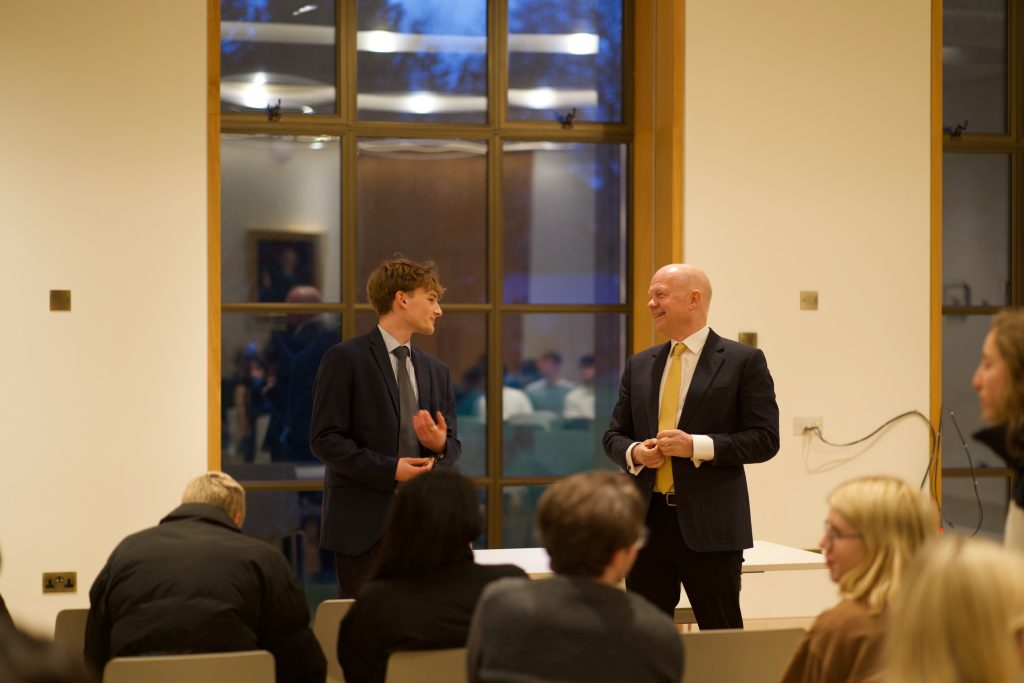
Although he expressed sympathy for the Prime Minister in foreign policy, Hague remained critical of Starmer’s policies on AI and technology. He argued that the Government needs to make greater investment and move faster on AI, robotics, and biotech. Without this, Hague warned that the UK risks becoming dependent on China and even more dependent on the U.S. AI has been central in discourse within the University of Oxford, too. Since Hague became Chancellor, the University has formed a partnership with OpenAI, as part of which the University has become the first in the UK to offer students and staff free access to an education-oriented form of ChatGPT.
Speaking on whether he thought Trump grasped the threat which China’s technological advance may pose to the West, Hague called China a “totalitarian system” and pointed out its high degree of state control in industry. However, he also emphasised that they possess a strategy in a diverse range of fields, including AI. He criticised Trump for not appreciating this, pointing once more to the Davos summit, where the President claimed that China merely sells wind turbines (calling them “windmills”) for a “fortune” to other countries, without having wind farms themselves. As Hague pointed out, China is home to the largest wind farm in the world, which is even visible from space.
Instability, for Hague, extends to the UK’s domestic political situation too. He argued that people in Western democracies feel that the system is not working for them, and that they are turning to “different kinds of leaders in their frustration”. Hague said that his electoral loss in 2001 to Tony Blair taught him that politics was not just about providing a policy list which people will agree with, but it is instead about telling a story. For Hague, though he does not agree with it, “Nigel Farage is telling a story about the country”. Linking his 2001 defeat to the state of today’s Conservative Party, which suffered an historic defeat in the 2024 General Election, Hague said he believed that the Conservatives’ tarnished image is still recoverable, though he recognised that now is a time of political “fragmentation”. Nonetheless, in politically fraught times like these, Hague argued there is a need for moderate, centrist parties to continue to exist.