

Thomas Yates
Six years after Ethiopian prime minister Abiy Ahmed won the Nobel Peace Prize for bringing an end to a lengthy military standoff with Eritrea, and four years after a ceasefire was declared in Ethiopia’s Tigray Region, the Horn of Africa is on edge again. Landlocked Ethiopia has expressed its desire to have a Red Sea port, which poses a problem for Eritrea, its coastal neighbour. But this is more than just a war of words. A militia known as the Fano is creating insurgency in northern Ethiopia – and Eritrea is accused of aiding it. Amongst the instability, regional powers like Turkey and Egypt have been quick to seek influence, too, while the conflict in Iran adds further uncertainty to an already volatile region.
Civil Strife in Ethiopia
In a country with a population of just under 140 million, 33 million live in the northwestern Amhara Region – much of which is now under Fano, rather than government, control.
The roots of the conflict with the Fano lie in a different war. From 2020 to 2022, Ethiopia fought rebels in the northernmost province, Tigray, which borders Eritrea. The rebels fought under the banner of the Tigrayan People’s Liberation Front (TPLF), which dominated Ethiopian coalition governments from 1991 to 2018, effectively acting as a ruling party.
Ethiopia is made up of numerous ethnic groups; the national census lists over 90. The largest is actually not the Tigray, which makes up around 6% of population, but the Oromo, which constitutes 35% of Ethiopians. After 27 years of Tigray rule, protests in the Oromia and Amhara regions led to the resignation of Hailemariam Desalegn and the appointment of Abiy Ahmed by the government as Ethiopia’s first Oromo prime minister.
It was hoped that Abiy could bring unity and a fresh start to the nation. Indeed, he quickly worked to free thousands of political prisoners – including Andargachew Tsege, who had led a party critical of the TPLF. In July 2018, it appeared that Abiy had secured a normalisation in relations with Eritrea when he visited Eritrea’s President Isaias Afwerki in the first meeting between leaders of the two nations in over 20 years, leading to the reopening of embassies, the border, and the peace agreement that would earn Abiy the Peace Prize.
But the fact that this international detente took place should not obscure the internal division that persisted within Ethiopia. National elections were due to be held in August 2020, but were postponed due to the COVID pandemic. Abiy’s mandate was then extended with almost total support in the House of Federation, Ethiopia’s national parliament. However, as well as the federal government, the regions of Ethiopia have their own local assemblies. Rejecting Abiy’s continued authority, the Tigray State Council took the unprecedented step of holding its own, federally unauthorised, local elections in September 2020. 189 of the 190 seats here were won by the TPLF. Abiy branded this action “illegal,” and the House of Federation voted to cut its relations with Tigray’s government and its leaders.
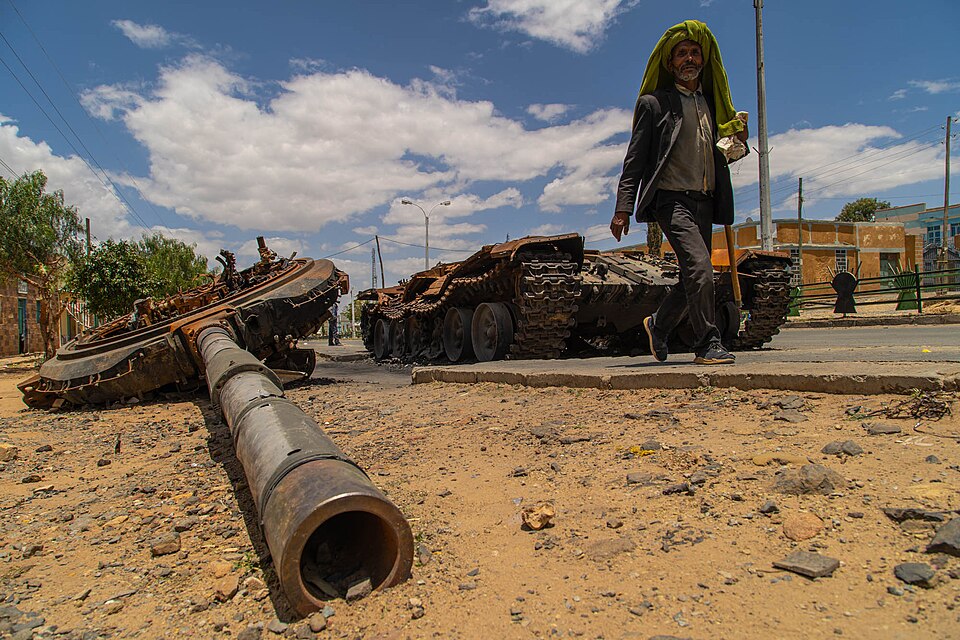
“The last red line had been crossed,” according to Abiy, when TPLF members allegedly attacked an Ethiopian National Defence Force base in Tigray at night. In response, government troops launched an offensive in Tigray on 4 November 2020, beginning the Tigray War.
This was not a swift operation. Tigray’s capital, Mekelle, was captured within a month, but resistance remained, and Mekelle was recaptured by the TPLF in June 2021. In August 2021, Abiy implored “all capable Ethiopians” to join the fight to end the conflict “once and for all.” Indeed, the federal forces represented a broad range of people. Militants from the northern regions of Amhara and Afar sided with the government, whilst Eritrean soldiers fought on Abiy’s side too, despite an initial lengthy denial of this by both Ethiopia and Eritrea.
Fighting was at last brought to an end after multiple failed attempts by the Pretoria Agreement, signed on 2 November 2022. This resulted in the disarmament of TPLF troops, the restoration of federal power in the region, and humanitarian access. But no reference was given to Eritrea in the agreement. Nor was the role of Amhara fighter groups, including the Fano, acknowledged in helping the government. This lack of recognition left the Fano feeling betrayed. The future of disputed Tigray territories, fought for and claimed by Amhara, was left unresolved.
To add insult to injury, Abiy quickly announced plans to dismantle the various regional special forces and bring all soldiers under government oversight. This threatened the very existence of the Fano, and left some Amharas concerned that their territory and people would become vulnerable. The resultant clashes between Fano militia and the federal army resulted in the declaration of a state of emergency in Amhara in August 2023. Nearly 20,000 combatants are now believed to be working against Ethiopia, some with ambitions as extreme as the deposition of Abiy Ahmed.
Fighting also took place in January 2026 between government troops and Tigrayans, culminating in a targeted drone strike in the region against two trucks which killed one civilian and left another wounded. The strikes were reportedly launched by the Ethiopian National Defence Force. The strategic value of the vehicles, if any, is unclear.
The Souring of Ethiopia-Eritrea Relations
In losing the support of the Amhara militias, Abiy has lost one ally from the Tigray War. But a potential international alliance has since been scuppered, too.
Eritrea voted for its independence from Ethiopia in 1993 after a lengthy civil war, depriving Ethiopia of its Red Sea coastline. In May 1998, a dispute over which side of the Ethiopian-Eritrean border the village of Badme lay on reignited hostilities, triggering a brutal two-year war that resulted in tens of thousands of casualties. Whilst fighting ended in 2000, Ethiopia rejected the Eritrea-Ethiopia Boundary Commission’s decision to place Badme in Eritrea, unless it could hold further negotiations with Eritrea. Eritrea refused, creating a stalemate which was only resolved in 2018 when Abiy met Afwerki and accepted the commission’s judgment.
After aiding Ethiopia in its fight against the TPLF, though, the relationship cooled. In October 2023, Abiy expressed Ethiopia’s right to sea access. “The Red Sea and the Nile are intimately linked to Ethiopia, serving as the pillars that could either propel the country’s progress or lead to its demise,” Abiy said. In September 2025, Abiy remarked in a televised interview that “the Red Sea was in our hands 30 years ago. That history was yesterday’s mistake. Tomorrow it will be corrected,” calling Ethiopia a “prisoner of the land.” In October 2025, Ethiopian army chief Field Marshal Birhanu Jula more directly threatened Eritrea, asking “how come the interests of two million people override those of 200 million people?”
In the wake of these comments, Eritrea withdrew from the Intergovernmental Authority on Development (Igad), an East African bloc of which Ethiopia is also a part, in December 2025. Eritrea’s foreign ministry said that Igad was “becoming a tool against” countries like Eritrea.
In January 2026, Ethiopia levelled a serious accusation against its neighbour: that the Fano insurgents are being supported by Eritrea. In a post on Facebook, Ethiopian police reported that they had seized “more than 50,000 rounds of ammunition” sent by Afwerki’s government to the Fano, a claim denied in Eritrea. In February, Abiy also lashed out at Eritrea’s army for allegedly participating in mass killings in the town of Aksum whilst aiding Ethiopia during the Tigray War.
According to Ethiopia, Eritrean soldiers also crossed the border onto Ethiopian soil in February. A local military source in Tigray supported this, suggesting that Eritrean troops disguised as Ethiopian soldiers were being caught regularly in the region, including in Mekelle. However, Eritrea’s Ministry of Information called these “patently false and fabricated accusations,” in a press release entitled “False Accusations to Serve Ulterior Agendas.” Sparks could fly at any minute.
Paying the Human Cost
Some in Tigray are already stockpiling in fear of war. Prices have risen, and so has demand for cash, leading to a new 2,000 birr (£10) cap on withdrawals per person.
Others have tried to flee, but this can be difficult. Ethiopian Airlines briefly cancelled its passenger flights between Ethiopia’s capital, Addis Ababa, and the Tigray region from the end of January. Some are seeking visas to get out of the country by legal means. If that fails, they turn to smugglers instead.
Ethiopians flee with the knowledge that, if they stay, there is unfortunately no guarantee that their rights as civilians will be respected. The Fano have been accused of ethnic cleansing in the regions they helped to annex in the Tigray War. They are themselves united by a shared sense of injustice at the atrocities carried out by other groups against the Amhara. This extends even to the Ethiopian National Defence Force, members of which have carried out sexual violence in the Fano conflict, including against minors, according to a report by the UN Office of the High Commissioner for Human Rights. According to BBC data from 43 health facilities in Amhara, there were 2,697 reported rape cases between 18 July and May 2025. 45% of victims were under 18.
The Tigray War is considered by investigators to have been marred by crimes against humanity, too. The International Commission of Human Rights Experts on Ethiopia, established by the UN Human Rights Council in December 2021, found that “there are reasonable grounds to believe that violations such as extrajudicial killings, rape, sexual violence and starvation of the civilian population as a method of warfare have been committed in Ethiopia since 3 November 2020,” and that “in several instances, these violations amounted to war crimes and crimes against humanity.” It suggested that the Eritrean Defence Forces were present in Tigray, and continued to commit atrocities after the Pretoria Agreement was signed, with the Ethiopian National Defence Forces complicit in this. It is believed that both the government-implemented communications blackout in Tigray, and the restrictions on journalism and humanitarian aid there, enabled atrocities to take place. Commission reports also highlighted the role of Amhara forces, including the Fano, in forcibly displacing Tigrayan civilians and looting the area.
No-one knows the full extent of civilian suffering in the Horn of Africa with any accuracy. The Commission’s October 2023 report stated that “The scale of violence in Ethiopia since 3 November 2020 is such that the present report cannot be considered to be fully reflective of the harms experienced by civilians in the regions under investigation.” But all sides appear to be implicated. Their actions are responsible for the internal displacement of around 4.5 million Ethiopians (a 2024 estimate), in a country in which 18.9 million people are in need of humanitarian assistance.
Beyond the Horn
Ethiopia’s politics has consequences for more than just its immediate neighbours. In January 2024, Abiy signed a memorandum of understanding with Somaliland as a possible solution to the Red Sea issue. Somaliland is a de facto independent state on the Red Sea that borders Ethiopia, with its own distinct currency, government, laws and army. However, its declared independence is not recognised by Somalia, which considers Somaliland an integral part of its territory, and it remains de jure under Somali control. The memorandum proposed that Ethiopia would be given access to one of Somaliland’s ports. In a press release by Somaliland’s Ministry of Foreign Affairs, it was also suggested that Somaliland’s offer would be “reciprocated by formal recognition of the Republic of Somaliland” by Ethiopia. This angered the Somali government, and also attracted the attention of Turkish president Recep Tayyip Erdogan, as Turkey has forged a strong relationship with Somalia in recent years. Erdogan subsequently mediated a deal to end the dispute between Ethiopia and Somalia, signed by Abiy and Somalia’s president Hassan Sheikh Mohamud in the Turkish capital in December 2024. Erdogan has since visited Ethiopia in February 2026, during which he criticised Israel’s decision to recognise Somaliland’s independence.
The construction of the Grand Ethiopian Renaissance Dam (GERD) on the Blue Nile has also been controversial. Egypt is concerned that the GERD will decrease water levels downriver (90% of Egyptians rely on the Nile’s water supply), and also decrease output on its own Aswan High Dam, which was built at great expense over the 1960s. Egypt has written to the United Nations Security Council on multiple occasions to accuse Ethiopia of “repeated violations of international law,” in relation to Ethiopia’s decision to initiate the construction of the GERD and fill its reservoir without international consultation. In 2024, Egypt’s minister of Foreign Affairs wrote to the Security Council that Egypt, “after having exhausted all amicable means… stands ready to exercise its right to defend and protect the rights and interests of the Egyptian people, in accordance with the Charter of the United Nations.“ Egypt’s claims were referred to as a “litany of unfounded allegations” by Ethiopia.
Tensions over the GERD may turn violent. There have been long-term suspicions that Egypt might take direct action against the dam’s construction. Sending special forces to destroy the dam was suggested in an accidental live broadcasting of a meeting of Egyptian politicians as long ago as 2013. Egypt has a military base in Somalia and has backing from the Arab League, while Egypt and Ethiopia support opposite sides in the Sudanese Civil War, in what may well be seen as a proxy war between them.
The recent conflict involving Iran could disrupt the Horn yet again. The Gulf States, which have been subject to missile attacks from Iran, are themselves also heavily involved in Sudan, whilst the UAE in particular has poured money into the region. It appears to have a well-developed military base in Somaliland, a possibility which Israel is exploring for itself, too. Iran has also in the past backed the Houthi movement, a political and military group in Yemen. If the Houthis in turn support Iran now, then such bases on the Red Sea could be threatened. Further attempts to build influence in East Africa could therefore ensue from the Iran conflict as Gulf Nations look to protect the Red Sea, though perhaps a more likely immediate consequence is that attention and wallets will be focused eastwards first, to deal with attacks from Iran itself. Could this therefore lead to a short-term calm-down in the Horn as international backing becomes more limited? It is possible, but the fundamental tensions driving hostility between ethnic groups internally will mean that civil wars remain.
The Horn of Africa must be understood as a teetering pile of different, interconnected conflicts. Even as Ethiopia pushes an assertive foreign policy, it struggles to deal with deadly internal divisions that have never quite been put to bed. For this reason, until Ethiopia reaches some sort of unity, perhaps we are further from international conflict than we might think. But if nothing else, we have found that Abiy is unpredictable, and it may not be beyond the realms of possibility that Ethiopia enters into an international war while still fighting a civil one. A host of different backers are bound to take part, too – though how events in Iran will now affect this dynamic remains unclear. No matter the case, humanity must be respected in the Horn going forward.