
Madi Bouchta’s production of Little Shop of Horrors could not have been any more timely.
We are currently in the thick of Welfare Week – and Welfare Week of Hilary term, no less. Amidst the inevitable crash-outs, I never thought that a 1982 horror-comedy musical about a rock-and-roll-singing, cannibalistic plant would be precisely the laugh I was looking for this week. And yet here we are. (Oh, and did I mention that it’s Green Action Week in a few days too…?)
But let’s not get too ahead of ourselves. Little Shop of Horrors tells the story of Seymour Krelborn (played by Will Jacobs), a run-down florist on the aptly-named “Skid Row”. Overworked by his boss Mr Mushnik (Tristan Hood), and ever-pining after his co-worker Audrey (Eliza Hogermeer), Seymour’s fortunes are changed forever when he encounters a strange little plant (christened “Audrey II”) with a peculiar taste for human blood…
With such a bizarre premise at hand, I really appreciated how the production chose to lean into the intentionally ridiculous and OTT comedy of a play like this. Of course, the play certainly had its fair share of sinister moments – the low, green lighting, and appropriately-timed strobe during Audrey II’s murders accentuated his ominous threat when the moment called for it. But ultimately, laughter was the overwhelming experience of Bouchta’s Little Shop.
Particularly in the first act, the laughs were nonstop, as the cast played up Little Shop’s essential campiness. Each character is over-caricatured to strong comedic effect: Jacobs is an awkward and somewhat nerdy young man who speaks in a whiny voice; Hogermeer complements this by playing an incredibly put-upon girlfriend who tolerates her sadomasochistic boyfriend (Cameron Maiklem) to ridiculous lengths. While I’ve personally never been particularly compelled by the Seymour-Audrey romance, I appreciate how this production’s overt silliness defuses any genuine emotional stakes. Perhaps intentionally deadpan, Jacobs’ delivery of “please don’t die, Audrey” became a source of laughter rather than consternation. You simply can’t take this play too seriously – and therein lies the production’s strength.
However, if we are speaking about the comedic force of this production, I would be committing a mortal sin if I did not mention Hood’s phenomenal performance of Mr Mushnik. Throughout all of Act I, I had literal tears in my eyes at his over-the-top, Mr Krabs-esque persona (and his surprisingly flawless New York accent). He is a commandeering and explosive stage presence, complementing the more subdued character of Seymour. In fact, Hood and Jacobs’ duet of ‘Mushnik and Son’ was undeniably the comic highlight of the play. Concluding with a salsa between the newly-adopted father and son, the dance number epitomised the dynamic between the two characters. And, as ever, left me howling with laughter.
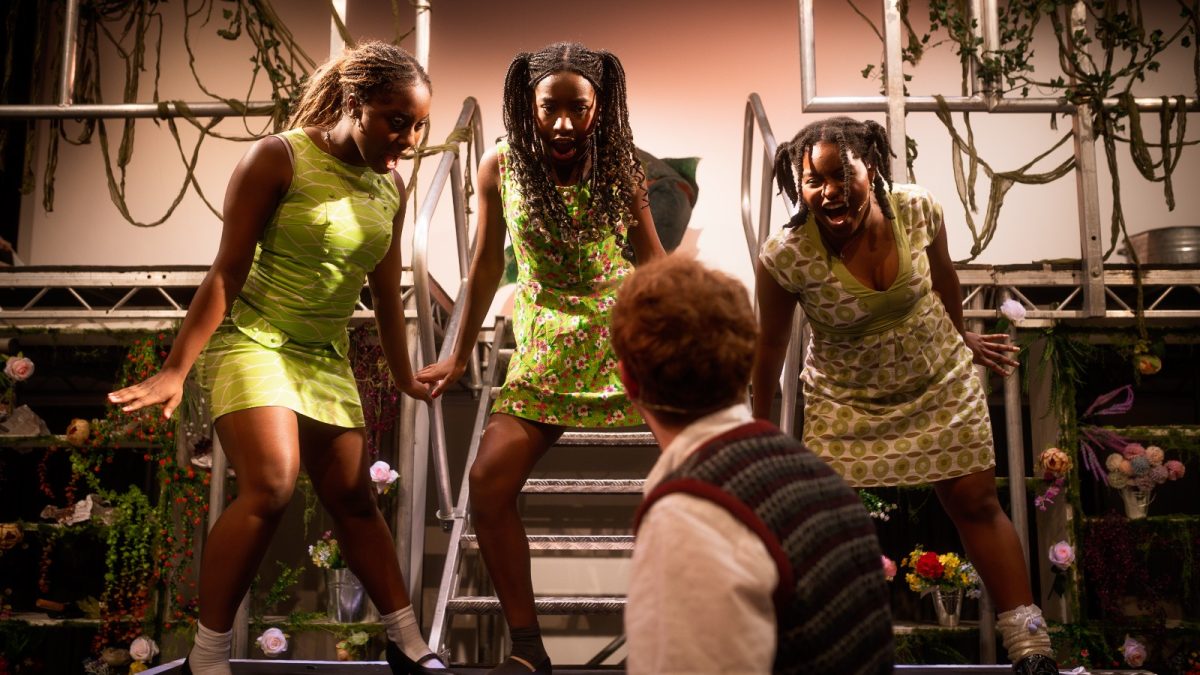
While the play undeniably hit all of the right comic beats, the music was sometimes a slightly different story. That is not to say that there were any poor singers whatsoever in this production – particular praise should be directed to the chorus of street urchins (Subom Adeleye, Lauren Lisk, and Praise Adebusoye), whose backing vocals and dancing always invested scenes with energy and spirit. And I have not begun to scratch the surface of Wally McCabe’s beautiful voice as Audrey II. Their singing voice is powerful and soulful, and never have I heard someone able to simply belt as much as they can. However, there were some audio glitches that I must regretfully admit were a tad distracting – and, moreover, moments when the (immensely talented) orchestra ensemble drowned out the singing voices of the actors on-stage. But when all is said and done, an opening night performance can be given the benefit of the doubt. And besides, there have been worse sinners in previous terms…
Bringing such a cult classic as this onto the student stage is no “little” feat. But this particular production – the result of a fruitful collaboration between both Cross Keys and 2046 Productions – proves itself more than up to the task. By scaling the production to the space of the O’Reilly, complete with a two-tiered stage which allowed for multiple layers of dramatic action – credit to the set designer Amelia Morton – the play felt like it maintained the scale of a Broadway musical while obviously working with a much lower budget.
But of course, the highlight of the stagecraft is, inevitably, the production’s rendering of Audrey II. The production creatively represents the venus man-trap at different stages of his growth: a small, animatronic toy for his youth, followed by a hand-puppet, and concluding with an appropriately much larger puppet that sits in the centre of the stage once he has grown to adult-size. It is impressive how, amidst the expansive set and grand scale orchestra, our attention is drawn so closely to this single puppet. I can only feel for puppeteer Charlotte Ward, who seemed to sit in what was quite an uncomfortable position for the duration of the play – she skilfully co-ordinated the puppet’s mouth-movements with McCabe’s vocals in a way that brought Audrey II to terrifying life.
Occasionally, you see a student play where you can just tell that a cast and crew has enjoyed every element of the process of putting on a production. Bouchta’s Little Shop is, in my opinion, one such play. There is heart and charm at every moment, in every actor’s performance, and in their dynamics with one another. Whether you too are looking for an effective Welfare Week (or Green Week) activity, or simply want to see a production that does Little Shop the justice it deserves, I can only wholeheartedly recommend this play.
Little Shop of Horrors may be about a plant. But above all, its performance grew on me. Pun very much intended.
[Little Shop of Horrors, staged by Cross Keys and 2046 Productions, is running at the Keble O’Reilly, 18th-21st February, 2026.]