
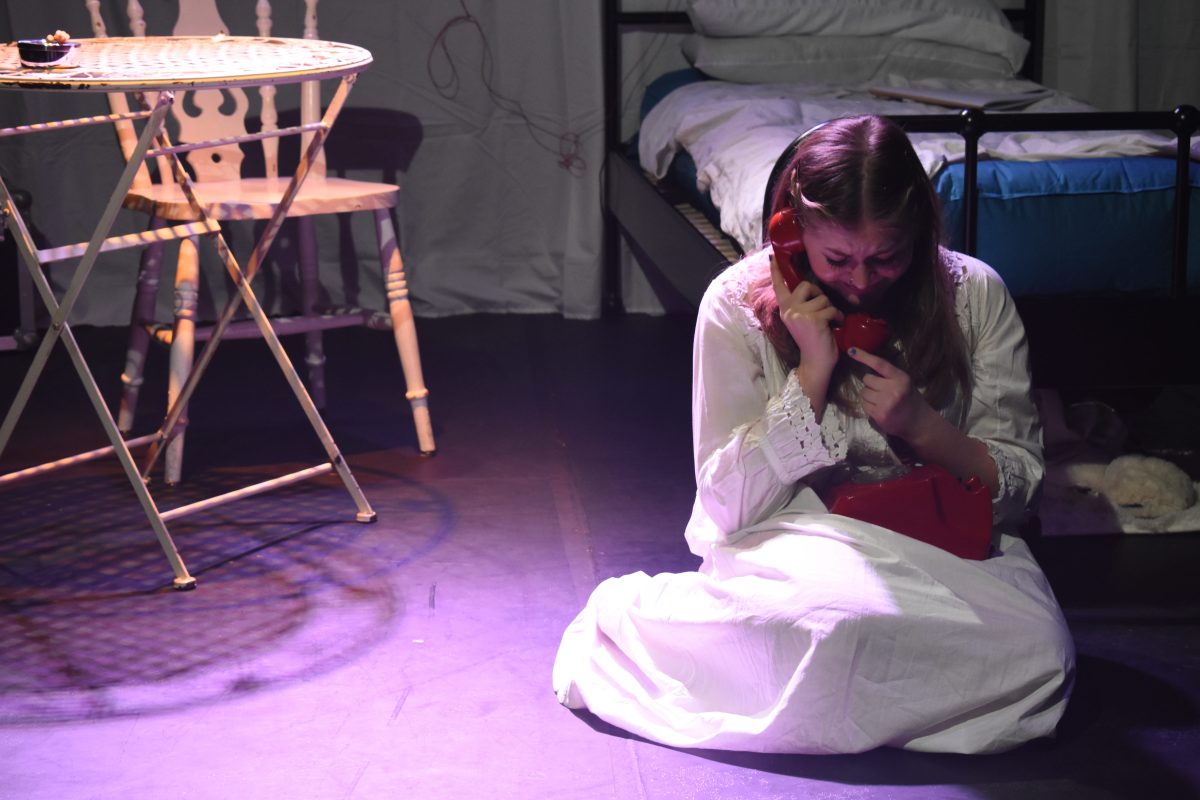
“The actress should give the impression that she is bleeding, losing her life’s blood, like a wounded beast.” The message, inscribed in both English and French across Full Moon Theatre’s leaflets for La Voix Humaine, is one that you cannot help but recall as you enter the BT studio to a set of red and white. Red thread on white curtain, red phone on white table, red scarf draped across white bed, red coat on white chair, red pills on white blanket. With this red comes all the connotations of passion, self-harm, and danger that flood Cocteau’s text, amplified by director Eva Bailey, bombarding you as you sit in anxious anticipation, waiting for the ring of the eerily spotlit phone.
From the moment the play begins, you are quickly wrapped up in the chaos and confusion of the woman (Grace Gordon) as she attempts to stay in contact with her ex-lover (Celine Denis). The chaos of crossed phone-lines throws you immediately into a narrative that seems to lack clarity at first, baffling the audience with the emotional whiplash typical of any breakup as it dips between casual conversation, screams, and silence. The woman runs on stage, shouting her ‘hellos’ in a frantic spectacle of light and movement, never seeing her lover as they dart past each other, with the woman in white and the lover in black.
Bailey’s decision to cast the lover, a character who is absent from the stage in Cocteau’s original, takes the parallels of love and life, light and darkness, even further in this production. She appears as a shadowy figure who intermittently enters the bedroom scene, dances with the woman, and watches from the sidelines. Occasionally she stands amongst the audience. Later, she disappears altogether. In this way, the desperation to speak to a lost love via the telephone becomes an even more isolating experience, as the visual conflicts between light/dark and desire/ability amplify their inability to touch or see each other, therefore emphasising the breakdown in communication that accompanies the end of most relationships.
As another addition, to honour Cocteau’s French language text, the figure of the lover only ever responds in French, if she is to respond at all. English monolinguists amongst the audience will wonder if the mourning of love is reciprocated, and question whether the woman’s ‘my darlings’ and ‘my sweethearts’ are responded to with cruelty or kindness by her ex-lover.
Though one may be led to believe that having two bodies on stage would reduce the sense of isolation that Cocteau’s one-woman act creates, it is instead successfully exaggerated. Scenes of brief recognition and horror as the bodies face one another are accompanied by sharp piano and flashing red lights (respectively arranged by Ice Dob and Juliet Taub), and a hauntingly choreographed routine between the lovers, sees the shadow ever-fleeting, spinning away like a memory that cannot be grasped whenever the woman attempts to turn and embrace her.
Gordon heartbreakingly performs the role of mourner by gently asking that the love letters be burned: ‘I’d be glad to have those ashes.’ In another moment that escapes translation, the woman and lover read their love letters simultaneously, both in French, keeping their romance a secret between the two of them. The woman and lover stand on opposite sides of the stage, not facing one another, a haunting representation of connection, unison in memory, even though physical distance, and indeed, mental distance, continues to separate them.
Just as Cocteau’s own one-act play was dictated by position, so it is in Bailey’s rendition, where the woman first stands, then sits on a chair, then the bed, and later is seen to lay in bed hopelessly. Here, one must also credit the set design by Alice Joy. A central bed is littered with letters, slippers, gloves, cardboard and coffee cups, becoming an accumulation of memory, rubbish, and mess that serve as a mirror to any post-break-up living space (perhaps also nodding to Tracy Emin’s My Bed). Disoriented by clutter, emotional whiplash and thumping sounds, we are thrown into despairing with, rather than just sympathising with, Gordon’s portrayal of heartache.
As aggressive prayers descend finally into quiet desperation, such a juxtaposition highlights Gordon’s ability to convincingly convey such a complex emotion as heartbreak in this masochistic spectacle. Gordon’s captivating performance allows the audience to suspend reality, as she breathlessly repeats ‘I love you’ by a flickering lamplight, one that eventually dies out to leave us in darkness with only the sound of uneasy panting and a shared sense of hopelessness.
Though it is unclear whether the woman’s lamentations are mere masochism, heartache, mania, or even schizophrenic, what is undoubtable is that Full Moon Theatre’s take on the French classic is harrowing, heartbreaking, and impeccably performed.
[La Voix Humaine, staged by Full Moon Theatre, is running at the Burton Taylor Studio, 10th-14th February 2026]